
UNITED STATES SECURITIES AND EXCHANGE COMMISSION
Washington, D.C. 20549
FORM
ANNUAL REPORT PURSUANT TO SECTION 13 OR 15(d) OF THE SECURITIES EXCHANGE ACT OF 1934. For the fiscal year ended |
OR
TRANSITION REPORT PURSUANT TO SECTION 13 OR 15(d) OF THE SECURITIES EXCHANGE ACT OF 1934. For the transition period of ____ to _____. |
Commission File No.:
(Exact name of registrant as specified in its charter)
(State or other jurisdiction of incorporation or organization) | (I.R.S. Employer Identification No.) | |
(Address of principal executive offices) | (Zip Code) |
Registrant’s telephone number, including area code
Securities registered pursuant to Section 12(b) of the Act:
Title of Each Class | Trading Symbol | Name of Each Exchange on Which Registered |
Indicate by check mark if the registrant is a well-known seasoned issuer, as defined in Rule 405 of the Securities Act.
Indicate by check mark if the registrant is not required to file reports pursuant to Section 13 or Section 15(d) of the Act. Yes ☐
Indicate by check mark whether the registrant (1) has filed all reports required to be filed by Section 13 or 15(d) of the Securities Exchange Act of 1934 during the preceding 12 months (or for such shorter period that the registrant was required to file such reports), and (2) has been subject to such filing requirements for the past 90 days.
Indicate by check mark whether the registrant has submitted electronically every Interactive Data File required to be submitted pursuant to Rule 405 of Regulation S-T (§ 232.405 of this chapter) during the preceding 12 months (or for such shorter period that the registrant was required to submit such files)
Indicate by check mark whether the registrant is a large accelerated filer, an accelerated filer, a non-accelerated filer, a smaller reporting company, or an emerging growth company. See the definitions of “large accelerated filer,” “accelerated filer,” “smaller reporting company,” and “emerging growth company” in Rule 12b-2 of the Exchange Act.
Accelerated filer ☐ | Non-accelerated filer ☐ | Smaller Reporting Company | Emerging growth company |
If an emerging growth company, indicate by check mark if the registrant has elected not to use the extended transition period for complying with a new or revised financial accounting standards provided pursuant to Section 13(a) of the Exchange Act. ☐
Indicate by check mark whether the registrant has filed a report on and attestation to its management’s assessment of the effectiveness of its internal control over financial reporting under Section 404(b) of the Sarbanes-Oxley Act (15 U.S.C. 7262(b)) by the registered public accounting firm that prepared or issued its audit report.
If securities are registered pursuant to Section 12(b) of the Act, indicate by check mark whether the financial statements of the registrant included in the filing reflect the correction of an error to previously issued financial statements.
Indicate by check mark whether any of those error corrections are restatements that required a recovery analysis of incentive-based compensation received by any of the registrant’s executive officers during the relevant recovery period pursuant to §240.10D-1(b). ☐
Indicate by check mark whether the registrant is a shell company (as defined in Rule 12b-2 of the Act). Yes
The aggregate market value of the common stock held by non-affiliates of the registrant (i.e. excluding shares held by executive officers, directors, and control persons as defined in Rule 405, 17 CFR 230.405) on June 27, 2025 (which was the last trading day of the registrant’s second quarter in the fiscal year ended December 27, 2025) was $
As of January 31, 2026,
Certain portions of the registrant’s Proxy Statement for its 2026 Annual Meeting of Shareholders are incorporated by reference into Part III of this Report.
Exhibit Index located on page E-79.
ANNUAL REPORT ON FORM 10-K
DECEMBER 27, 2025
TABLE OF CONTENTS
1
PART I
Item 1. Business.
General Development of the Business.
UFP Industries, Inc. (“we,” “our,” “the Company,” or “UFP”) is a holding company with subsidiaries throughout the United States, Mexico, Canada, Spain, India and Australia that design, manufacture and supply products made from wood, wood and non-wood composites, and other materials to three segments: retail, packaging, and construction. We are headquartered in Grand Rapids, Michigan.
For information relating to current developments in our business please see "Management’s Discussion and Analysis of Financial Condition and Results of Operations" in Item 7 below.
Financial Information About Segments.
ASC 280, Segment Reporting (“ASC 280”) defines operating segments as components of an enterprise about which separate financial information is available that is evaluated regularly by the chief operating decision maker (“CODM”) in deciding how to allocate resources and in assessing performance.
Our business segments consist of UFP Retail Solutions (“Retail”), UFP Packaging (“Packaging”) and UFP Construction (“Construction”), and align with the end markets we serve. Among other advantages, this structure allows for a more specialized and focused sales approach, more efficient use of resources and capital, and quicker introduction of new products and services. We manage the operations of our individual locations primarily through a market-centered reporting structure under which each location is included in a business unit and business units are included in our Retail, Packaging, and Construction segments. In the case of locations that serve multiple segments, results are allocated and accounted for by segment.
The exception to this market-centered reporting and management structure is our International segment, which comprises our packaging operations in Mexico, Canada, Spain, India and Australia, and sales and buying offices in other parts of the world, and our Ardellis segment, which represents our wholly owned fully licensed captive insurance company based in Bermuda. Our International segment and Ardellis are referred to as “All Other” throughout this report.
“Corporate” includes purchasing, transportation, corporate ventures, and administrative functions that serve our operating segments. Operating results of Corporate primarily consist of over (under) allocated costs and net sales to external customers initiated by UFP Purchasing, which manages supplier relationships and purchases lumber and other materials, UFP Transportation, which owns, leases and operates transportation equipment, and UFP Real Estate, which owns and leases real estate. Inter-company lease and service charges are assessed to our operating segments for the use of these assets and services at fair market value rates.
Narrative Description of Business.
Historically, we owned and operated a number of manufacturing facilities across North America that served our various markets, and we managed those operations primarily on a geographic basis. As part of that structure, the managers of those facilities and geographic business units were responsible for and compensated on the basis of each facility's, unit's, and region's respective financial performance. This structure fostered a strong entrepreneurial and sales culture, as well as significant revenue growth – from 2011 to 2019 our revenues increased from $1.8 billion to $4.4 billion. We believe that the duration and durability of our relationships with many of our customers, which extend over several decades with certain key customers, is a reflection of our strong sales culture and intense focus on providing custom solutions.
2
Our current structure focuses on our end markets which allows us to better serve our customers, recognize and exploit market opportunities, enhance the efficiency of our operations, and improve the deployment of capital. We continue to maintain our existing compensation philosophy and practices of rewarding the financial performance of our plants, business units, and segments, based upon pre-bonus operating profits and return on investment, to preserve our strong entrepreneurial and sales culture.
Our business segments are functionally interdependent and are supported by common corporate services, such as accounting and finance, information technology, human resources, legal and compliance, and others. We regularly invest in automation and create best practices to improve the efficiency of our manufacturing facilities across each of the segments. The results and improvements from these investments are shared among the segments. This exchange of improvements and ideas has also prompted better and faster innovation for new products, processes, and product improvements.
Importantly, our structure allows us to evaluate market conditions and opportunities, while effectively allocating capital and resources to the appropriate segments and business units. We believe that the diversification and manner in which we operate our business provides an inherent hedge against the inevitable business cycles that our markets experience and over which we have little control. Accordingly, our goal is to provide stable earnings and cash flows to our shareholders. Our diversification and operating practices also mitigate the impact of volatile lumber market conditions experienced by traditional lumber companies.
Retail Solutions segment. Our Retail Solutions segment is comprised of the following business units: ProWood, Deckorators and UFP Edge. The segment is focused on distinct product offerings which are grouped by brands and business units. These groupings may change periodically as opportunities to gain efficiencies occur or new products that deliver increased scale and synergy are developed. The segment primarily sells to three main verticals including big box retailers, independent distributors, and distribution centers including two-step distributors.
ProWood. Our ProWood business unit manufactures and sells pressure-treated lumber products, including decking, fencing, and lattice, as well as decorative and functional lawn and garden products to building products retailers across the U.S. This business unit includes our branded ProWood line of pressure-treated and fire-retardant products used primarily for outdoor decking environments, including associated accessories. It also includes our branded Outdoor Essentials line of lawn and garden products, consisting of wood and vinyl fencing and lattice, garden beds and planters, pergolas, picnic tables, and other landscaping products. Numerous pressure-treaters exist on local and regional scales with none approaching the volume sold by UFP. We estimate we produce approximately 28% of all residential treated wood, 17% of all wood fencing, and 7% of all fire-retardant wood products within the U.S.
Deckorators. This business unit includes the manufacture of wood plastic composite and our patented Surestone™ mineral based composite decking and related decking accessories, including aluminum railing systems, balusters, post caps, and similar products, as well as customized, aluminum fencing. Customers include big box home improvement retailers, regional home centers and two-step distributors. We estimate we manufacture approximately 6-8% of all composite decking and railing in the U.S.
UFP Edge. This business unit manufactures and sells exterior siding, pattern, trim and fascia products. These products include traditional wood, engineered wood and modified wood siding with a variety of finish and profile alternatives as well as primed wood trim boards and fascia. The products also include interior pattern and trim products, as well as pre-painted and primed shiplap and project boards.
UFP Retail Solutions has numerous competitive advantages. We are not aware of any competitor that currently manufactures, treats and distributes a full line of both value-added and commodity-based products, on a national basis, as we do within this segment. We believe the breadth of our product offering, scale and geographic dispersion, proximity of our plants to core customers and key vendors, product innovation initiatives, purchasing and manufacturing expertise, procurement advantages, and service capabilities provide us a competitive edge in this segment.
3
We supply customers in this segment from many of our locations. Our facilities supply mixed truckloads of products delivered to customers with rapid turnaround. Freight costs are a factor in the ability to competitively service this market, especially with treated wood products due to their weight. The proximity of our manufacturing facilities to customer locations is factored into annual sales programs. The Retail segment services two of our largest customers, The Home Depot and Lowes, which accounted for approximately 17% and 11%, respectively, of our total net sales in fiscal 2025, 17% and 11%, respectively, in 2024, and 17% and 12%, respectively, in 2023.
See Note M "Segment Reporting" to our consolidated financial statements for the fiscal year ended December 27, 2025 in Item 8 for our disaggregated net sales by business unit for our Retail Solutions segment.
Packaging segment. Our Packaging segment is comprised of the following business units: Structural Packaging, PalletOne, and Protective Packaging Solutions. We serve a wide variety of regional, national, and global customers across several verticals including building materials, durable goods, agricultural, moving and storage, heavy equipment and automotive.
Structural Packaging. This business unit designs, engineers, manufactures and tests custom packaging products primarily made of wood and metal. These products are custom designed, often including mixed materials, and manufactured based upon specific customer needs and requirements. We utilize combinations of various materials through industrial engineering and testing to promote the best value and functionality for our customers. In Structural Packaging there are regional companies that produce similar product lines and small single-location competitors in most of our markets. We estimate our domestic market share in Structural Packaging to be 10-12%.
PalletOne. This business unit designs and manufactures pallets primarily made of wood and heat-treated wood. Our pallets are designed and manufactured in numerous sizes and configurations and are used by our customers for shipping a wide assortment of consumer and industrial products. This business unit also includes a recycling operation of previously used pallets. Keys to our success in this business unit are low-cost production through expanded automation, including robotics and high efficiency pallet machines, and the procurement of competitively priced industrial grade wood fiber. We own 50% of Dempsey Wood Products, LLC (“Dempsey”), which produces pallet lumber and other industrial wood products in Orangeburg, South Carolina. The lumber Dempsey produces is a crucial product for pallet operations and has been in short supply as larger mills produce less of this type of lumber. PalletOne’s investment in Dempsey helps it secure and grow a critical long-term supply source. There are numerous local and regional pallet manufacturers that compete with PalletOne. We estimate that, as the largest supplier, we manufacture approximately 8-10% of new machine-built pallets nationally.
Protective Packaging Solutions. This business unit consists of a wide variety of products, such as corrugate, foam, labels, strapping and films. These products are primarily sold as additional offerings to our structural packaging products and pallets and are generally sold as a means of providing a more complete solution to our customers' packaging needs and requirements. Over the last several years, we have added additional products and services to this business unit to meet the increasing demand of our customers to provide a wider array of innovative solutions to their packaging and shipping needs. Through the acquisitions of Advantage Label in Grand Rapids, Michigan, and Titan Manufacturing, a highly-automated corrugate converter in Flower Mound, Texas, we have become a manufacturer of labels and corrugate boxes, two significant growth categories for UFP Packaging.
Competitive advantages for UFP Packaging include: being a low cost pallet producer due to our supply agreements, investments in vertical integration, and level of automation in our manufacturing plants; our scale and ability to serve large global, national and regional customers; design and engineering expertise, coupled with our ability to manufacture structural packaging with mixed materials, allowing us to provide creative, value-added solutions to our customers; and serving as a single-source supplier offering a wide breadth of products, allowing customers to buy more efficiently.
We plan to acquire companies across the industrial packaging spectrum with capabilities in product categories that allow us to fill geographical gaps that enhance our ability to offer valuable packaging solutions to our customers.
See Note M "Segment Reporting" to our consolidated financial statements for the fiscal year ended December 27, 2025 in Item 8 for our disaggregated net sales by business unit for our Packaging segment.
4
Construction segment. Our Construction segment is comprised of the following business units: Factory-Built Housing, Site-Built Construction, Commercial Construction, and Concrete Forming.
Factory-Built Housing. This business unit designs and manufactures roof trusses, cut-to-size dimensional and board lumber, plywood, and oriented strand board, all intended for use in the construction of manufactured housing. Our three main verticals in this business unit include producers of mobile, modular and prefabricated homes and, to a lesser extent, recreational vehicles (RV) and cargo trailers. Our principal competitive advantages include our product knowledge, the strength of our engineering support services, the proximity of our regional facilities to our customers, our purchasing and manufacturing expertise and our ability to provide national sales programs to certain customers. As a result of these advantages, we estimate we produce approximately 35% of all roof trusses used in factory-built housing in the United States. We also distribute products such as siding, electrical, plumbing, and many other specialty products to factory-built housing and RV customers. Customer vertical integration strategies have affected us in certain regions, and we’ve taken steps to mitigate this risk by increasing our value as a supplier through innovation and low cost production.
Site-Built Construction. This business unit designs and manufactures roof and floor trusses, wall panels, I-joists and lumber packages as well as engineered wood components used to frame residential and light commercial projects. Historical acquisitions, including Atlantic Prefab, Inc., Exterior Designs, LLC, Patriot Building Systems, LLC, and Endurable Building Products have given the Company manufacturing capability in alternate material components such as metal trusses, sheathed and pre-finished light gauge metal wall panels and aluminum balconies, decks and rail accessories. We also provide framing services for builders in certain regional markets in which we erect the wood structure. We’ve made a variety of investments in automation, allowing us to enhance efficiency and capacity in numerous UFP Construction operations. Our proprietary smartphone application, TrussTrax, provides a convenient, simple way for builders to track orders, shipments and engineered documents 24 hours a day, and has enjoyed wide customer adoption. Our customers in this market are primarily large-volume, multi-tract builders and smaller volume custom builders. We also supply builders engaged in multi-family and light commercial construction. We currently estimate that approximately 70% of the unit's business is for single-family homes while 30% is for multi-family structures.
Competition in site-built construction consists of numerous national and regional building products dealers who also manufacture components and/or provide framing services, as well as regional manufacturers of engineered wood components. We believe our primary competitive advantages relate to the engineering and design capabilities of our staff, purchasing and manufacturing expertise, product quality, timeliness of delivery, and financial strength, as well as providing a comprehensive turn-key package, including installation in selected markets. As a result of these strengths, we estimate we produce approximately 12% of all engineered wood components used in housing in the United States. Generally, terms of sale and pricing are determined based on contracts we enter into with our customers. We currently supply customers in these markets from manufacturing facilities in many different states, primarily located in the non-urban Northeast, mid-Atlantic, Southeast, Texas, and Colorado. We have intentionally avoided markets that have experienced more severe demand volatility for housing. Also, the states in which we have a presence are forecasted to continue to benefit from migration trends in the United States. Freight costs are a factor in the ability to competitively service this market due to the space requirements of these products on each truckload.
Commercial Construction. Our commercial construction business unit primarily includes the operations of idX Holdings, Inc. idX is a designer, manufacturer and installer of highly customized interior fixtures, casework and architectural millwork used in a variety of retail and commercial structures. This business unit serves customers throughout North America and to a lesser extent, Asia and Europe, in healthcare, hospitality, quick service restaurants, retail, and financial, offering comprehensive, streamlined solutions and customized products while managing programs from concept through completion, on a global scale. We believe we are one of the top five custom interior environment providers globally and the largest diversified custom solutions provider.
Concrete Forming. This business unit designs, manufactures and supplies wood forms and related products that are used by our customers to set or form concrete for various structures. This business unit serves four verticals including residential building, non-residential building, distribution, and infrastructure. Our customers in this business unit include general contractors as well as distributors. We believe we are unique in our ability to deliver highly engineered, factory-built solutions to job sites.
5
We believe the diversification of the end markets we serve in our Construction segment as well as the breadth of our products and services represent competitive advantages.
See Note M "Segment Reporting" to our consolidated financial statements for the fiscal year ended December 27, 2025 in Item 8 for our disaggregated net sales by business unit for our Construction segment.
UFP Purchasing/Suppliers. Our purchasing team manages and purchases wood fiber for each of our segments. The three main end markets for softwood lumber in North America – retail, construction, and packaging – align with our three business segments We are the largest converter of solid sawn softwood lumber from North American primary producers (lumber mills). For 2025, we estimate we purchased approximately 6.4% of the 56 billion board feet of North America softwood lumber production. The volume and variety of lumber dimensions purchased allows us to consume all grades and dimensions of what many of our mill suppliers produce, effecting and maintaining long-term, beneficial relationships with many of those suppliers. In turn, this has allowed us to better manage our raw materials inventory (including vendor-managed inventory), lower our costs, and mitigate the volatility of lumber prices.
We use primarily southern yellow pine in our pressure-treating operations and our site-built housing, structural packaging, and machine-built pallet operations in the Southeastern United States. Southern yellow pine is sourced from mills ranging from Texas to the Carolinas. We also use spruce-pine-fir from both Eastern and Western Canada; hemlock, douglas fir and cedar from the Pacific Northwest; inland species of pine, plantation grown radiata and southern yellow pines from South America; and various European softwoods. During 2025 our annual purchases of lumber, excluding panels, totaled approximately $1.7 billion and consisted of the following species and their respective percent of total lumber purchases: southern yellow pine (75%), spruce-pine-fir (12%), and douglas fir (4%), while the remaining 9% of lumber purchases comprise various other species and imports outside of North America. Additionally, we purchased approximately $545 million in plywood and $464 million in other panel products in 2025. There are numerous primary producers for all varieties we use, and we are not dependent on any particular source of supply.
Intellectual Property. We own numerous patents and have several patents pending on technologies related to our business. Examples include our Deckorators brand of composite decking and railing and its proprietary, patented Surestone™ technology used to produce mineral-based composite decking; TrussTrax, a mobile application offered to our Site-Built customers; and the ProWood brand of pressure-treated lumber and outdoor living products. In addition, we own numerous registered trademarks and claim common law trademark rights to several others. As we develop proprietary brands, we may pursue registration or other formal protection. While we believe our patent and trademark rights are valuable, the loss of a patent or any trademark would not be likely to have a material adverse impact on our competitive position.
Backlog. Due to the nature of our retail and industrial businesses, backlog information is not meaningful. The maximum time between receipt of a firm order and shipment does not usually exceed a few days. Therefore, we would not normally have a backlog of unfilled orders in a material amount. The relationships with our major customers are such that we are either the exclusive supplier of certain products and/or certain geographic areas, or the designated source for a specified portion of a customer's requirements. In such cases, either we are able to forecast the customer's requirements, or the customer may provide an estimate of its future needs. In neither case, however, will we receive firm orders until just prior to the anticipated delivery dates for the products ordered.
On December 27, 2025 and December 28, 2024, we estimate that backlog orders associated with our customized interior fixture businesses approximated $56.6 million and $41.9 million, respectively. On December 27, 2025 and December 28, 2024, we estimate that backlog orders associated with our site-built construction businesses approximated $45.9 million and $74.4 million, respectively. The decline is due to a decrease in demand and slowdown associated with tariff policy. We expect that the orders above will be primarily filled within the next fiscal year; however, it is possible that some orders could be canceled.
Environmental. We are self-insured for environmental impairment liability, including certain liabilities which are insured through a wholly owned subsidiary, Ardellis Insurance Ltd., a licensed captive insurance company.
6
Seasonality. Seasonality has a significant impact on our working capital due to our primary selling season occurring during the period from March to September. Consequently, our working capital increases during our first and second quarters resulting in negative or modest cash flows from operations during those periods. Conversely, we experience a substantial decrease in working capital once we move beyond our peak selling season which typically results in significant cash flows from operations in our third and fourth quarters. Please also see the risk factor in Item 1A. Risk Factors under the caption “Seasonality and weather conditions, including those arising from climate change, could adversely affect us.”
Human Capital Management. On December 27, 2025, we had approximately 13,800 employees. For over 70 years, the success of our company has rested on the skill, motivation and performance of our employees. We treat our people honestly and fairly, creating career paths and training opportunities to develop and expand their scope of responsibilities and financial rewards. This approach to human capital, which is embedded in the Company's culture, has fostered an environment where our employees often commit their respective careers to UFP Industries, Inc.
Environmental, Social, and Governance. Matters of sustainability, health and safety, employee welfare, supply chain management, and community engagement are managed by our executive team, with oversight from our Nominating and Corporate Governance and Personnel and Compensation Committees. In July 2025, we published on our website our fiscal year 2024 “Governance Report,” detailing our responsible practices as well as our future outlook. We anticipate publishing on our website our fiscal year 2025 Governance Report during 2026.
Our manufacturing operations have a long history of environmental stewardship through efficiency and energy savings, waste management, and responsible product sourcing. We quantified our 2024 Scope 1 and Scope 2 greenhouse gas (GHG) emissions in our fiscal year 2024 Governance Report and plan to disclose our 2025 Scope 1 and Scope 2 GHG emissions in 2026.
We are driven by operational excellence throughout the enterprise and by cultivating a unique culture that provides significant opportunity for professional and personal growth. In managing our human capital, we have focused our efforts on employee health and safety, equal opportunity for all, and learning and development.
At UFP, we welcome all who are willing to work hard. We do not discriminate in hiring, promotion, or opportunity – we believe the best performers should be rewarded commensurately. We prefer hiring people with potential and helping them grow and achieve their goals within our company. To provide opportunity to a broader base of our teammates, we removed the requirement of a 4-year degree for sales and management positions and give credit for work experience. We use our internal training programs and UFP Business School to help employees gain functional knowledge and hone the skills and competencies that allow them advancement to greater roles and responsibilities.
We have a long history of supporting talented and hard-working employees go from factory floor to management, sales and operations roles. These transformations require diligence and dedication, and they demonstrate that regardless of background, our teammates at UFP have a chance to make a better life for themselves and their families. We also recognize the need to hire talented individuals from outside the company who bring special expertise and innovative skills to UFP.
Available Information.
Our Internet address is www.ufpi.com. Through our Internet website under "News Filings & Reports – SEC Filings" in the Investor Relations section, we make available free of charge, as soon as reasonably practical after such information has been filed with the SEC, our annual report on Form 10-K, quarterly reports on Form 10-Q, current reports on Form 8-K, and amendments to those reports filed pursuant to Section 13(a) or 15(d) of the Securities Exchange Act. Also available through our Internet website under " Governance – Governance Documents” in the Investor Relations sections is our Code of Ethics for Senior Financial Officers.
7
Item 1A. Risk Factors.
Pressures from various global and national macroeconomic events, including heightened inflation, uncertainty regarding future interest rates, foreign currency exchange rate fluctuations, recent adverse weather conditions, geo-political events, and potential governmental responses to these events have created, and continue to create, significant economic uncertainty and could materially and adversely impact our financial performance. The extent to which these macroeconomic pressures may impact our business, results of operations, costs and financial condition will depend on future developments, which continue to be highly uncertain and difficult to predict. While we have planned for and anticipate a continuation of soft demand within our markets into 2026, any one or more of the above macroeconomic factors could result in a more severe and longer downturn and/or increased costs, which would have an adverse and potentially material impact on our business and financial performance.
We may be impacted by new tariffs and duties on U.S. imports and foreign export sales and changes in import/export regulations. Instability of established free trade agreements, the potential imposition of new or increased tariffs on U.S. imports or exports, and potential changes to import/export regulations may lead to raw material and finished goods price volatility as well as instability and uncertainty in our supply chain. The proposed tariffs in Canada continue to be paused. If they are activated, the demand for domestic lumber products may increase, which will likely result in higher costs if capacity gets challenged. Although the trade landscape continues to evolve, since we do not own any foreign sawmills and have excellent relationships with our mill partners, we believe we are currently in a strong position to adapt quickly to tariffs without material adverse financial impact after a short adjustment period. We will continue to monitor the market and intend to make decisions quickly to minimize disruption. As of December 27, 2025, 84% of our lumber purchases are from domestic suppliers, 11% are imported from Canada, and 5% are imported from other international suppliers
An increase in foreign tariffs on U.S. goods could curtail our export sales to other countries, which were approximately $239.5 million in 2025, compared to $258.9 million in 2024. Increased tariffs and duties on U.S. imports will increase pricing by adding duty cost, where the duty is sustainable in light of overall unit price, or otherwise constrain supply by eliminating historical production sources by country or commodity type with unsustainable duties. Our purchases that were impacted by tariffs were approximately $407.1 million in 2025 (compared to $390.9 million in 2024), including our import of Canadian Softwood Lumber of approximately $174.9 million in 2025 (compared to $211.8 million in 2024) which is the largest imported commodity. In addition, there is a risk that U.S. tariffs on imports and countering tariffs on U.S. exports could trigger broader international trade conflicts that could adversely impact our business.
We may be impacted by a significant change in the value of the U.S. dollar and our results of operations may be harmed by currency fluctuations and inflation. We purchase a variety of raw materials and finished goods from sources around the world and export certain products. The impact of a change in U.S. dollar exchange rates, and inflation, would impact our import purchases and export sales, which totaled $407.1 million and $239.5 million respectively, in 2025, compared to $390.9 million and $258.9 million in 2024, respectively. In addition, many of our packaging customers export their products; consequently, any adverse impact on those customers from currency fluctuations and inflation may have an adverse impact on our sales to those customers.
Our growth may be limited by the customer demand in the markets we serve, including our construction market which is highly cyclical. Our sales growth is dependent, in part, upon the growth of the markets we serve. If our markets do not achieve anticipated growth, or if we fail to maintain our market share, financial results could be impaired.
8
We are subject to fluctuations in the price of lumber. We experience significant fluctuations in the cost of commodity lumber products from primary producers (the "Lumber Market"). A variety of factors over which we have no control, including government and environmental regulations, weather conditions, economic conditions, and natural disasters, impact the cost of lumber products and our selling prices. While we attempt to minimize our risk from severe price fluctuations, substantial, prolonged trends in lumber prices can affect our sales, cost of materials, and gross profits. Our products are generally priced to the customer based on a quoted, fixed selling price or "indexed" to the Lumber Market with a fixed dollar adder to cover conversion costs and profit. The impact on our profitability from changes in lumber prices is discussed in the “Historical Lumber Prices” and "Impact of the Lumber Market on Our Operating Results" captions of our Management’s Discussion and Analysis of Financial Condition and Results of Operations section under Item 7 of this Form 10-K. Our lumber costs, including plywood, as a percentage of net sales were 41.6% in 2025, compared to 40.4% in 2024.
A significant portion of our sales are concentrated with two customers. Our sales to The Home Depot and Lowes comprised 17% and 11%, respectively, of our total net sales in fiscal 2025, 17% and 11%, respectively, in 2024, and 17% and 12%, respectively, in 2023.
We may be impacted by vertical integration strategies. In certain markets and product lines, our customers or vendors could pursue vertical integration strategies that could have an adverse effect on our sales. We strive to add value and be a low-cost producer while maintaining competitive pricing in each of our markets to mitigate this risk.
We may be impacted by industry capacity of products we supply. From time to time, we may experience excess capacity among suppliers of certain products in some of the markets we serve. Our selling prices and profitability are impacted during periods of shortages or excess industry capacity relative to market demand. We may also experience limited capacity among suppliers of certain products as a result of supply chain challenges, which may impact our profitability and ability to meet sales objectives.
Our growth may be limited by our ability to make successful acquisitions. A key component of our growth strategy is to complete business combinations. Business combinations involve inherent risks, including assimilation and successfully managing growth. While we conduct extensive due diligence and have taken steps to ensure successful assimilation, factors beyond our control could influence the relative success of these acquisitions.
We may be adversely affected by the impact of environmental and safety regulations. We are subject to the requirements of federal, state, and local environmental and occupational health and safety laws and regulations. There can be no assurance that we are at all times in complete compliance with all of these requirements. We have made and will continue to make capital and other expenditures to comply with environmental regulations. If additional laws and regulations are enacted, which restrict our ability to manufacture and market our products, including our treated lumber products, it could adversely affect our sales and profits. Changes in the interpretation of existing laws could also adversely impact our financial results.
Seasonality and weather conditions, including those arising from climate change, could adversely affect us. Some aspects of our business are seasonal in nature and results of operations vary from quarter to quarter. In addition, the majority of our products sold to the Retail and Construction markets are used or installed in outdoor construction applications; therefore, short-term sales volume, productivity and gross profits can be negatively affected by adverse weather conditions, particularly in our first and fourth quarters. To the extent changes in the world’s climate have a greater impact on adverse weather conditions, we would expect more variability in our business operations and results. Climate change, which could result in more and more severe and adverse weather events, would likely create greater volatility in our financial results. In addition, it is possible that new legislation or regulation enacted to address the impact of climate change could increase costs for us and our suppliers, including costs associated with raw materials, energy, production, transportation, environmental monitoring and reporting, and capital expenditures.
Inbound and outbound transportation costs represent a significant part of our cost structure. An increase in fuel and other operating expenses will significantly increase our costs. While we attempt to pass these costs along to our customers, there can be no assurance that they would agree to these price increases. Our total inbound and outbound transportation costs were approximately 9.5%, 7.8%, and 9.4% of net sales in 2025, 2024, and 2023, respectively.
9
New alternatives may be developed to replace traditional treated wood products. The manufacturers of wood preservatives continue to develop new preservatives. While we believe treated products are reasonably priced relative to alternative products such as composites or vinyl, new alternatives may impact the sales of treated wood products. In addition, new preservatives could increase our cost of treating products in the future.
Cybersecurity breaches or other failures in our information technology systems could disrupt our business. We rely upon information technology systems and network products and the secure operation of these systems and products. Despite security measures, these systems and products may be vulnerable to physical damage, hackers, computer viruses, or breaches due to errors or malfeasance by employees, vendors, or customers. We have experienced such events in the past and, although past events were immaterial, future events may occur and may be material. Our failure to successfully identify and manage these risks and uncertainties could disrupt our operations and increase our costs, which could negatively impact our results of operations.
Artificial intelligence (“AI”) is an emerging area of technology that has and may further impact various aspects of our business operations, and we may not be successful in our artificial intelligence initiatives, which could adversely affect our business, financial condition and/or operating results. We have made, and expect to continue making, investments in the integration of artificial intelligence into our platforms, products, and services. However, AI presents various risks, challenges, and potential unintended consequences that could disrupt our ability to effectively integrate and leverage these technologies. The integration of AI may also require significant capital investment, specialized talent, and new safety protocols, and we may be unable to recruit or retain personnel with the necessary expertise. Additionally, competitors may develop more effective or efficient AI solutions, potentially undermining our competitive position. The regulatory environment surrounding AI is still in development, and new laws or regulations could emerge that require substantial adjustments to our business practices. These changes could impose unexpected costs or operational disruptions, and the full scope and impact of such regulatory developments remain uncertain. If we suffer adverse consequences due to any of these factors, it could in turn have a material adverse effect on our financial performance and operations.
Our financial results could be negatively impacted by costs associated with product liability, casualty, manufacturing and construction defects, and other claims. From time to time, we are exposed to claims relating to product liability, casualty events, manufacturing and construction defects, and similar claims, including as the result of the conduct of our employees and subcontractors. These claims could have a negative impact on our results of operation and financial condition, including through increased litigation costs, insurance-related costs, and damage to our reputation and customer relationships.
We may be adversely affected by the impact of pandemics and similar outbreaks. Disease outbreaks could have an adverse impact on the Company's operations and financial results. These outbreaks may adversely impact our business, consolidated results of operations and financial condition. Any such outbreak, as well as measures taken by governmental authorities and businesses to limit the spread of any outbreak, may result in adverse changes in customer demand and our sales, interfere with the ability of our employees and suppliers to perform and function in a manner consistent with targeted objectives and otherwise adversely impact the efficiency of our operations. This may cause us to materially curtail certain segments and could have a material adverse effect on the results of our operations and cash flow.
Adverse economic conditions and our customers’ ability to operate may impact their ability to pay. This may result in higher write-offs of receivables than we normally experience. We continue to monitor our customers’ business activities, payment patterns, and credit profiles carefully and make changes in our terms when necessary in response to this risk. As a result, our accounts receivable aging as of December 27, 2025 was approximately 90% current. Our bad debt expense as a percentage of sales was 0.01%, 0.05%, and 0.03%, in 2025, 2024, and 2023, respectively. During the most difficult collection period of the Great Recession, from 2008 through 2010, our bad debt expense as a percentage of sales averaged 0.25%.
Item 1B. Unresolved Staff Comments.
Not applicable.
10
Item 1C. Cybersecurity.
Risk Management and Strategy.
We recognize the importance of managing cybersecurity risks to protect our business operations, assets, data, and stakeholders. This is achieved through implementation of an enterprise-wide security risk management program, risk-based approach to cybersecurity program management, and an internal security control framework. We employ a structured approach to frame, assess, treat and monitor risks to determine if such risks are material.
Material cybersecurity risks are identified, assessed and managed in several ways. Cybersecurity risk management processes are embedded in our enterprise-level activities, business processes as well as day-to-day operations. This includes but is not limited to:
| ● | Program foundations and standards. We established information security, cybersecurity and risk management frameworks that serve as the foundation for our cybersecurity program, which aligns with internationally recognized frameworks, including the NIST CSF and ISO 27001, as well as risk management guidelines such as NIST SP 800-37 (RMF) and ISO 27005. These frameworks have been adapted to include the assessment and management of risks associated with emerging technologies, including artificial intelligence (AI). Additional security and privacy controls are selected, implemented, assessed and monitored for organizational systems and processes that access, process, transfer or store data categorized to fall under regulatory requirements. |
| ● | Integration with enterprise risk management (ERM). Cybersecurity risk management is an integral component of our ERM program, ensuring that cybersecurity risks are aggregated and compared against other enterprise-level risks to inform strategic decision-making. |
| ● | Risk management process. Our strategic and operational risk management approach begins with risk framing activities to align the enterprise-wide cybersecurity strategy with day-to-day operations. Cybersecurity risks are identified, analyzed, evaluated, communicated, and prioritized across the organization through a comprehensive assessment. Risk responses are then managed to reflect our established risk appetite, tolerance, and thresholds. Ongoing monitoring of risk factors, treatment effectiveness, and compliance changes are performed to maintain continuous oversight and monitoring of acceptable risk levels consistent with our governance model. |
| ● | Threat monitoring, detection and response. Our dedicated Cybersecurity Incident Response Team (CSIRT) in conjunction with our Security Operations Center (SOC) monitors threats and vulnerabilities, investigates potential incidents, and coordinates response and remediation. Our Incident Response Plan is maintained and tested to verify completeness and effectiveness of its preparation, detection and analysis, containment, eradication and recovery, as well as post-incident review stages. Incidents are risk-ranked, prioritized and escalated according to defined thresholds to members of the Incident Response Team, including executive leadership, when warranted, consisting of our CIO, our Director of Cybersecurity, and other members of the executive team to facilitate timely assessment of potential materiality and coordination of required disclosures. |
| ● | Security controls and layered defense. As part of our defense in depth strategy, we operate multiple layers of frontline controls spanning network security, endpoint protection, identity and access management (including privileged access management) along with data protection and encryption safeguards. In addition to these technical frontline controls, we maintain a secondary layer of defense consisting of internal control owners and functional managers who perform regular self-assessments and monitoring of control effectiveness. This dual-layered approach is further validated by periodic independent testing and internal audits. These preventive layers are reinforced by comprehensive logging, detection, and response capabilities, ensuring that threats are identified and contained even if one control layer is bypassed. This layered approach strengthens our overall security posture by creating overlapping defenses that collectively reduce risk and improve resilience across the enterprise. |
11
| ● | Testing, exercises, and continuous improvement. We conduct tabletop exercises for our incident response and disaster recovery activities and perform internal and external vulnerability assessments as well as penetration testing. Lessons learned from these activities are analyzed and |
| ● | Training and awareness. Mandatory, periodic security and privacy training is provided to all employees during their onboarding and employment with our organization. This training is supplemented with phishing simulations and awareness activities on an ongoing basis. |
| ● | Use of external parties. We engage external assessors, consultants, independent auditors and, as needed, outside counsel, to evaluate aspects of our cybersecurity program, controls and overall posture. This is achieved through control audits as well as testing, exercises, and continuous improvement activities. |
| ● | Supply chain security. We monitor |
As of the date of this report, we have not experienced any risks from cybersecurity threats, including as a result of any previous cybersecurity incidents, that have
Governance.
Management’s Role. Primary
| ● | CIO. With over 20 years of experience in the information technology space, our CIO brings expertise and strategic insight to cybersecurity, compliance, enterprise architecture, systems resilience, and digital transformation. |
| ● | Director of Cybersecurity. With over 30 years of experience in information technology, including systems architecture and management, our Director of Cybersecurity holds the Certified Information Security Manager (CISM) designation. This expertise supports the Director's responsibility for day-to-day cybersecurity operations, the alignment of security strategies with business objectives, and the management of our information security risk framework. The Director reports directly to the CIO and leads the cross-functional team in identifying and mitigating material risks. |
Our cross-functional cybersecurity team, composed of experts with decades of combined experience, supports the CIO and Director in implementing our cybersecurity program. This team consults with legal, HR, and IT specialists to assess the materiality of cybersecurity risks and incidents, using a well-established Incident Response Plan that includes clear escalation measures.
Board of Directors Oversight. The role of the Board of Directors with respect to our cybersecurity program is one of oversight of management, and the Board has delegated primary oversight authority over the program to the Audit Committee. The
12
The Audit Committee meets quarterly and receives
Item 2. Properties.
Our corporate headquarters building is located in suburban Grand Rapids, Michigan. We currently have approximately 196 facilities located throughout the United States, Mexico, Canada, Spain, India and Australia. Depending upon function and location, these facilities typically utilize office, manufacturing, and indoor and outdoor storage space.
The following tables summarize our property locations assigned by the primary segment the plant serves.
RETAIL SEGMENT | ||||||
Property Location | Number of Properties | Property Location | Number of Properties | |||
Athens, AL | 1 | Moneta, VA | 1 | |||
Avondale, AZ | 1 | Mosheim, TN | 1 | |||
Bartow, FL | 2 | Moultrie, GA | 1 | |||
Belchertown, MA | 1 | Overland Park, KS | 1 | |||
Bennett, IA | 1 | Ponce, Puerto Rico | 1 | |||
Brunswick, GA | 1 | Prairie du Chien, WI | 1 | |||
Callao, VA | 1 | Rancho Cucamonga, CA* | 1 | |||
Durango, Mexico | 1 | Ranson, WV | 1 | |||
Fairless Hills, PA | 1 | Ringgold, GA | 1 | |||
Fort Worth, TX | 1 | Rockledge, FL | 1 | |||
Grand Rapids, MI | 1 | Rockwell, NC | 1 | |||
Greeneville, TN | 1 | Saginaw, TX* | 1 | |||
Hamilton, OH | 1 | Schertz, TX* | 1 | |||
Hampton, VA | 1 | Selma, AL | 2 | |||
Hazelhurst, GA | 1 | Spartanburg, SC | 1 | |||
Howell, MI | 2 | Stockertown, PA | 1 | |||
Idabel, OK | 1 | Tampa, FL | 2 | |||
Janesville, WI* | 1 | Thomaston, GA | 1 | |||
Kearneysville, WV | 2 | Tipton, IA | 1 | |||
Lackawanna, NY | 1 | Union City, GA* | 1 | |||
Lansing, MI | 1 | White Bear Lake, MN* | 1 | |||
Lockhart, FL | 1 | White Pigeon, MI | 1 | |||
Louisville, AL | 1 | Windsor, CO* | 1 | |||
TOTAL | 51 | |||||
13
PACKAGING SEGMENT | ||||||
Property Location | Number of Properties | Property Location | Number of Properties | |||
Adairsville, GA | 1 | Milwaukee, WI | 1 | |||
Ashburn, GA* | 1 | Minneota, MN* | 1 | |||
Auburndale, FL* | 1 | Mocksville, NC | 1 | |||
Bartow, FL | 2 | Morristown, TN | 1 | |||
Blue Island, IL* | 1 | Muscle Shoals, AL | 2 | |||
Butner, NC | 1 | Nappanee, IN | 1 | |||
Chandler, AZ* | 1 | New London, WI | 2 | |||
Clarksville, TX | 1 | Newnan, GA | 2 | |||
Clearfield, UT* | 1 | Orangeburg, SC | 1 | |||
Dallas, TX | 1 | Peru, IL | 1 | |||
Delano, PA | 1 | Port Arthur, TX | 1 | |||
Eatonton, GA | 1 | Prattville, AL | 1 | |||
Flower Mound, TX | 2 | Riverside, CA* | 1 | |||
Gilmer, TX | 1 | Robertsdale, AL | 1 | |||
Grand Rapids, MI | 1 | Rowesville, SC | 1 | |||
Grandview, TX | 4 | Salina, KS* | 1 | |||
Harrisonville, MO* | 1 | Salisbury, NC* | 1 | |||
Hartford, WI | 1 | Shawnee, OK | 1 | |||
Hazelhurst, GA | 1 | Shipshewana, IN | 1 | |||
Inwood, WV | 1 | Siler City, NC | 1 | |||
Kansas City, MO | 1 | Snohomish, WA* | 1 | |||
Las Vegas, NV | 1 | Stayton, OR* | 1 | |||
Lawrenceburg, TN | 1 | Thornton, CA* | 1 | |||
Livermore Falls, ME | 1 | Warrens, WI* | 1 | |||
Magna, UT* | 1 | Woodburn, OR* | 1 | |||
Martin, TN | 1 | Yakima, WA | 1 | |||
McMinnville, OR* | 1 | TOTAL | 61 | |||
CONSTRUCTION SEGMENT | ||||||
Property Location | Number of Properties | Property Location | Number of Properties | |||
Athena, OR | 1 | Kyle, TX | 1 | |||
Auburn, NY | 1 | Lafayette, CO | 1 | |||
Belchertown, MA | 1 | Lenoir City, TN | 1 | |||
Berlin, NJ | 2 | Liberty, NC | 1 | |||
Berthoud, CO | 1 | Locust, NC | 1 | |||
Blanchester, OH | 1 | Londonderry, NH | 1 | |||
Brooklyn Center, MN | 1 | Nampa, ID* | 1 | |||
Burlington, NC | 2 | Naugatuck, CT | 1 | |||
Cedar Hill, TX | 1 | New London, NC* | 1 | |||
Charlotte, NC | 1 | New Waverly, TX* | 1 | |||
Chesapeake, VA | 1 | New Windsor, MD | 1 | |||
Chicopee, MA | 1 | Ontario, CA | 1 | |||
Clinton, NC | 1 | Ooltewah, TN | 1 | |||
Conway, SC | 1 | Pearisburg, VA* | 1 | |||
Cordele, GA | 1 | Plainville, MA | 1 | |||
Dayton, OH | 1 | San Antonio, TX | 1 | |||
DuBois, PA | 1 | Shippenville, PA | 1 | |||
Edwardsburg, MI* | 1 | Sidney, NY | 1 | |||
Elkhart, IN | 2 | Stafford, TX | 1 | |||
Folkston, GA | 2 | Stanfield, NC | 2 | |||
Fredericksburg, VA | 1 | Temple, TX | 1 | |||
Gordon, PA | 1 | Tooele, UT | 1 | |||
Granger, IN* | 1 | Twin Falls, ID | 1 | |||
Haleyville, AL* | 1 | Washington, NC | 1 | |||
Hillsboro, TX* | 1 | Westbury, NY | 1 | |||
Jefferson, GA | 1 | Wilton, NH | 1 | |||
Jeffersonville, IN | 1 | Wujinang, China | 1 | |||
TOTAL | 59 | |||||
14
ALL OTHER SEGMENT | ||||||
Property Location | Number of Properties | Property Location | Number of Properties | |||
Apaseo el Grande, Mexico | 1 | Gladstone, Australia | 1 | |||
Bangalore, India | 2 | Guntur, India | 1 | |||
Carole Park, Australia | 1 | Hyderabad, India | 1 | |||
Castellón, Spain | 2 | Lacolle, Canada | 1 | |||
Chennai, India | 1 | Mordialloc, Australia | 1 | |||
Coimbatore, India | 1 | Noida, India | 1 | |||
Deer Park, Australia | 1 | Nuevo Leon, Mexico | 2 | |||
Durango, Mexico | 1 | Port Melbourne, Australia | 1 | |||
Erskine Park, Australia | 1 | Vadodara, India | 1 | |||
TOTAL | 21 | |||||
CORPORATE SEGMENT | ||||||
Property Location | Number of Properties | |||||
Grand Rapids, MI | 2 | |||||
Matthews, NC | 1 | |||||
Bryant, AR | 1 | |||||
TOTAL | 4 | |||||
* Due to the nature of our business and historical operating strategy, many of our locations service more than one segment.
We own all of our properties, free from any significant mortgage or other encumbrance, except for approximately 73 facilities which are leased. We believe all of these operating facilities are adequate in capacity and condition to service our existing markets.
Item 3. Legal Proceedings.
Information regarding our legal proceedings is set forth in Note L of our Consolidated Financial Statements which are presented under Item 8 of this Form 10-K.
Item 4. Mine Safety Disclosures.
Not applicable.
Additional Item: Executive Officers of the Registrant.
Our executive officers are appointed annually by our Board of Directors. There are no family relationships among these officers and our directors nor any arrangement or understanding between any of these officers and any other person pursuant to which the officer was appointed.
The following table lists the names, ages, and positions of our executive officers as of February 2026.
Name | | Age | | Position |
William D. Schwartz, Jr. | 48 | President and Chief Executive Officer | ||
Matthew J. Missad | 65 | Executive Chairman of the Board | ||
Michael R. Cole | 59 | Chief Financial Officer, Treasurer and President of Corporate Services | ||
Patrick M. Benton | 56 | President of UFP Construction, LLC | ||
Scott A. Worthington | 55 | President of UFP Packaging, LLC | ||
Landon Tarvin | 45 | President of UFP Retail Solutions, LLC | ||
R. Paul Guerre | 61 | Corporate Secretary and Director of Corporate Compliance |
William D. Schwartz, Jr. joined us in 1998. He became Operations Vice President in 2014 and Executive Vice President of Purchasing and Transportation in 2020. On July 1, 2022, he became Executive Vice President of Operations Services and on September 26, 2022, he was promoted to President of UFP Retail Solutions, LLC. On December 29, 2024, Mr. Schwartz became President and Chief Executive Officer of the Company.
15
Matthew J. Missad joined us in 1985. In February 1996, Mr. Missad was promoted to Executive Vice President of the Company and on July 13, 2011, he was promoted to Chief Executive Officer of the Company. On January 1, 2023, Mr. Missad added the title of President of the Company. On December 29, 2024, Mr. Missad became Executive Chairman of the Board.
Michael R. Cole joined us in 1993 from the international public accounting firm Deloitte & Touche. In December 1999, he was promoted to Vice President of Finance. On July 19, 2000, Mr. Cole became Chief Financial Officer of the Company. On December 29, 2024, Mr. Cole added the title of President of Corporate Services to his current role.
Patrick M. Benton joined us in 1993. In 2008 he became Operations Vice President of the South Texas Region, and on July 1, 2014, he became Executive Vice President of UFP Eastern Division – North. On February 1, 2017, Mr. Benton became President of the UFP Northern Division, and on January 1, 2020, he became President of UFP Construction, LLC.
Scott A. Worthington joined us in 1997. In 2014, he was promoted to Regional Vice President of the South Texas Region. On January 1, 2020, he became President of UFP Packaging, LLC.
Landon C. Tarvin joined us in 2002. In 2019, he was promoted to Vice President of Outdoor Essentials and in 2021, he was promoted to Vice President of Deckorators. On December 29, 2024, he became President of UFP Retail Solutions, LLC.
R. Paul Guerre joined us in 2020 as Senior Corporate Counsel. On May 15, 2023, he was promoted to Deputy General Counsel – Compliance & Administration. On July 1, 2024, he was promoted to Corporate Secretary and Director of Corporate Compliance.
16
PART II
Item 5. Market for Registrant’s Common Equity, Related Shareholder Matters and Issuer Purchases of Equity Securities.
| (a) | Our common stock trades on The Nasdaq Stock Market (“NASDAQ”) under the symbol UFPI. |
As of January 27, 2026, there were approximately 2,531 record holders of our common stock.
Our dividend rates are typically reviewed and approved at each of our February, April, July, and October board meetings and payments are typically made in March, June, September, and December of each year. On February 12, 2026, our board approved a quarterly cash dividend of $0.36 per share, which represents a 3% increase from the quarterly dividend of $0.35 per share paid in 2025. This dividend will be payable on March 16, 2026, to shareholders of record on March 2, 2026. Our board considers our dividend yield, payout ratios relative to earnings and operating cash flow, and potential variability of future results, among other factors, as part of its decision-making process. Further declarations of dividends and the establishment of future record and payment dates are subject to approval by our board.
See Part III - Item 12 below for information about securities authorized for issuance under our equity compensation plans.
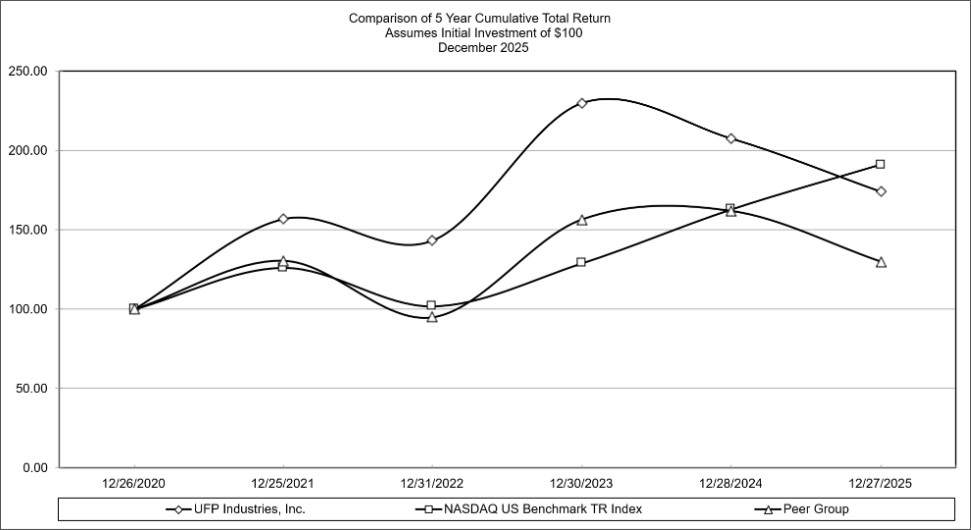
Stock Performance Graph:
The following stock price performance graph compares the annual percentage change in the cumulative total return on our common stock with the cumulative total returns of companies comprising the NASDAQ US Benchmark TR index and an industry peer group we selected. The graph assumes an investment of $100 on December 26, 2020, and reinvestment of dividends in all cases.
17
The companies included in our self-determined industry peer group are as follows:
American Woodmark Corporation | Masco Corporation |
Boise Cascade Company | Patrick Industries, Inc. |
Builders FirstSource, Inc. | Simpson Manufacturing Company, Inc. |
Gibraltar Industries, Inc. | Smurfit Westrock plc |
Greif, Inc. | Sonoco Products Company |
Louisiana-Pacific Corporation | Trex Company, Inc. |
The returns of each company included in the self-determined peer group are weighted according to each respective company’s stock market capitalization at the beginning of each period presented in the graph above. In determining the members of our peer group, we considered companies who selected UFPI as a member of their peer group, and looked for similarly sized companies or companies that are a good fit with the markets we serve.
Unregistered Sales of Equity Securities
Director Compensation Plan
A portion of the annual retainer payable to each of our non-employee directors (such portion for each director was $135,000 for 2025) is paid in shares of our common stock. The retainer is deemed earned in equal quarterly installments on February 1, May 1, August 1, and November 1. We use the market price per share on each such installment date (or the preceding trading day if there were no trades on that installment date) to determine the number of shares issuable to each non-employee director, and except as described below, the shares are issued to the director within five business days.
We maintain a Director Compensation Plan (the “Plan”) pursuant to which non-employee directors can elect to (1) receive shares of our common stock, on a deferred basis, in lieu of all or a portion of the annual retainer payable to the director in cash (which deferred cash is used to purchase our common stock on a deferred basis at the rate of 110% of the deferred cash amount), and/or (2) defer receipt of all or a portion of the annual retainer payable to the director in the form of our common stock. Any shares of common stock issuable to a director on a deferred basis pursuant to the Plan are not actually issued until the deferred payment date specified pursuant to the Plan, which is typically after a director’s retirement from the Board. However, on the date such shares are deemed earned by the director, we issue deferred stock units (“DSUs”) to a bookkeeping account for each director to represent the shares issuable in the future pursuant to the Plan. Directors who have DSUs credited to their account pursuant to the Plan receive additional DSUs credited to their account whenever a dividend is paid on the Company’s common stock.
On November 1, 2025, the Company issued 1,098 shares of its common stock to non-employee directors as part of the annual retainer payable to directors in stock (i.e., shares that were issued on a current basis and not deferred pursuant to the Plan). The Company issued all shares described in this paragraph pursuant to an exemption from registration under Section 4(2) of the Securities Act of 1933 due to the fact that the issuance of the shares was made on a private basis pursuant to the Plan.
18
Deferred Compensation Plan
We maintain a Deferred Compensation Plan (the “DCP”) which allows key employees to defer a portion of their salary and/or cash incentive compensation. Participants in the DCP may elect to invest the deferred amounts in certain investment alternatives, including our common stock. Also, under the DCP, if a key employee’s ownership of our common stock is below certain targeted thresholds, the amount of deferral must be used to invest in shares of our common stock. All amounts deferred to the DCP that are invested in our common stock are invested at a price per share representing a 15% discount to the prevailing market price of our stock. In general, each employee receives a payout of his or her DCP account one year from the date her or she terminates employment with the Company, unless termination of employment is due to retirement, death or change in control, in which case the employee or his or her beneficiary may receive the distribution earlier, subject to DCP provisions. The Company issued all shares described in this paragraph pursuant to an exemption under Section 4(2) of the Securities Act of 1933 due to the fact that the issuance of the shares was made on a private basis pursuant to the DCP. On February 20, 2025, we issued a total of 70,528 shares to employees who elected to defer a portion of their annual incentive bonus into our common stock. In addition, shares were issued on the respective employees’ last payroll dates in each month. During the fiscal year ended December 27, 2025 we issued 43,218 shares over the course of the year to employees who elected to defer a portion of their salaries into our common stock, which were as follows:
| Common stock | ||||
Date issued | | shares issued | |||
January 30, 2025 | 31 | ||||
January 31, 2025 | 3,007 | ||||
February 27, 2025 | 34 | ||||
February 28, 2025 | 3,349 | ||||
March 27, 2025 | 33 | ||||
March 31, 2025 | 3,360 | ||||
April 24, 2025 | 34 | ||||
April 30, 2025 | 3,654 | ||||
May 29, 2025 | 37 | ||||
May 30, 2025 | 3,655 | ||||
June 26, 2025 | 37 | ||||
June 30, 2025 | 3,582 | ||||
July 31, 2025 | 3,640 | ||||
August 28, 2025 | 36 | ||||
August 29, 2025 | 3,480 | ||||
September 25, 2025 | 40 | ||||
September 30, 2025 | 3,744 | ||||
October 30, 2025 | 40 | ||||
October 31, 2025 | 3,800 | ||||
November 26, 2025 | 39 | ||||
November 28, 2025 | 3,722 | ||||
December 24, 2025 | 40 | ||||
December 31, 2025 | 3,824 | ||||
Total common stock shares issued | 43,218 | ||||
| (b) | Not applicable. |
19
| (c) | Issuer purchases of equity securities during the fourth quarter: |
Fiscal Month | | (1) | | (2) | | (3) | | (4) | ||
September 28 - November 1, 2025 |
| 804,516 | $ | 91.07 |
| 804,516 |
| $ | 204,769,928 | |
November 2 - 29, 2025 |
| 774,418 | 90.11 |
| 774,418 |
| 134,986,695 | |||
November 30 - December 27, 2025 |
| 100,000 | 89.98 |
| 100,000 |
| 125,989,005 | |||
Note: October includes 84 shares tendered by certain employees of the Company (and repurchased by the Company) in order to satisfy their respective tax withholding obligations resulting from the vesting of restricted stock awards. The Company treats these share repurchases against its board approved share repurchase authorizations described below.
| (1) | Total number of shares purchased. |
| (2) | Average price paid per share. |
| (3) | Total number of shares purchased as part of publicly announced plans or programs. |
| (4) | Approximate dollar value of shares that may yet be purchased under the plans or programs as of the end of the respective month. |
On and effective as of July 23, 2025, our board authorized the repurchase of up to $300 million worth of shares of our common stock through the period ending July 31, 2026, which supersedes and replaces prior authorizations.
Item 6. [RESERVED.]
Item 7. Management’s Discussion and Analysis of Financial Condition and Results of Operations.
UFP Industries, Inc. is a holding company with subsidiaries in the United States, Mexico, Canada, Spain, India and Australia that design, manufacture, and supply products made from wood, wood and non-wood composites, and other materials to three segments: retail, packaging, and construction. We are headquartered in Grand Rapids, Michigan.
This report contains forward-looking statements within the meaning of Section 21E of the Securities Exchange Act, as amended, that are based on management’s beliefs, assumptions, current expectations, estimates and projections about the markets we serve, the economy and the Company itself. Words like “anticipates,” “believes,” “confident,” “estimates,” “expects,” “forecasts,” “likely,” “plans,” “projects,” “should,” variations of such words, and similar expressions identify such forward-looking statements. These statements do not guarantee future performance and involve certain risks, uncertainties and assumptions that are difficult to predict with regard to timing, extent, likelihood and degree of occurrence. We do not undertake to update forward-looking statements to reflect facts, circumstances, events, or assumptions that occur after the date the forward-looking statements are made. Actual results could differ materially from those included in such forward-looking statements. Investors are cautioned that all forward-looking statements involve risks and uncertainty. Among the factors that could cause actual results to differ materially from forward-looking statements are the following: fluctuations in currency and inflation; fluctuations in the price of lumber; adverse economic conditions in the markets we serve; concentration of sales to customers; vertical integration strategies; excess capacity or supply chain challenges; our ability to make successful business acquisitions; government regulations, particularly involving environmental and safety regulations; adverse or unusual weather conditions; inbound and outbound transportation costs; alternatives to replace treated wood products; cybersecurity breaches; tariffs on import and export sales; and potential pandemics. Certain of these risk factors as well as other risk factors and additional information are included in our reports on Form 10-K and 10-Q on file with the Securities and Exchange Commission, included under Item 1A above.
OVERVIEW
We are pleased to present this overview of 2025. Our results for 2025 include the following highlights:
| ● | Our net sales decreased 5% compared to 2024, which was comprised of a 2% decrease in selling prices and a 3% decrease in unit sales. The overall decrease in our selling prices is primarily due to more competitive pricing in our Site-Built business unit. The overall organic unit decline consists of a 7% decrease in our Retail segment and a 1% decrease in our Packaging segment, while unit sales in our Construction segment were flat compared to 2024. An acquired business contributed a 1% unit increase in our Packaging segment. We believe we maintained or gained market share in each of our business units. |
20
| ● | Our gross profits decreased by $167 million, or 14%, compared to last year, exceeding our 3% decrease in unit sales. By segment, gross profits decreased by $81 million in Construction, $36 million in Packaging, and $43 million in Retail. The overall decrease in our gross profits is primarily due to the decline in unit sales as a result of weaker demand, which also resulted in more competitive pricing. |
| ● | Our operating profits decreased $128 million, or 26%, compared to last year. The overall decrease is a result of the decline in gross profits above which was partially offset by a $44 million decrease in selling, general, and administrative (“SG&A”) expenses. The decrease in SG&A is due to our cost reduction efforts totaling $40 million and our incentive compensation plans (bonus and sales incentives) totaling $24 million. These decreases in SG&A were partially offset by a $20 million increase in advertising costs to build brand awareness of our Deckorators’ Surestone™ composite decking. |
| ● | Our cash flows from operations in 2025 were $546 million compared to $643 million in 2024. The $97 million decline resulted primarily from the change in our investment in net working capital, which was $54 million higher in 2025 than 2024. In 2025, working capital increased by $3 million, reflecting a $35 million decrease in current assets and a $38 million decrease in current liabilities. The prior year included a $53 million net decrease in working capital comprised of a $54 million decrease in current assets and $3 million decrease in current liabilities. Additionally, net earnings and non-cash expenses decreased $43 million compared to the prior year due to the factors stated above. |
| ● | We invested $269 million in capital expenditures, which was comprised of expansionary and efficiency capital expenditures, to support and grow our existing businesses, totaling $163 million, maintenance capital expenditures totaling $106 million, and $18 million invested in business combinations. |
| ● | We returned $82 million to our shareholders through dividends. We repurchased 4,498,835 shares of our common stock for $443 million, at an average price of $98.39 per share. Of this amount, 87,327 shares were repurchased in order to settle tax withholding obligations of long-term stock incentive plan participants’ awards that vested in 2025. These shares were purchased at an average price of $109.83 per share, totaling $10 million. |
| ● | Our Cash and cash equivalents at the end of 2025 was $914 million compared to $1.2 billion at the end of 2024. Our unused borrowing capacity under our revolving credit facility and a shelf agreement with certain lenders along with our cash resulted in total liquidity of approximately $2.2 billion at the end of December 2025. We plan to continue to pursue a balanced and return driven approach to capital allocation focused on continuing to increase our dividend at a rate that is aligned with our anticipated long-term earnings growth rate, repurchasing our common stock to offset dilution from issuances under our equity-based compensation programs, making capital investments needed to execute our organic growth and operating improvement strategies, and completing business acquisitions that complement our existing businesses and provide new avenues for growth. We will opportunistically increase repurchases of our stock when the price reaches a pre-determined level that we believe represents an attractive investment. |
21
HISTORICAL LUMBER PRICES
The following table presents the Random Lengths framing lumber composite price.
Random Lengths Composite | ||||||
Average $/MBF | ||||||
| 2025 | | 2024 | |||
January | $ | 434 | $ | 398 | ||
February |
| 442 |
| 389 | ||
March |
| 479 |
| 416 | ||
April |
| 485 |
| 403 | ||
May |
| 453 |
| 377 | ||
June |
| 431 |
| 382 | ||
July |
| 426 |
| 363 | ||
August |
| 433 |
| 386 | ||
September |
| 384 |
| 398 | ||
October | 380 | 405 | ||||
November | 381 | 442 | ||||
December | 367 | 436 | ||||
Annual average | $ | 425 | $ | 400 | ||
Annual percentage change |
| 6.3 | % |
| ||
In addition, a Southern Yellow Pine (“SYP”) composite price, which we prepare and use, is presented below. Our purchases of this species comprise approximately 75% of our total lumber purchases.
Random Lengths SYP | ||||||
Average $/MBF | ||||||
| 2025 | | 2024 | |||
January | $ | 386 | $ | 380 | ||
February |
| 401 |
| 371 | ||
March |
| 424 |
| 394 | ||
April |
| 446 |
| 371 | ||
May |
| 445 |
| 353 | ||
June |
| 381 |
| 355 | ||
July |
| 351 |
| 333 | ||
August |
| 347 |
| 345 | ||
September |
| 320 |
| 337 | ||
October | 323 | 368 | ||||
November | 335 | 386 | ||||
December | 346 | 359 | ||||
Annual average | $ | 375 | $ | 363 | ||
Annual percentage change | 3.3 | % | ||||
22
Finally, a Spruce Pine Fir (“SPF”) composite price, which we prepare and use, is presented below. Our purchases of this species comprise approximately 12% of our total lumber purchases.
Random Lengths SPF | ||||||
Average $/MBF | ||||||
| 2025 | | 2024 | |||
January | $ | 480 | $ | 424 | ||
February |
| 479 |
| 420 | ||
March |
| 526 |
| 449 | ||
April |
| 504 |
| 437 | ||
May |
| 446 |
| 401 | ||
June |
| 444 |
| 393 | ||
July |
| 462 |
| 369 | ||
August |
| 484 |
| 400 | ||
September |
| 422 |
| 423 | ||
October | 432 | 428 | ||||
November | 422 | 487 | ||||
December | 403 | 495 | ||||
Annual average | $ | 459 | $ | 427 | ||
Annual percentage change | 7.5 | % | ||||
Overall lumber prices in 2025 have increased compared to 2024 despite overall weak demand in the end markets that primarily consume softwood lumber – new housing, housing repair and remodel activity, and industrial (including packaging) – as a result of higher duties on Canadian lumber imported to the United States and capacity curtailments in the U.S. and Canada.
IMPACT OF THE LUMBER MARKET ON OUR OPERATING RESULTS
We generally price our products to pass lumber costs through to our customers so that our profitability is based on the value-added manufacturing, distribution, engineering, and other services we provide. As a result, our dollar sales levels (and working capital requirements) are impacted by the lumber costs of our products. Lumber costs were 41.6% and 40.4% of our net sales in 2025 and 2024, respectively.
Our gross margins are impacted by (1) the relative level of the Lumber Market (i.e. whether prices are higher or lower from comparative periods), and (2) the trend in the market price of lumber (i.e. whether the price of lumber is increasing or decreasing within a period or from period to period). Moreover, as explained below, our products are priced differently. Some of our products have fixed selling prices, while the selling prices of other products are indexed to the reported Lumber Market with a fixed dollar adder to cover conversion costs and profits. Consequently, the level and trend of the Lumber Market impact our products differently.
Below is a general description of the primary ways in which our products are priced.
| ● | Products with fixed selling prices. These products include value-added products, such as manufactured items, sold within all segments. Prices for these products are generally fixed at the time of the sales quotation for a specified period of time. In order to reduce any exposure to adverse trends in the price of component lumber products, we attempt to lock in costs with our suppliers or purchase necessary inventory for these sales commitments. The time period limitation eventually allows us to periodically re-price our products for changes in lumber costs from our suppliers. |
23
| ● | Products with selling prices indexed to the reported Lumber Market with a fixed dollar "adder" to cover conversion costs and profits. These products primarily include treated lumber, panel goods, other commodity-type items, and trusses sold to the manufactured housing industry. For these products, we estimate customers’ needs and carry appropriate levels of inventory. Because lumber costs are incurred in advance of final sale prices, subsequent increases or decreases in the market price of lumber impact our gross margins. We believe our sales of these products are at their highest relative level in our second quarter, primarily due to pressure-treated lumber sold in our retail segment. |
For each of the product pricing categories above, our margins are exposed to changes in the trend of lumber prices. As a result of the balance in our net sales to each of our end markets, we believe our gross profits are more stable than those of our competitors who are less diversified.
The greatest risk associated with changes in the trend of lumber prices is on the following products:
| ● | Products with significant inventory levels with low turnover rates, whose selling prices are indexed to the Lumber Market. In other words, the longer the period of time these products remain in inventory, the greater the exposure to changes in the price of lumber. This includes treated lumber, which comprised approximately 21% of our total net sales in 2025. This exposure is less significant with remanufactured lumber, panel goods, other commodity-type items, and trusses sold to the manufactured housing market due to the higher rate of inventory turnover. We attempt to mitigate the risk associated with treated lumber through inventory consignment programs with our vendors. We estimate that 13% of our total purchases for 2025 were completed under these programs. (Please refer to the “Risk Factors” in Item 1A above for more information.) |
| ● | Products with fixed selling prices sold under long-term supply arrangements, particularly those involving multi-family construction projects. We attempt to mitigate this risk through our purchasing practices and longer vendor commitments. |
In addition to the impact of the Lumber Market trends on gross margins, changes in the level of the market cause fluctuations in gross margins when comparing operating results from period to period. This is explained in the following example, which assumes the price of lumber has increased from period one to period two, with no changes in the trend within each period.
| Period 1 | | Period 2 |
| |||
Lumber cost | $ | 300 | $ | 400 | |||
Conversion cost |
| 50 |
| 50 | |||
= Product cost |
| 350 |
| 450 | |||
Adder |
| 50 |
| 50 | |||
= Sell price | $ | 400 | $ | 500 | |||
Gross margin |
| 12.5 | % |
| 10.0 | % | |
As is apparent from the preceding example, the level of lumber prices does not impact our overall profits but does impact our margins. Gross margins and operating margins are negatively impacted during periods of high lumber prices; conversely, we experience margin improvement when lumber prices are relatively low. As a result of this factor, we believe it is useful to compare our change in units sold with our change in gross profits, selling, general, and administrative expenses, and operating profits as presented in the following table.
Annual Percentage Change from | ||||||
Prior Year Ended | ||||||
| December 27, | December 28, | ||||
| 2025 | | 2024 | |||
Units sold |
| (3.0) | % | (1.0) | % | |
Gross profit | (13.6) | (13.5) | ||||
Selling, general, and administrative expenses | (6.0) | (4.1) | ||||
Earnings from operations | (26.1) | (23.9) | ||||
24
The results above reflect the impact of generally weaker demand across most of the end markets we serve as well as more competitive pricing and higher material costs for most of 2025. Notwithstanding our recent results, it is our long-term goal to increase our gross profits and earnings from operations at a rate of growth that exceeds our unit sales growth, or in other words, increase our profit per unit sold. We also have a long-term goal of improving our efficiencies and leveraging the fixed costs in our selling, general, and administrative expenses as we grow, which would result in a rate of growth of these expenses which is less than our unit sales growth resulting in a lower cost per unit.
BUSINESS COMBINATIONS AND ASSET PURCHASES
We completed two business acquisitions during 2025 that had annual historical sales of approximately $24 million in aggregate. During 2024 we completed one business acquisition that had approximately $25 million in annual historical sales. These business combinations were not significant to our operating results; consequently pro forma results for 2025 and 2024 are not presented.
See Note C “Business Combinations” of our Consolidated Financial Statements which are presented under Item 8 below for additional information.
RESULTS OF OPERATIONS
The following table presents, for the periods indicated, the components of our Consolidated Statements of Earnings as a percentage of net sales. See “Impact of the Lumber Market on our Operating Results”.
Year Ended | ||||
December 27, | | December 28, | | |
2025 |
| 2024 |
| |
Net sales | 100.0 | % | 100.0 | % |
Cost of goods sold | 83.2 |
| 81.6 |
|
Gross profit | 16.8 |
| 18.4 |
|
Selling, general, and administrative expenses | 10.9 |
| 11.0 |
|
Net loss (gain) on disposition and impairment of assets | — | 0.1 | ||
Other losses (gains), net | — |
| (0.1) |
|
Earnings from operations | 5.8 |
| 7.4 |
|
Interest and other | (0.4) |
| (0.7) |
|
Earnings before income taxes | 6.2 |
| 8.1 |
|
Income taxes | 1.5 |
| 1.8 |
|
Net earnings | 4.7 |
| 6.3 |
|
Less net earnings attributable to noncontrolling interest | — |
| (0.1) |
|
Net earnings attributable to controlling interest | 4.7 | % | 6.2 | % |
Note: Actual percentages are calculated and may not sum to total due to rounding.
The following table presents, for the periods indicated, our selling, general, and administrative (SG&A) costs as a percentage of gross profit. Over time, we believe this ratio provides an enhanced view of our effectiveness in managing these costs given our strategies to enhance our capabilities and improve our value-added product offering and recognizing the higher relative level of SG&A these strategies require. This ratio also mitigates the impact of changing lumber prices. The increase in the ratio of SG&A as a percentage of gross profit from the prior year is primarily due to the impact of competitive pricing and higher material costs for most of the year, which has reduced our gross profits.
Year Ended | |||||
| December 27, | | December 28, | ||
| 2025 |
| 2024 | ||
Gross profit | $ | 1,060,150 | $ | 1,226,742 | |
Selling, general, and administrative expenses | $ | 691,008 | $ | 735,046 | |
SG&A as percentage of gross profit |
| 65.2% |
| 59.9% | |
25
OPERATING RESULTS BY SEGMENT
Our business segments consist of UFP Retail Solutions, UFP Packaging and UFP Construction, and align with the end markets we serve. Among other advantages, this structure allows for a specialized and consistent sales approach, more efficient use of resources and capital, and quicker introduction of new products and services. We manage the operations of our individual locations primarily through a market-centered reporting structure under which each location is included in a business unit, and business units are included in our Retail, Packaging, and Construction segments. The exception to this market-centered reporting and management structure is our International segment, which comprises our packaging operations in Mexico, Canada, Spain, India and Australia and sales and buying offices in other parts of the world. Our International segment and Ardellis (our insurance captive) are included in the “All Other” column of the table below. The “Corporate” includes purchasing, transportation, corporate ventures, and administrative functions that serve our operating segments. Operating results of Corporate primarily consist of over (under) allocated costs and net sales to external customers initiated by UFP Purchasing, which manages supplier relationships and purchases lumber and other materials, UFP Transportation, which owns, leases and operates transportation equipment, and UFP Real Estate, which owns and leases real estate. Inter-company lease and service charges are assessed to our operating segments for the use of these assets and services at fair market value rates.
The following tables present our operating results by segment for December 27, 2025 and December 28, 2024 (in thousands).
Year Ended December 27, 2025 | ||||||||||||||||||
Retail | Packaging | Construction | All Other | Corporate | Total | |||||||||||||
Net sales | $ | 2,433,556 | $ | 1,603,723 | $ | 2,003,785 | $ | 271,550 | $ | 7,729 | $ | 6,320,343 | ||||||
Cost of goods sold |
| 2,087,657 |
| 1,338,247 |
| 1,645,998 |
| 212,499 | (24,208) | 5,260,193 | ||||||||
Gross profit | 345,899 | 265,476 | 357,787 | 59,051 | 31,937 | 1,060,150 | ||||||||||||
Selling, general, administrative expenses | 218,262 | 180,619 | 237,949 | 37,858 | 16,320 | 691,008 | ||||||||||||
Net loss (gain) on disposition and impairment of assets | 11,139 | (2,887) | 259 | 3,167 | (8,550) | 3,128 | ||||||||||||
Other losses (gains), net | 1,398 | — | 265 | 691 | (241) | 2,113 | ||||||||||||
Earnings from operations | $ | 115,100 | $ | 87,744 | $ | 119,314 | $ | 17,335 | $ | 24,408 | $ | 363,901 | ||||||
Year Ended December 28, 2024 | ||||||||||||||||||
Retail | Packaging | Construction | All Other | Corporate | Total | |||||||||||||
Net sales | $ | 2,597,994 | $ | 1,636,563 | $ | 2,113,844 | $ | 298,190 | $ | 5,718 | $ | 6,652,309 | ||||||
Cost of goods sold |
| 2,209,195 |
| 1,335,304 |
| 1,675,346 |
| 240,518 | (34,796) | 5,425,567 | ||||||||
Gross profit | 388,799 | 301,259 | 438,498 | 57,672 | 40,514 | 1,226,742 | ||||||||||||
Selling, general, administrative expenses | 209,592 | 191,757 | 262,517 | 39,940 | 31,240 | 735,046 | ||||||||||||
Net loss (gain) on disposition and impairment of assets | 3,067 | 6,545 | 673 | 28 | (4,156) | 6,157 | ||||||||||||
Other (gains) losses, net | (2,964) | — | (376) | (3,572) | 209 | (6,703) | ||||||||||||
Earnings from operations | $ | 179,104 | $ | 102,957 | $ | 175,684 | $ | 21,276 | $ | 13,221 | $ | 492,242 | ||||||
26
The following tables present the components of our operating results as a percentage of net sales by segment for December 27, 2025 and December 28, 2024.
Year Ended December 27, 2025 | |||||||||||||
| | | | ||||||||||
Retail | Packaging | Construction | All Other | Corporate | Total | ||||||||
Net sales | 100.0 | % | 100.0 | % | 100.0 | % | 100.0 | % | N/A | 100.0 | % | ||
Cost of goods sold | 85.8 | 83.4 | 82.1 | 78.3 | — | 83.2 | |||||||
Gross profit | 14.2 | 16.6 | 17.9 | 21.7 | — | 16.8 | |||||||
Selling, general, administrative expenses | 9.0 | 11.3 | 11.9 | 13.9 | — | 10.9 | |||||||
Net loss (gain) on disposition and impairment of assets | 0.5 | (0.2) | — | 1.2 | — | — | |||||||
Other losses (gains), net | 0.1 | — | — | 0.3 | — | — | |||||||
Earnings from operations | 4.7 | % | 5.5 | % | 6.0 | % | 6.4 | % | — | 5.8 | % | ||
Note: Actual percentages are calculated and may not sum to total due to rounding.
Year Ended December 28, 2024 | |||||||||||||
| | | | ||||||||||
Retail | Packaging | Construction | All Other | Corporate | Total | ||||||||
Net sales | 100.0 | % | 100.0 | % | 100.0 | % | 100.0 | % | N/A | 100.0 | % | ||
Cost of goods sold | 85.0 | 81.6 | 79.3 | 80.7 | — | 81.6 | |||||||
Gross profit | 15.0 | 18.4 | 20.7 | 19.3 | — | 18.4 | |||||||
Selling, general, administrative expenses | 8.1 | 11.7 | 12.4 | 13.4 | — | 11.0 | |||||||
Net loss (gain) on disposition and impairment of assets | 0.1 | 0.4 | — | — | — | 0.1 | |||||||
Other (gains) losses, net | (0.1) | — | — | (1.2) | — | (0.1) | |||||||
Earnings from operations | 6.9 | % | 6.3 | % | 8.3 | % | 7.1 | % | — | 7.4 | % | ||
Note: Actual percentages are calculated and may not sum to total due to rounding.
27
NET SALES
We design, manufacture and market wood and wood-alternative products, primarily used to enhance outdoor living environments sold to national home centers and other retailers; engineered wood components, structural lumber, and other products for factory-built and site-built residential and commercial construction; customized interior fixtures used in a variety of retail stores, commercial, and other structures; and structural wood packaging, components and packing materials for various industries. Our strategic long-term sales objectives include:
| ● | Maximizing unit sales growth while achieving return on investment goals. The following table presents estimates, for the periods indicated, of our percentage change in net sales attributable to changes in overall selling prices versus changes in units shipped by segment. |
% Change | |||||||||||
2025 versus 2024 | |||||||||||
in Sales | | in Selling | | in Units | | Acquisition Unit Change | | Organic Unit Change | | ||
Retail | (6.3) | % | 0.7 | % | (7.0) | % | — | % | (7.0) | % | |
Packaging | (2.0) | % | (2.0) | % | — | % | 1.0 | % | (1.0) | % | |
Construction | (5.2) | % | (5.2) | % | — | % | — | % | — | % | |
All Other | (8.9) | % | 1.1 | % | (10.0) | % | — | % | (10.0) | % | |
Corporate | 35.2 | % | 0.2 | % | 35.0 | % | — | % | 35.0 | % | |
Total Sales | (5.0) | % | (2.0) | % | (3.0) | % | — | % | (3.0) | % | |
| ● | Expanding geographically in our core businesses, domestically and internationally. |
| ● | Increasing our sales of “value-added” products and enhancing our product offering with new or improved products. Value-added products generally consist of fencing, decking, lattice, and other specialty products sold in the Retail segment; structural and protective packaging and machine-built pallets sold in the Packaging segment; engineered wood components, customized interior fixtures, manufactured and assembled concrete forms sold in the Construction segment; and “wood alternative” products. Engineered wood components include roof trusses, wall panels, and floor systems. Wood alternative products consist of products manufactured with wood and non-wood composites, metals and plastics sold in each of our segments. Although we consider the treatment of dimensional lumber and panels with certain chemical preservatives a value-added process, treated lumber is not presently included in the value-added sales totals. Remanufactured lumber and panels that are components of finished goods are also generally categorized as “commodity-based” products. We estimate that approximately 80% of our sales consist of products we manufacture at our locations, while 20% of our sales consist of products manufactured by suppliers that we inventory and distribute to customers. |
The following table presents, for the periods indicated, our percentage of value-added and commodity-based sales to total sales by our segments.
Year Ended December 27, 2025 | Year Ended December 28, 2024 | ||||||||||||
| Value-Added | | Commodity-Based | | Value-Added | | Commodity-Based | | |||||
Retail |
| 51.8 | % | 48.2 | % |
| 52.8 | % | 47.2 | % | |||
Packaging | 75.4 | % | 24.6 | % | 75.5 | % | 24.5 | % | |||||
Construction | 81.0 | % | 19.0 | % | 80.5 | % | 19.5 | % | |||||
All Other | 76.1 | % | 23.9 | % | 76.6 | % | 23.4 | % | |||||
Corporate | 80.5 | % | 19.5 | % | 61.6 | % | 38.4 | % | |||||
Total Sales | 68.0 | % | 32.0 | % | 68.1 | % | 31.9 | % | |||||
Note: Certain prior year product reclassifications and the change in designation of certain products as "value-added" resulted in a change in prior year's sales. | |||||||||||||
28
Our overall unit sales of value-added products decreased approximately 1% in 2025 compared to 2024. Our overall unit sales of commodity-based products decreased approximately 3% compared to 2024.
| ● | Developing new products. We define new products as those that will generate sales of at least $1 million per year within 4 years of launch and are still growing and gaining market penetration and meet our internal definition of value-added products. New product sales in 2025 increased 6% compared to the prior year, primarily due to an increase in unit sales in our Deckorators business unit. Approximately $76.2 million of new product sales for 2024, while still sold, were sunset in 2025 and excluded from the table below because they no longer meet the definition above. Our goal was to achieve annual new product sales of at least $550 million in 2025. Our short-term goal is to achieve annual new product sales of at least $560 million for 2026. On a long-term basis, our goal is for new product sales to comprise at least 10% of our total net sales. |
The table below presents new product sales in thousands:
New Product Sales by Segment | ||||||||||||||||
Year Ended | ||||||||||||||||
| December 27, | % of Segment | | December 28, | % of Segment | | % Change | |||||||||
2025 | Net Sales | 2024 | Net Sales | in Sales | ||||||||||||
Retail | $ | 210,986 | 8.7 | % | $ | 179,036 | 6.9 | % |
| 17.8 | % | |||||
Packaging |
| 175,729 | 11.0 | % | 184,531 | 11.3 | % |
| (4.8) | % | ||||||
Construction | 73,739 | 3.7 | % | 69,001 | 3.3 | % | 6.9 | % | ||||||||
All Other | 416 | 0.2 | % | 790 | 0.3 | % | (47.3) | % | ||||||||
Corporate |
| 2,683 | 34.7 | % | 2,540 | 44.4 | % |
| 5.6 | % | ||||||
Total New Product Sales |
| 463,553 | 7.3 | % | 435,898 | 6.6 | % |
| 6.3 | % | ||||||
Note: Certain prior year product reclassifications and the change in designation of certain products as "new" resulted in a change in prior year's sales. | ||||||||||||||||
Retail Segment:
Net sales from the Retail segment decreased 6% in 2025 compared to 2024 due to a 1% increase in selling prices and a 7% decrease in units. Unit changes within this segment consisted of decreases of 27% in UFP Edge, as we complete the closure of our Bonner, Montana plants and transition production to other facilities, and 6% in ProWood; while Deckorators unit sales were flat. Additionally, our unit sales to big box customers, which we believe are more closely correlated with repair and remodel activity, decreased approximately 7%, while unit sales to independent retailers, which we believe are more closely correlated to new housing starts, decreased approximately 9%. The decline in ProWood volume is primarily due to higher interest rates and weaker consumer sentiment resulting in a softening of demand to complete repair and remodel projects.
Within our Deckorators business unit, our sales of wood-plastic composite decking and Surestone™ mineral-based-composite decking increased 20%. Of the 20% increase in net sales for our Deckorators business unit, wood-plastic composite decking and mineral based-composite decking (sold under our new Surestone™ tradename) increased 5% and 36% from the prior year, respectively. The increases were offset by railings, which declined 23% from the prior year. The decline in our railing sales is due to lost market share with a big box customer which began impacting sales at the beginning of the year. However, we gained market share with another big box customer which began to more favorably impact the sales of our mineral-based composite decking products beginning in July with most of the growth from these market share gains expected to be realized in 2026. Our long-term goal is to double our market share of composite decking and railing over the next 5 years.
29
Gross profits declined by $43 million, or 11%, and totaled $346 million in 2025 compared to $389 million in 2024. The change in gross profit was attributable to the following:
| ● | The gross profit of our ProWood pressure-treated products decreased by $25 million, primarily due to falling lumber prices in our primary selling season. Additionally, gross profits associated with our Edge products declined by $9 million due to inefficiencies and the closure of our Edge manufacturing facilities in Bonner, MT and the shift of that volume to other locations. |
| ● | The gross profit of our Deckorators business unit decreased by $9 million due to lower railing sales and inefficiencies associated with adding new capacity to produce our mineral-based composite decking. In the future, we believe this new, more efficient technology will allow us to achieve our targeted cost per unit. Additionally, our wood plastic composite plant has experienced an unfavorable change in sales mix. |
Selling, general and administrative expenses (“SG&A”) within our Retail segment increased $9 million, or 4%, in 2025 compared to 2024. This increase is a result of a $20 million increase in advertising expenses primarily related to Deckorators. The increase was partially offset by a decrease in wages and benefits of $5 million, a decrease in accrued bonus expense of $5 million, and decreases across several other accounts totaling $1 million. Accrued bonus expense varies with the overall profitability and return on investment of the segment, and totaled approximately $42 million in 2025.
Earnings from operations of the Retail segment decreased in 2025 compared to 2024 by $64 million, or 36%, as a result of the factors mentioned above as well as a foreign exchange loss totaling $1 million and an increase in the net loss on disposition and impairment of assets, which was comprised of machinery and equipment impairments and losses of $11 million, lease impairment charges of $2 million and intangible asset impairment charges of $1 million, partially offset by a gain on the sale of real estate totaling $5 million. The prior year included a $3 million net loss on disposition and impairment of assets which was comprised of lease impairment charges and intangible asset impairments, offset by foreign exchange gains of $3 million.
Packaging Segment:
Net sales from the Packaging segment decreased 2% in 2025 compared to 2024 due to a 2% decrease in selling prices, and a 1% decrease in organic unit sales, partially offset by an acquired business which contributed 1% to unit growth. The decrease in prices is primarily due to competitive price pressure. The decrease in units was due to organic unit declines of 3% in Structural Packaging and 2% in PalletOne, which was partially offset by an increase in unit sales of 8% in Protective Packaging due to geographic expansion and market share gains.
Gross profits decreased by $36 million, or 12%, to $266 million in 2025 compared to 2024. The decrease in gross profits was attributable to the following:
| ● | The gross profit of our PalletOne business unit decreased by a total of $17 million. The decline in gross profit is attributable to competitive price pressure as we continue to execute our strategy to gain market share. |
| ● | The gross profit of our Structural Packaging business unit decreased by $15 million primarily due to lower unit sales and competitive price pressure due to lower demand. |
| ● | The gross profit of our Protective Packaging business unit decreased by $4 million due to fixed manufacturing costs resulting in unfavorable cost variances related to new greenfield locations which more than offset the sales increase resulting from increased prices and unit sales. |
30
SG&A expenses within the Packaging segment decreased by approximately $11 million, or 6%, in 2025 compared to 2024. The decrease in SG&A was due to decreases in insurance expense of $3 million, sales incentive compensation of $2 million, travel expenses of $2 million, accrued bonus expense of $2 million, and several smaller decreases in many accounts totaling $2 million. Accrued bonus varies with the overall profitability and return on investment of the segment, and totaled approximately $29 million for 2025.
Earnings from operations of the Packaging segment decreased by $15 million in 2025, or 15%, compared to 2024 due to the factors discussed above. The losses were offset by net gains on the disposition of assets totaling $3 million, compared to a $7 million loss in 2024.
Construction Segment:
Net sales from the Construction segment decreased 5% in 2025 compared to 2024 due to a 5% decrease in selling prices, while unit sales remained flat. Increases in unit sales of 7% in each of our Factory-Built, Commercial, and Concrete Forming business units were fully offset by a decrease in unit sales of 11% in Site-Built.
Gross profits decreased by $81 million, or 18%, to $358 million in 2025 compared to 2024. The decrease in our gross profit was comprised of the following:
| ● | The gross profit of our Site-Built business unit decreased by $92 million due to a decline in unit sales and competitive price pressure due to weaker demand. |
| ● | The gross profit of our Concrete Forming and Commercial business units increased by $5 million and $3 million, respectively, due to the favorable impact of unit sales growth. The gross profit of our Factory-Built business unit increased by $4 million due to an increase in unit sales. |
SG&A expenses within the Construction segment decreased by approximately $25 million, or 9%, in 2025 compared to 2024. Accrued bonus expense, which varies with the overall profitability of the segment and return on investment, decreased approximately $10 million compared to last year and totaled approximately $36 million for 2025. The decline in SG&A was also due to decreases in wages and benefits of $4 million, sales incentives of $4 million, insurance costs of $2 million, gains on insurance settlements of $2 million, and several smaller decreases in many accounts totaling $3 million.
Earnings from operations of the Construction reportable segment decreased by $56 million in 2025 compared to 2024, or 32%, due to the factors mentioned above.
All Other Segment:
Our All Other reportable segment consists of our International and Ardellis (our insurance captive) segments that are not significant.
Corporate:
The Corporate segment consists primarily of over (under) allocated costs which are not significant and net sales to external customers initiated by UFP Purchasing, UFP Transportation, and UFP Real Estate.
INTEREST EXPENSE
Interest expense in 2025 decreased by $2 million compared to 2024 due to a $40 million debt repayment at the end of 2024 on our Series 2012 Senior Note Tranche B, which matured on December 17, 2024. See “Note E of our Consolidated Financial Statements” which are presented under Item 8 below.
31
INTEREST AND INVESTMENT INCOME
Interest and investment income decreased by $22.0 million in 2025 compared to 2024 due to the decrease in cash and a lower interest rate earned on those deposits as well as an impairment loss of $6.5 million on an investment in our Innov8 Fund recorded in the fourth quarter.
INCOME TAXES
Effective tax rates differ from statutory federal income tax rates, primarily due to provisions for state and local income taxes, and permanent tax differences. Our effective tax rate was 24.5% in 2025 compared to 22.5% in 2024. The increase was primarily due to an increase in our state income tax expense as a result of timing differences in the deductibility of R&D costs between federal and state, as well as an increase in nondeductible officer compensation relative to overall income.
OFF-BALANCE SHEET COMMITMENTS AND CONTRACTUAL OBLIGATIONS
We have no significant off-balance sheet commitments. The following table summarizes our contractual obligations as of December 27, 2025 (in thousands).
Payments Due by Period | |||||||||||||||
| Less than | | 1 – 3 | | 3 – 5 | | After | | |||||||
Contractual Obligation | 1 Year | Years | Years | 5 Years | Total | ||||||||||
Long-term debt and finance lease obligations | $ | 800 | $ | 40,326 | $ | 38,639 | $ | 149,993 | $ | 229,758 | |||||
Estimated interest on long-term debt and finance lease obligations |
| 8,032 |
| 15,103 |
| 11,633 |
| 14,117 |
| 48,885 | |||||
Operating leases |
| 33,158 |
| 44,425 |
| 25,341 |
| 56,356 |
| 159,280 | |||||
Capital project purchase obligations |
| 135,410 |
| — |
| — |
| — |
| 135,410 | |||||
Total | $ | 177,400 | $ | 99,854 | $ | 75,613 | $ | 220,466 | $ | 573,333 | |||||
As of December 27, 2025, we also had $40.4 million in outstanding letters of credit issued during the normal course of business, as required by some vendor contracts.
LIQUIDITY AND CAPITAL RESOURCES
The table below presents, for the periods indicated, a summary of our cash flow statement (in thousands):
Year Ended | ||||||
| December 27, | | December 28, | |||
2025 | 2024 | |||||
Cash from operating activities | $ | 545,737 | $ | 642,571 | ||
Cash used in investing activities |
| (273,241) |
| (270,750) | ||
Cash used in financing activities |
| (530,143) |
| (307,120) | ||
Effect of exchange rate changes on cash |
| 3,124 |
| (7,363) | ||
Net change in all cash and cash equivalents |
| (254,523) |
| 57,338 | ||
Cash, cash equivalents, and restricted cash, beginning of period |
| 1,179,594 |
| 1,122,256 | ||
Cash, cash equivalents, and restricted cash, end of period | $ | 925,071 | $ | 1,179,594 | ||
In general, we fund our growth through a combination of operating cash flows, our revolving credit facility, and issuance of long-term notes. We have not issued equity to finance growth except in the case of a large acquisition that occurred many years ago. We manage our capital structure by attempting to maintain a targeted ratio of debt to equity and debt to earnings before interest, taxes, depreciation and amortization. We believe these financial ratios are among many other important factors to maintaining a strong credit profile, which in turn helps ensure timely access to capital when needed.
32
Seasonality has a significant impact on our working capital due to our primary selling season occurring during the period from March to September. Consequently, our working capital increases during our first and second quarters resulting in negative or modest cash flows from operations during those periods. Conversely, we experience a substantial decrease in working capital once we move beyond our peak selling season which typically results in significant cash flows from operations in our third and fourth quarters.
Due to the seasonality of our business and the effects of the Lumber Market, we believe our cash cycle (days of sales outstanding plus days supply of inventory less days payables are outstanding) is a good indicator of our working capital management. As indicated in the table below, our cash cycle increased to 63 days in 2025 from 60 days in 2024.
Year Ended | |||||||
December 27, | December 28, | ||||||
2025 | 2024 | ||||||
Days of sales outstanding | | 36 | | 35 | | ||
Days supply of inventory |
| 40 |
| 38 | |||
Days of payables outstanding |
| (13) |
| (13) | |||
Days in cash cycle |
| 63 |
| 60 | |||
The increase in our days supply of inventory in 2025 is due to additional safety stock inventory resulting from anticipated supply chain disruptions and new stocking programs in the Deckorators business unit. The increase in our days of sales outstanding is primarily due to the UFP Edge business unit resulting from a decline in sales due to restructuring. We continue to focus on past due account balances with customers, and the percentage of our accounts receivable that are current was 90% in both 2025 and 2024.
Our cash flows from operating activities in 2025 were $546 million, which was comprised of net earnings of $296 million, $253 million of non-cash expenses, and a $3 million increase in working capital since the end of December 2024. Our cash flows from operations decreased by $97 million compared to last year primarily due to a $54 million increase in our investment in net working capital compared to the prior year period and a decrease in our net earnings and non-cash expenses of $43 million.
Capital expenditures of $269 million comprised most of our cash used in investing activities during 2025. Capital spending primarily consists of several projects to expand capacity to manufacture new and value-added products, primarily in our Deckorators and ProWood business units, and Packaging segment. Additionally there were investments to achieve efficiencies through automation in all segments and to make improvements to a number of facilities. On December 27, 2025, we had outstanding purchase commitments on capital projects of approximately $135.4 million. We intend to fund capital expenditures and purchase commitments through our operating cash flows. Cash used for acquisitions during the year totaled $18 million compared to $30 million in 2024. In 2025, we completed two acquisitions, RWP West, LLC and National Supply, LLC. See Note C “Business Combinations” of our Consolidated Financial Statements which are presented under Item 8 below for additional information. Our cash used in investing activities was partially offset by $31 million of proceeds from sale of property, plant and equipment as we divest assets that do not meet our profitability targets and strategic objectives.
Cash flows used in financing activities primarily consisted of:
| ● | Cash paid for repurchases of common stock of $443 million. We repurchased 4,498,835 shares of our common stock for the year at an average share price of $98.39. Of this amount, 87,327 shares were repurchased in order to settle tax withholding obligations of long-term stock incentive plan participants’ awards that vested in 2025. These shares were purchased at an average price of $109.83 per share, totaling $10 million. |
| ● | Dividends paid during 2025 totaled $82 million, reflecting a quarterly rate of $0.35 per share, a 6% increase over the prior year. |
| ● | Distributions to noncontrolling interests of $3 million. |
33
As of December 6, 2022, we entered into a five-year, $750 million unsecured revolving credit facility with a syndicate of U.S. banks. This facility includes up to $60 million which may be advanced in the form of letters of credit, and up to $100 million (U.S. dollar equivalent) which may be advanced in Canadian dollars, Australian dollars, Sterling, Euros and such other foreign currencies as may subsequently be agreed upon among the parties. Cash borrowings are charged interest based upon an index selected by the Company, plus a margin that is determined based upon the index selected and upon the financial performance of the Company and certain of its subsidiaries. We are charged a facility fee on the entire amount of the lending commitment, at a per annum rate ranging from 15.0 to 30.0 basis points, also determined based upon our performance.
On December 27, 2025, we had no amount outstanding on our $750 million revolving credit facility. The revolving credit facility also supports letters of credit totaling $39.2 million which includes approximately $3.3 million related to industrial development revenue bonds. As a result, we have approximately $710.8 million in remaining availability. We also had approximately $1.3 million of outstanding letters of credit that were issued outside of the revolving credit facility. Financial covenants on the unsecured revolving credit facility and unsecured notes include minimum interest tests and a maximum leverage ratio. The agreements also restrict the amount of additional indebtedness we may incur and the amount of assets which may be sold. We were in compliance with all our covenant requirements on December 27, 2025.
ENVIRONMENTAL CONSIDERATIONS AND REGULATIONS
See Note L “Commitments, Contingencies, and Guarantees” of our Consolidated Financial Statements which are presented under Item 8 below.
CRITICAL ACCOUNTING POLICIES
In preparing our consolidated financial statements, we follow accounting principles generally accepted in the United States. These principles require us to make certain estimates and apply judgments that affect our financial position and results of operations. We continually review our accounting policies and financial information disclosures. Following is a summary of our more significant accounting policies that require the use of estimates and judgments in preparing the financial statements.
GOODWILL
We evaluate goodwill for indicators of impairment when events or circumstances indicate that this risk may be present. Our judgments regarding the existence of impairment are based on market conditions, operational performance and estimated future cash flows. Determining whether an impairment has occurred requires the valuation of the respective reporting unit, which we have consistently estimated using primarily a weighted average between income and market valuation approaches. We believe this approach is the most appropriate and accurate method to measure the fair value of our intangible assets. We use discounted cash flow analysis with the following assumption: a business is worth today what it can generate in future cash flows; cash received today is worth more than an equal amount of cash received in the future; and future cash flows can be reasonably estimated. The discounted cash flow analysis is based on the present value of projected cash flows and residual values.
If the carrying value of goodwill is considered impaired, an impairment charge is recorded to adjust it to its fair value. Changes in forecasted operations and changes in discount rates can materially affect these estimates. In addition, we test goodwill annually for impairment or more frequently if changes in circumstances or the occurrence of other events suggest impairments exist. The test for impairment requires us to make several estimates about fair value, most of which are based on projected future cash flows and market valuation multiples. Changes in these estimates may result in the recognition of an impairment loss.
On our annual testing date of September 27, 2025, the fair values exceeded the carrying values for all reporting units and there were no indicators for impairment. We believe we have sufficient available information, both current and historical, to support our assumptions, judgments and estimates used in the goodwill impairment test.
34
REVENUE RECOGNITION
Revenue for product sales is recognized at the time the performance obligation is satisfied, which is primarily when the goods are delivered to the carrier, Free On Board (FOB) shipping point. Generally, title passes at the time of shipment. In certain circumstances, the customer takes title when the shipment arrives at the destination. However, our shipping process is typically completed the same day.
Performance on construction contracts is reflected in operations using over time accounting, under either the cost to cost or units of delivery methods, depending on the nature of the business at individual operations. Under over time accounting using the cost to cost method, revenues and related earnings on construction contracts are measured by the relationships of actual costs incurred related to the total estimated costs. Under over time accounting using the units of delivery method, revenues and related earnings on construction contracts are measured by the relationships of actual units produced related to the total number of units. Revisions in earnings estimates on the construction contracts are recorded in the accounting period in which the basis for such revisions becomes known. Projected losses on individual contracts are charged to operations in their entirety when such losses become apparent.
Our construction contracts are generally entered into with a fixed price and completion of the projects can range from 6 to 18 months in duration. Therefore, our operating results are impacted by, among many other things, labor rates and commodity costs. During the year, we update our estimated costs to complete our projects using current labor and commodity costs and recognize losses to the extent that they exist.
SHORT-TERM DEMAND AND OUTLOOK
We believe improvements in demand in the end markets we serve and effectively executing our strategies will allow us to achieve our long-term goals below. However, in the short-term, demand in our markets has contracted due to a variety of macro-economic factors, which will continue to impact our results to varying degrees depending on the severity and duration of this cycle. As a result of these more challenging conditions, we have developed and are executing plans to reduce or eliminate capacity at locations that are not meeting our profitability targets and reduce our SG&A costs. At the beginning of 2025, we announced that our goal through these actions was to improve our operating profits by $60 million by the end of 2026. In 2025, we achieved $35 million of targeted SG&A cost reductions and $7 million of profitability improvements due to capacity consolidations that reduced our cost of goods sold. The reductions in SG&A were partially offset by an additional $20 million of investments in advertising to build our Surestone™ brand of mineral-based composite decking. In 2026, we anticipate capacity consolidations completed in 2025 will reduce our cost of goods sold and improve our profitability by $25 million, primarily in our Retail segment. Therefore, we currently anticipate achieving cumulative cost reductions in 2025 and 2026 totaling $67 million, exceeding our original goal.
The following factors should be considered when evaluating our future results:
| ● | We anticipate lumber prices will remain near current levels, and experience typical seasonal trends, until there is a substantial change in the balance of supply and demand. In the event new tariffs are enacted on imports, we anticipate lumber prices will increase accordingly. We believe we are currently in a strong position to adapt quickly to new tariffs without adverse financial impact after a short adjustment period. Approximately 84% of our purchases of lumber are from domestic sources. |
| ● | Retail segment sales accounted for 39% of our net sales in 2025. When evaluating future demand for the segment, we analyze data such as the same-store sales growth of national home improvement retailers and forecasts of home remodeling activity. Based on this data, we currently anticipate market demand to be flat to slightly down in the first half of 2026. We anticipate market share gains in our composite decking and railing products will contribute approximately $100 million of sales growth in our Deckorators business unit. In addition, we anticipate recent investments in equipment to improve the manufacturing throughput and lower the cost of our Surestone™ decking products will result in margin improvements in those products in 2026 as the new capacity is effectively brought on-line and once the higher cost inventory is sold. |
35
| ● | Packaging segment sales accounted for 25% of our net sales in 2025. When evaluating future demand, we consider a number of metrics, including the Purchasing Managers Index (PMI), durable goods manufacturing, and U.S. real GDP. We currently believe overall demand in the markets we serve to be flat to slightly down in the first half of 2026. |
| ● | Construction segment sales accounted for 32% of our net sales in 2025. |
| - | The site-built business unit accounted for 11% of our net sales in 2025. Our sales mix of single-family and multi-family homes builders is approximately 70% and 30%, respectively. The industry consensus estimate of national housing starts for 2026 is 1.34 million, with estimates generally predicting flat to slightly negative growth in the coming year with a softer single-family outlook more than offsetting an improving multi-family outlook. We anticipate demand in the regions we operate to be slightly down in the first half of 2026. |
| - | The factory-built business unit accounted for 13% of our net sales in 2025. When evaluating future demand, we analyze data from production and shipments of manufactured housing. The National Association of Home Builders forecast the manufactured home shipments in 2026 to be flat to slightly down. |
| - | The commercial and concrete forming business units accounted for 8% of our net sales in 2025. When evaluating future demand, we analyze data from non-residential construction spending. We anticipate the slightly positive trends seen in 2025 will carry through into the first half of 2026. |
LONG-TERM OUTLOOK
GOALS
Our long-term financial goals include:
| ● | Growing our annual unit sales by 7 to 10 percent (including smaller tuck-in acquisitions) with at least 10 percent of all sales coming from new products; |
| ● | Achieving and sustaining a 12.5 percent EBITDA margin by continuing to enhance our capabilities and grow our portfolio and sales of value-added products, expanding geographically in our higher margin business units, and achieving operating improvements; |
| ● | Earning an incremental return on new investment over our hurdle rate of 15 percent; and |
| ● | Maintaining a conservative capital structure. |
RETAIL SEGMENT
The Home Improvement Research Institute (“HIRI”) anticipates growth in home improvement spending and has forecasted 4.0% annual growth from 2026 through 2029. Markets remain competitive and we target market share gains with certain retail customers by introducing new value-add products and focusing on customer service.
Our long-term goal is to achieve sales growth by:
| ● | Increasing our market share of value-added products, including our Deckorators business unit, which is focused on capitalizing on the advantages of our Surestone™ technology. Continued investment in capacity for Deckorators is expected to contribute to this increase. |
| ● | Developing new products and increasing our emphasis on product innovation and product differentiation in order to counter commoditization trends and influences. |
36
| ● | Acquiring businesses in core product categories. |
| ● | Adding new products and customers through business acquisitions that strengthen our core business and meet our strategic objectives. |
PACKAGING SEGMENT
Our goal is to increase our sales of wood, wood alternative, and protective packaging products to a wide variety of packaging customers and manufactured wood components for OEM users. We believe the vast amount of hardwood and softwood lumber consumed for packaging applications, combined with the highly fragmented nature of this market, provides us with market share growth opportunities as a result of our competitive advantages in manufacturing, purchasing, and material utilization.
In addition, purchasers of packaging products with a wide geographic footprint increasingly desire to reduce the number of suppliers they buy from, which provides an opportunity to gain market share due to our international presence. We plan to continue to obtain market share by expanding our manufacturing capacity, enhancing our capabilities and product offerings to enhance the solutions we offer our customers, and improving our ability to serve large regional and international customers in targeted markets.
We plan to continue to pursue acquisition opportunities that meet our strategic criteria and help us meet these objectives.
Market indicators that should be considered when evaluating future demand for our products in the packaging segment include industrial production, durable goods manufacturing, the PMI, U.S. GDP growth, and others.
CONSTRUCTION SEGMENT
The industry consensus estimate of national housing starts for 2026 is 1.34 million, with estimates generally predicting flat to slightly negative growth in 2026 with a softer single-family and multi-family outlook. Housing starts are projected to increase low single-digits in 2027.
The National Association of Home Builders forecasts a 1% decrease in manufactured home shipments from 2025 to 2026 and a 1% to 2% compounded annual growth rate through 2027.
Non-residential construction spending is a market indicator that should be considered when evaluating future demand for our products in our Commercial and Concrete Forming business units within our Construction segment.
GROSS PROFIT
As a result of more challenging market conditions, we continue to reduce or eliminate capacity at locations that are not meeting our profitability targets and to better align capacity with current demand. We anticipate these actions will improve operating profits by $25 million in 2026.
In addition, we believe the following factors are likely to impact our gross profits and margins in the future:
| ● | End market demand and our ability to grow and leverage fixed costs and price our products based on the value we offer our customers. |
| ● | Our ability to maintain market share and gross margins on products sold to our largest customers. We believe our level of service, geographic diversity, and quality of products provides an added value to our customers. However, if our customers are unwilling to pay for these advantages, our sales and gross margins may be reduced. |
37
| ● | Sales mix of value-added and commodity products and our ability to sell new products. We anticipate significant growth in our Deckorators branded products that use our patented Surestone™ technology and believe recent investments in more efficient manufacturing capabilities will lower our costs per unit. |
| ● | Fluctuations in the relative level of the Lumber Market and trends in the market price of lumber. (See “Impact of the Lumber Market on our Operating Results.”) |
| ● | Fuel and transportation costs. |
| ● | Rising labor and benefit costs. |
| ● | Our ability to continue to achieve productivity improvements as our unit sales increase and planned cost reductions through continuous improvement activities, automation, and other operating improvement initiatives, including our investments to improve the manufacturing throughput and reduce the cost of our Surestone™ decking products. |
| ● | Changes in the cost of complying with new or increased government regulations. |
SELLING, GENERAL, AND ADMINISTRATIVE EXPENSES
As indicated above, we are taking actions to reduce our cost structure to better align it with current demand. We are also investing in the resources needed to achieve our long-term objectives for growth, product innovation, building brand awareness for certain products, and improving our efficiency through technology. With these considerations in mind, we have targeted “core” selling, general, and administrative expenses (SG&A) totaling approximately $570 million in 2026, excluding highly variable sales incentive and bonus expenses tied to profitability and return on investment, compared to approximately $550 million in 2025 excluding insurance settlement gains. We expect an increase of $20 million in core SG&A primarily due to increases in compensation and related benefits. Additionally, we anticipate sales incentives will be 3% of gross profits (3% of gross profits in 2025) and bonus expense will range from 17% to 18% of pre-bonus operating profits (17% of pre-bonus operating profits in 2025) plus approximately $21 million associated with the vesting expense of shares granted in prior years under our bonus plan ($29 million in 2025). See Note H “Common Stock” of our Consolidated Financial Statements which are presented under Item 8 below for a discussion of future compensation costs related to long-term share-based bonus awards.
On a long-term basis, we expect that our SG&A expenses will primarily be impacted by:
| ● | Our growth in sales in the Packaging and the Construction segments. Our sales in these segments require a higher ratio of SG&A costs due, in part, to product design and engineering requirements. |
| ● | Sales of new and value-added product and branded products in the Retail segment, which generally require higher product development, marketing, advertising, and other selling costs. |
| ● | Our incentive compensation programs which are tied to gross profits, pre-bonus earnings from operations and threshold levels of return on investment. |
| ● | Our growth and success in achieving continuous improvement and automation objectives designed to improve our productivity and leverage our fixed costs as we grow. |
LIQUIDITY AND CAPITAL RESOURCES
Our cash cycle will continue to be impacted in the future by our mix of sales by segment. Sales from our Construction and Packaging segments generally require a greater investment in receivables than sales in our Retail segment, while our Retail segment generally requires a greater investment in inventory. Also, our net investment in trade receivables, inventory, and accounts payable will continue to be impacted by the level of lumber prices.
38
Additionally, we expect to spend approximately $300 million to $325 million on capital expenditures, incur depreciation of approximately $153 million, and incur amortization and other non-cash expenses of approximately $50 million in 2026.
On December 27, 2025, we had outstanding purchase commitments on capital projects of approximately $135.4 million. We intend to fund capital expenditures and purchase commitments through our operating cash flows and availability under our revolving credit facility which is considered sufficient to meet these commitments and working capital needs.
Our dividend rates are typically reviewed and approved at each of our February, April, July, and October board meetings and payments are typically made in March, June, September, and December of each year. On February 12, 2026, our board approved a quarterly cash dividend of $0.36 per share, which represents a 3% increase from the quarterly dividend of $0.35 per share paid in 2025. This dividend will be payable on March 16, 2026, to shareholders of record on March 2, 2026. Our board considers our dividend yield, payout ratios relative to earnings and operating cash flow, and potential variability of future results, among other factors, as part of its decision-making process. Future declarations of dividends and the establishment of future record and payment dates are subject to approval by the Board of Directors.
We have a share repurchase program approved by our Board of Directors, and on July 23, 2025, our board authorized the repurchase of up to $300 million worth of shares of outstanding stock through July 31, 2026. As of February 25, 2026, we have approximately $125 million of remaining availability under this authorization. In the past, we have repurchased shares in order to offset the effect of issuances resulting from our employee benefit plans and at opportune times when our stock price falls to predetermined levels.
Item 7A. Quantitative and Qualitative Disclosures about Market Risk.
We are exposed to market risks related to fluctuations in interest rates on our variable rate debt, which consists of a revolving credit facility and industrial development revenue bonds. We do not enter into any material interest rate swaps, futures contracts or options on futures, or other types of derivative financial instruments to mitigate this risk.
For fixed rate debt, changes in interest rates generally affect the fair market value, but not earnings or cash flows. Conversely, for variable rate debt, changes in interest rates generally do not influence fair market value, but do affect future earnings and cash flows. We do not have an obligation to prepay fixed rate debt prior to maturity, and as a result, interest rate risk and changes in fair market value should not have a significant impact on such debt until we would be required to refinance it.
On December 27, 2025, the estimated fair value of our long-term debt, including the current portion, was $210.1 million. The estimated fair value is based on rates anticipated to be available to us for debt with similar terms and maturities. The estimated fair value of notes payable included in current liabilities and the revolving credit facility approximated the carrying values as these debt instruments have interest rates that fluctuate with current market conditions.
Expected cash flows over the next five years related to debt instruments, excluding debt issuance costs, are as follows:
($US equivalents, in thousands) | 2026 | | 2027 | | 2028 | | 2029 | | 2030 | | Thereafter | | Total | |||||||
Long-term Debt: |
| |
| |
| |
| |
| |
| |
| | ||||||
Fixed Rate ($US) | $ | 200 |
| $ | 217 |
| $ | 40,235 |
| $ | 255 |
| $ | 35,093 | $ | 150,000 |
| $ | 226,000 | |
Average interest rate |
| 8.45 | % |
| 8.45 | % |
| 4.25 | % |
| 2.10 | % | 4.29 | % |
| 3.09 | % | | ||
Variable Rate ($US) | $ | 698 |
| $ | — |
| $ | — | $ | 3,300 | $ | — | $ | — |
| $ | 3,998 | |||
Average interest rate(1) |
| 8.45 | % | — | % | — | % | 2.65 | % |
| — | % |
| — | % | | ||||
(1) Average of rates at December 27, 2025 | ||||||||||||||||||||
39
Item 8. Financial Statements and Supplementary Data.
Report of Independent Registered Public Accounting Firm – Opinion on Internal Control Over Financial Reporting (PCAOB ID 34) | 41 |
Report of Independent Registered Public Accounting Firm – Opinion on Financial Statements (PCAOB ID | 42 |
44 | |
Consolidated Statements of Earnings and Comprehensive Income | 45 |
46 | |
47 | |
48 |
40
REPORT OF INDEPENDENT REGISTERED PUBLIC ACCOUNTING FIRM
To the shareholders and the Board of Directors of UFP Industries, Inc.
Opinion on Internal Control over Financial Reporting
We have audited the internal control over financial reporting of UFP Industries, Inc. and subsidiaries (the "Company") as of December 27, 2025, based on criteria established in Internal Control — Integrated Framework (2013) issued by the Committee of Sponsoring Organizations of the Treadway Commission (COSO). In our opinion, the Company maintained, in all material respects, effective internal control over financial reporting as of December 27, 2025, based on criteria established in Internal Control — Integrated Framework (2013) issued by COSO.
We have also audited, in accordance with the standards of the Public Company Accounting Oversight Board (United States) (PCAOB), the consolidated financial statements as of and for the year ended December 27, 2025, of the Company and our report dated February 25, 2026, expressed an unqualified opinion on those consolidated financial statements.
Basis for Opinion
The Company's management is responsible for maintaining effective internal control over financial reporting and for its assessment of the effectiveness of internal control over financial reporting, included in the accompanying Management's Annual Report on Internal Control Over Financial Reporting. Our responsibility is to express an opinion on the Company's internal control over financial reporting based on our audit. We are a public accounting firm registered with the PCAOB and are required to be independent with respect to the Company in accordance with the U.S. federal securities laws and the applicable rules and regulations of the Securities and Exchange Commission and the PCAOB.
We conducted our audit in accordance with the standards of the PCAOB. Those standards require that we plan and perform the audit to obtain reasonable assurance about whether effective internal control over financial reporting was maintained in all material respects. Our audit included obtaining an understanding of internal control over financial reporting, assessing the risk that a material weakness exists, testing and evaluating the design and operating effectiveness of internal control based on the assessed risk, and performing such other procedures as we considered necessary in the circumstances. We believe that our audit provides a reasonable basis for our opinion.
Definition and Limitations of Internal Control over Financial Reporting
A company's internal control over financial reporting is a process designed to provide reasonable assurance regarding the reliability of financial reporting and the preparation of financial statements for external purposes in accordance with generally accepted accounting principles. A company's internal control over financial reporting includes those policies and procedures that (1) pertain to the maintenance of records that, in reasonable detail, accurately and fairly reflect the transactions and dispositions of the assets of the company; (2) provide reasonable assurance that transactions are recorded as necessary to permit preparation of financial statements in accordance with generally accepted accounting principles, and that receipts and expenditures of the company are being made only in accordance with authorizations of management and directors of the company; and (3) provide reasonable assurance regarding prevention or timely detection of unauthorized acquisition, use, or disposition of the company's assets that could have a material effect on the financial statements.
Because of its inherent limitations, internal control over financial reporting may not prevent or detect misstatements. Also, projections of any evaluation of effectiveness to future periods are subject to the risk that controls may become inadequate because of changes in conditions, or that the degree of compliance with the policies or procedures may deteriorate.
/s/ Deloitte & Touche LLP
Grand Rapids, Michigan
February 25, 2026
41
REPORT OF INDEPENDENT REGISTERED PUBLIC ACCOUNTING FIRM
To the shareholders and the Board of Directors of UFP Industries, Inc.
Opinion on the Financial Statements
We have audited the accompanying consolidated balance sheets of UFP Industries, Inc. and subsidiaries (the "Company") as of December 27, 2025 and December 28, 2024, the related consolidated statements of earnings and comprehensive income, shareholders' equity, and cash flows, for each of the three years in the period ended December 27, 2025, and the related notes (collectively referred to as the "financial statements"). In our opinion, the financial statements present fairly, in all material respects, the financial position of the Company as of December 27, 2025 and December 28, 2024, and the results of its operations and its cash flows for each of the three years in the period ended December 27, 2025, in conformity with accounting principles generally accepted in the United States of America.
We have also audited, in accordance with the standards of the Public Company Accounting Oversight Board (United States) (PCAOB), the Company's internal control over financial reporting as of December 27, 2025, based on criteria established in Internal Control — Integrated Framework (2013) issued by the Committee of Sponsoring Organizations of the Treadway Commission and our report dated February 25, 2026, expressed an unqualified opinion on the Company's internal control over financial reporting.
Basis for Opinion
These financial statements are the responsibility of the Company's management. Our responsibility is to express an opinion on the Company's financial statements based on our audits. We are a public accounting firm registered with the PCAOB and are required to be independent with respect to the Company in accordance with the U.S. federal securities laws and the applicable rules and regulations of the Securities and Exchange Commission and the PCAOB.
We conducted our audits in accordance with the standards of the PCAOB. Those standards require that we plan and perform the audit to obtain reasonable assurance about whether the financial statements are free of material misstatement, whether due to error or fraud. Our audits included performing procedures to assess the risks of material misstatement of the financial statements, whether due to error or fraud, and performing procedures that respond to those risks. Such procedures included examining, on a test basis, evidence regarding the amounts and disclosures in the financial statements. Our audits also included evaluating the accounting principles used and significant estimates made by management, as well as evaluating the overall presentation of the financial statements. We believe that our audits provide a reasonable basis for our opinion.
Critical Audit Matter
The critical audit matter communicated below is a matter arising from the current-period audit of the financial statements that was communicated or required to be communicated to the audit committee and that (1) relates to accounts or disclosures that are material to the financial statements and (2) involved our especially challenging, subjective, or complex judgments. The communication of critical audit matters does not alter in any way our opinion on the financial statements, taken as a whole, and we are not, by communicating the critical audit matter below, providing a separate opinion on the critical audit matter or on the accounts or disclosures to which it relates.
Net Sales – Point in Time Revenue - Refer to Note A to the financial statements.
Critical Audit Matter Description
The Company’s point in time revenue for product sales is recognized at the time the performance obligation is satisfied and the majority of the Company’s contracts have a single performance obligation. Generally, title and control passes at the time of shipment. In certain circumstances, the customer takes title when the shipment arrives at the destination. However, the shipping process is typically completed the same day.
42
Auditing point in time revenue required a significant extent of effort, including the involvement of professionals in our firm with expertise in information technology.
How the Critical Audit Matter Was Addressed in the Audit
Our audit procedures related to point in time revenue included the following, among others:
| ● | With the assistance of professionals in our firm with expertise in information technology, we tested the effectiveness of controls over point in time revenue, including automated controls and general IT controls. |
| ● | We performed substantive analytical procedures by developing independent expectations for point in time revenue and comparing the expectations to the point in time revenue that was recorded by the Company. |
/s/ Deloitte & Touche LLP
Grand Rapids, Michigan
February 25, 2026
We have served as the Company's auditor since 2014.
43
UFP INDUSTRIES, INC.
CONSOLIDATED BALANCE SHEETS
(in thousands of United States dollars, except share data) | December 27, | December 28, | ||||
| 2025 | | 2024 | |||
Assets | | |||||
Current assets | | |||||
Cash and cash equivalents | $ | | | $ | | |
Restricted cash |
| |
| | ||
Investments |
| |
| | ||
Accounts receivable, net |
| |
| | ||
Inventories: | | |||||
Raw materials |
| |
| | ||
Finished goods |
| |
| | ||
Total inventories |
| |
| | ||
Refundable income taxes |
| |
| | ||
Assets held for sale |
| |
| — | ||
Other current assets |
| |
| | ||
Total current assets |
| |
| | ||
Deferred income taxes |
| |
| | ||
Restricted investments | |
| | |||
Right of use assets | | | ||||
Other assets |
| |
| | ||
Goodwill |
| |
| | ||
Indefinite-lived intangible assets |
| |
| | ||
Other intangible assets, net |
| |
| | ||
Property, plant and equipment: | | |||||
Property, plant and equipment | | | ||||
Less accumulated depreciation and amortization |
| ( |
| ( | ||
Property, plant and equipment, net | | | ||||
Total assets | $ | | $ | | ||
Liabilities, temporary equity and shareholders’ equity | ||||||
Current liabilities | | |||||
Accounts payable | $ | | $ | | ||
Accrued compensation and benefits |
| |
| | ||
Other accrued liabilities |
| |
| | ||
Current portion of lease liability | | | ||||
Current portion of long-term debt |
| |
| | ||
Total current liabilities |
| |
| | ||
Long-term debt and finance lease obligations |
| |
| | ||
Lease liability | | | ||||
Deferred income taxes |
| |
| | ||
Other liabilities |
| |
| | ||
Total liabilities |
| |
| | ||
Temporary Equity | ||||||
Redeemable noncontrolling interest | | | ||||
Shareholders’ equity | | |||||
Controlling interest shareholders’ equity: | | |||||
Preferred stock, | ||||||
Common stock, $ |
| |
| | ||
Additional paid-in capital |
| |
| | ||
Retained earnings |
| |
| | ||
Accumulated other comprehensive income (loss) |
| |
| ( | ||
Total controlling interest shareholders’ equity |
| |
| | ||
Noncontrolling interest |
| |
| | ||
Total shareholders’ equity |
| |
| | ||
Total liabilities, temporary equity and shareholders’ equity | $ | | $ | | ||
See notes to consolidated financial statements.
44
UFP INDUSTRIES, INC.
CONSOLIDATED STATEMENTS OF EARNINGS AND COMPREHENSIVE INCOME
(in thousands of United States dollars, except per share data) | Year Ended | ||||||||
December 27, | December 28, | December 30, | |||||||
2025 | | 2024 | 2023 | ||||||
Net sales | $ | | | $ | | $ | | ||
Cost of sales |
| |
| |
| | |||
Gross profit |
| |
| |
| | |||
Operating expenses | |||||||||
Selling, general and administrative expenses |
| |
| |
| | |||
Net loss (gain) on disposition and impairments of assets | | | ( | ||||||
Other losses (gains), net | | ( | | ||||||
Total operating expenses | | | | ||||||
Earnings from operations |
| |
| |
| | |||
Interest and other | |||||||||
Interest expense |
| |
| |
| | |||
Interest and investment income |
| ( |
| ( |
| ( | |||
Equity in (earnings) loss of investee | ( | ( | | ||||||
Total interest and other |
| ( |
| ( |
| ( | |||
Earnings before income taxes |
| |
| |
| | |||
Income taxes |
| |
| |
| | |||
Net earnings |
| |
| |
| | |||
Less net earnings attributable to noncontrolling interest |
| ( |
| ( |
| ( | |||
Net earnings attributable to controlling interest | $ | | $ | | $ | | |||
Earnings per share - basic | $ | | $ | | $ | | |||
Earnings per share - diluted | $ | | $ | | $ | | |||
Other comprehensive income: | |||||||||
Net earnings | $ | | $ | | $ | | |||
Other comprehensive income (loss) |
| |
| ( |
| | |||
Comprehensive income |
| |
| |
| | |||
Less comprehensive income attributable to noncontrolling interest |
| ( |
| ( |
| ( | |||
Comprehensive income attributable to controlling interest | $ | | $ | | $ | | |||
See notes to consolidated financial statements.
45
UFP INDUSTRIES, INC.
CONSOLIDATED STATEMENTS OF SHAREHOLDERS’ EQUITY
(in thousands of United States dollars, | Controlling Interest Shareholders’ Equity | ||||||||||||||||||||
except share and per share data) | Additional | Accumulated Other | |||||||||||||||||||
Common | Paid-In | Retained | Comprehensive | Noncontrolling | Temporary | ||||||||||||||||
| Stock | | Capital | | Earnings | | Earnings | | Interest (NCI) | | Total | | Equity | ||||||||
Balance on December 31, 2022 | $ | | $ | | | $ | | $ | ( | | $ | | | $ | | $ | | ||||
Net earnings (loss) | | | |
| | ( | |||||||||||||||
Foreign currency translation adjustment | | | |
| | | |||||||||||||||
Unrealized gain on investments and other | |
| | ||||||||||||||||||
Other | ( | | | | |||||||||||||||||
Distributions to NCI | ( |
| ( | ||||||||||||||||||
Purchase of remaining NCI of subsidiary | ( | ( | ( | ||||||||||||||||||
NCI related to business combinations | — | | |||||||||||||||||||
Cash dividends - $ | ( |
| ( | ||||||||||||||||||
Issuance of |
| | | |
| | |||||||||||||||
Issuance of |
| | | | |
| | ||||||||||||||
Issuance of |
| | ( | |
| — | |||||||||||||||
Repurchase of | ( |
|
| ( | ( | ||||||||||||||||
Expense associated with share-based compensation arrangements | |
| | ||||||||||||||||||
Accrued expense under deferred compensation plans | | | | ||||||||||||||||||
Balance on December 30, 2023 | $ | | $ | | | $ | | $ | | | $ | | | $ | | $ | | ||||
Net earnings (loss) | | | |
| | ( | |||||||||||||||
Foreign currency translation adjustment | ( | ( | |
| ( | ( | |||||||||||||||
Unrealized gain on investments and other | |
| | ||||||||||||||||||
Other | ( | ( | |||||||||||||||||||
Distributions to NCI | ( |
| ( | ||||||||||||||||||
Purchase of remaining NCI of subsidiary | | | ( | ||||||||||||||||||
Cash dividends - $ | ( |
| ( | ||||||||||||||||||
Issuance of |
| | | |
| | |||||||||||||||
Issuance of |
| | | | |
| | ||||||||||||||
Issuance of |
| | ( | |
| — | |||||||||||||||
Repurchase of | ( | ( | ( | ( | |||||||||||||||||
Expense associated with share-based compensation arrangements | |
| | ||||||||||||||||||
Accrued expense under deferred compensation plans | |
| | ||||||||||||||||||
Balance on December 28, 2024 | $ | | $ | | | $ | | $ | ( | | $ | | | $ | | $ | | ||||
Net earnings (loss) | | | | ( | |||||||||||||||||
Foreign currency translation adjustment | | | | ( | |||||||||||||||||
Unrealized gain on investments and other | | | |||||||||||||||||||
Other | ( | ( | | ||||||||||||||||||
Distributions to NCI | ( | ( | |||||||||||||||||||
Purchase of remaining NCI of subsidiary | — | ( | |||||||||||||||||||
Cash dividends - $ | ( | ( | |||||||||||||||||||
Issuance of | | | | ||||||||||||||||||
Issuance of | | | | | |||||||||||||||||
Issuance of | | ( | — | ||||||||||||||||||
Repurchase of | ( | ( | ( | ( | |||||||||||||||||
Expense associated with share-based compensation arrangements | | | |||||||||||||||||||
Accrued expense under deferred compensation plans | | | |||||||||||||||||||
Balance on December 27, 2025 | $ | | $ | | | $ | | $ | | | $ | | $ | | $ | | |||||
See notes to consolidated financial statements
46
UFP INDUSTRIES, INC.
CONSOLIDATED STATEMENTS OF CASH FLOWS
(in thousands of United States dollars) | Year Ended | ||||||||
December 27, | December 28, | December 30, | |||||||
| 2025 | | 2024 | | 2023 | ||||
Cash flows from operating activities: | | ||||||||
Net earnings | $ | | | $ | | $ | | ||
Adjustments to reconcile net earnings to net cash from operating activities: | | ||||||||
Depreciation |
| | |
| | ||||
Amortization of intangibles |
| | |
| | ||||
Expense associated with share-based and grant compensation arrangements |
| | |
| | ||||
Deferred income taxes |
| | ( |
| ( | ||||
Unrealized gain on investments and other |
| ( | ( |
| ( | ||||
Impairment of investments | | — | — | ||||||
Equity in (earnings) loss of investee | ( | ( | | ||||||
Net loss (gain) loss on sale, disposition and impairment of assets |
| | |
| ( | ||||
Impairment of goodwill and other intangibles | | | — | ||||||
Gain from reduction of estimated earnout liability | ( | ( | ( | ||||||
Changes in: | |||||||||
Accounts receivable |
| | |
| | ||||
Inventories |
| | |
| | ||||
Accounts payable and cash overdraft |
| ( | |
| ( | ||||
Accrued liabilities and other |
| ( | ( |
| ( | ||||
Net cash from operating activities |
| |
| |
| | |||
Cash flows used in investing activities: | | ||||||||
Capital expenditures |
| ( | ( |
| ( | ||||
Proceeds from sale of property, plant and equipment |
| | |
| | ||||
Acquisitions and purchases of noncontrolling interest, net of cash received |
| ( | ( |
| ( | ||||
Purchases of investments |
| ( | ( |
| ( | ||||
Proceeds from sale of investments |
| | |
| | ||||
Other |
| | |
| ( | ||||
Net cash used in investing activities |
| ( |
| ( |
| ( | |||
Cash flows used in financing activities: | | ||||||||
Borrowings under revolving credit facilities |
| | |
| | ||||
Repayments under revolving credit facilities |
| ( | ( |
| ( | ||||
Repayments of debt | — | ( | ( | ||||||
Repayment of debt on behalf of investee | — | ( | — | ||||||
Contingent consideration payments and other | ( | ( | ( | ||||||
Proceeds from issuance of common stock |
| | |
| | ||||
Dividends paid to shareholders |
| ( | ( |
| ( | ||||
Distributions to noncontrolling interest | ( | ( | ( | ||||||
Purchase of remaining noncontrolling interest of subsidiary | ( | ( | — | ||||||
Payments to taxing authorities in connection with shares directly withheld from employees | ( | ( | — | ||||||
Repurchase of common stock |
| ( | ( |
| ( | ||||
Other |
| ( | |
| | ||||
Net cash used in financing activities |
| ( |
| ( |
| ( | |||
Effect of exchange rate changes on cash |
| | ( |
| | ||||
Net change in cash and cash equivalents |
| ( |
| |
| | |||
Cash, cash equivalents, and restricted cash, beginning of period |
| |
| |
| | |||
Cash, cash equivalents, and restricted cash, end of period | $ | | $ | | $ | | |||
Reconciliation of cash, cash equivalents, and restricted cash: | |||||||||
Cash and cash equivalents, beginning of period | $ | | $ | | $ | | |||
Restricted cash, beginning of period | | | | ||||||
Cash, cash equivalents, and restricted cash, beginning of period | $ | | $ | | $ | | |||
Cash and cash equivalents, end of period | $ | | $ | | $ | | |||
Restricted cash, end of period | | | | ||||||
Cash, cash equivalents, and restricted cash, end of period | $ | | $ | | $ | | |||
Supplemental information: | | ||||||||
Interest paid | $ | | $ | | $ | | |||
Income taxes paid |
| |
| |
| | |||
Non-cash investing activities: | | ||||||||
Capital expenditures included in accounts payable | $ | | $ | | $ | | |||
Non-cash financing activities: | |||||||||
Common stock issued under deferred compensation plans | $ | | $ | | $ | | |||
See notes to consolidated financial statements
47
UFP INDUSTRIES, INC.
NOTES TO CONSOLIDATED FINANCIAL STATEMENTS
A.SUMMARY OF SIGNIFICANT ACCOUNTING POLICIES
OPERATIONS
We are a holding company whose subsidiaries supply products primarily made from wood, wood and non-wood composites, and other materials through
PRESENTATION CURRENCY
The accompanying consolidated financial statements are presented in United States dollars (“US dollars” or “USD”), unless otherwise indicated.
PRINCIPLES OF CONSOLIDATION
The accompanying consolidated financial statements, which have been prepared in conformity with accounting principles generally accepted in the United States of America (“GAAP”) and with the rules and regulations of the Securities and Exchange Commission (the "SEC"), represent our assets and liabilities and operating results. The consolidated financial statements include our accounts and those of our wholly-owned and majority-owned subsidiaries and partnerships. All significant intercompany balances and transactions have been eliminated in consolidation.
We consolidate entities in which we have a controlling financial interest. In determining whether we have a controlling financial interest in a partially owned entity and the requirement to consolidate the accounts of that entity, we consider factors such as ownership interest, board representation, management representation, authority to make decisions, and contractual and substantive participating rights of the partners/members as well as whether the entity is a variable interest entity (“VIE”) and whether we are the primary beneficiary. The primary beneficiary of a VIE is the entity that has (i) the power to direct the activities that most significantly impact the entity's economic performance and (ii) the obligation to absorb losses of the VIE or the right to receive benefits from the VIE that could be significant to the VIE. The primary beneficiary is required to consolidate the VIE. We account for unconsolidated VIEs using the equity method of accounting.
As a result of the investment in Dempsey on June 27, 2022, we own
NONCONTROLLING INTEREST IN SUBSIDIARIES
Noncontrolling interest in results of operations of consolidated subsidiaries represents the noncontrolling shareholders’ share of the income or loss of various consolidated subsidiaries. The noncontrolling interest reflects the original investment by these noncontrolling shareholders combined with their proportional share of the earnings or losses of these subsidiaries, net of distributions paid.
48
FISCAL YEAR
Our fiscal year is a
FAIR VALUE DISCLOSURES OF FINANCIAL INSTRUMENTS
We follow ASC Topic 820, Fair Value Measurements and Disclosures, which provides a consistent definition of fair value, focuses on exit price, prioritizes the use of market-based inputs over entity-specific inputs for measuring fair value and establishes a three-tier hierarchy for fair value measurements. This topic requires fair value measurements to be classified and disclosed in one of the following three categories:
| ● | Level 1 — Financial instruments with unadjusted, quoted prices listed on active market exchanges. |
| ● | Level 2 — Financial instruments lacking unadjusted, quoted prices from active market exchanges, including over-the-counter traded financial instruments. Financial instrument values are determined using prices for recently traded financial instruments with similar underlying terms and direct or indirect observational inputs, such as interest rates and yield curves at commonly quoted intervals. |
| ● | Level 3 — Financial instruments not actively traded on a market exchange and there is little, if any, market activity. Values are determined using significant unobservable inputs or valuation techniques. |
Our investment portfolio includes restricted investments within our wholly-owned subsidiary, Ardellis Insurance Ltd. There are $
CASH AND CASH EQUIVALENTS
Cash and cash equivalents consist of cash and highly liquid investments purchased with an original maturity of three months or less.
INVESTMENTS
Investments are deemed to be "available for sale" and are, accordingly, carried at fair value being the quoted market value.
ACCOUNTS RECEIVABLE AND ALLOWANCES
We perform periodic credit evaluations of our customers and generally do not require collateral. Accounts receivable are due under a range of terms we offer to our customers. Discounts are offered, in most instances, as an incentive for early payment.
We base our allowances related to receivables on historical credit and collections experience, reasonable and supportable forecasts, and the specific identification of other potential problems, including the general economic climate. Actual collections can differ, requiring adjustments to the allowances. Individual accounts receivable balances are evaluated on a monthly basis, and those balances considered uncollectible are charged to the allowance.
49
The following table presents the activity in our accounts receivable allowances (in thousands):
| | Additions | | | ||||||||
Charged to | ||||||||||||
Beginning | Costs and | Ending | ||||||||||
Balance | Expenses | Deductions* | Balance | |||||||||
Allowance for possible losses on accounts receivable: |
| |
| |
| |
| | ||||
Year Ended December 27, 2025 | $ | | $ | | $ | ( | $ | | ||||
Year Ended December 28, 2024 | | | ( | | ||||||||
Year Ended December 30, 2023 | | | ( | | ||||||||
* |
We record estimated sales returns, discounts, and other applicable adjustments as a reduction of net sales in the same period revenue is recognized.
Accounts receivable retainage amounts related to long term construction contracts totaled $
RECENTLY ISSUED ACCOUNTING GUIDANCE
In September 2025, the FASB issued ASU 2025-06, Intangible - Goodwill and Other - Internal-Use Software (Subtopic 350-40): Targeted Improvements to the Accounting for Internal-Use Software. The ASU removes all references to prescriptive and sequential software development stages. The ASU requires entities to begin capitalizing software costs when management authorizes and commits to funding the software project, and it is probable that the project will be completed, and the software will be used for its intended purpose. The amendments in this ASU are effective for fiscal years beginning after December 15, 2027, and interim reporting periods within those annual reporting periods, using a prospective, retrospective or modified transition approach, with early adoption permitted. We are currently evaluating the impact of adopting this guidance on the consolidated financial statements and related disclosures.
In November 2024, the FASB issued ASU 2024-03, Income Statement - Reporting Comprehensive Income (Topic 220): Expense Disaggregation Disclosures. Additionally, in January 2025, the FASB issued ASU 2025-01 to clarify the effective date of ASU 2024-03. This ASU provides guidance to expand disclosures related to the disaggregation of income statement expenses. Also, this ASU requires, in the notes to the financial statements, disclosure of specified information about certain costs and expenses which includes purchases of inventory, employee compensation, depreciation, and intangible asset amortization included in each relevant expense caption. ASU 2025-01 is effective for fiscal years beginning after December 15, 2026, and interim periods within annual reporting periods beginning after December 15, 2027, on a retrospective or prospective basis, with early adoption permitted. We are currently evaluating the impact of adopting this guidance on the financial statement disclosures.
In December 2023, the FASB issued ASU 2023-09, "Income Taxes (Topic 740): Improvements to Income Tax Disclosures," which is intended to enhance the transparency, decision usefulness and effectiveness of income tax disclosures. The amendments in this ASU require a public entity to disclose a tabular tax rate reconciliation, using both percentages and currency, with specific categories. A public entity is also required to provide a qualitative description of the states and local jurisdictions that make up the majority of the effect of the state and local income tax category and the net amount of income taxes paid, disaggregated by federal, state and foreign taxes and also disaggregated by individual jurisdictions. The amendments also remove certain disclosures that are no longer considered cost beneficial. The amendments are effective prospectively for annual periods beginning after December 15, 2024. Our disclosures required by the new standard have been provided and updated retrospectively for all periods presented. Refer to Note J – Income Taxes.
50
INVENTORIES
Inventories are stated at the lower of cost or net realizable value. The cost of inventories includes raw materials, direct labor, and manufacturing overhead and is determined using the weighted average cost method. Raw materials consist primarily of unfinished wood products and other materials expected to be manufactured or treated prior to sale, while finished goods represent various manufactured and treated wood products ready for sale. We have inventory on consignment at customer locations valued at $
We write down the value of inventory, the impact of which is reflected in cost of goods sold in the Consolidated Statement of Earnings and Comprehensive Income, if the cost of specific inventory items on hand exceeds the amount we expect to realize from the ultimate sale or disposal of the inventory. These estimates are based on management's judgment regarding future demand and market conditions and analysis of historical experience.
PROPERTY, PLANT, AND EQUIPMENT
Property, plant, and equipment are stated at cost. Expenditures for renewals and betterments are capitalized, and maintenance and repairs are expensed as incurred. The components of property, plant and equipment as of December 27, 2025 and December 28, 2024 were as follows:
Year Ended | ||||||
| December 27, | | December 28, | |||
2025 | 2024 | |||||
Land and improvements |
| $ | | $ | | |
Building and improvements | | | ||||
Machinery and equipment | | | ||||
Furniture and fixtures |
| | | |||
Construction in progress |
| | | |||
Total Property, Plant and Equipment, Gross | $ | | $ | | ||
Amortization of assets held under finance leases is included in depreciation and amortized over the shorter of the estimated useful life of the asset or the lease term. Depreciation expense included in Cost of goods sold is $
Land improvements | | |
Buildings and improvements |
| |
Machinery, equipment and office furniture |
|
Software costs are included in machinery and equipment on the balance sheet with gross amounts and accumulated amortization totaling $
LONG-LIVED ASSETS
In accordance with ASC 360, Property, Plant, and Equipment (“ASC 360”), when an indicator of potential impairment exists, we evaluate the recoverability of our long-lived assets by determining whether unamortized balances could be recovered through undiscounted future operating cash flows over the remaining lives of the assets. If the sum of the expected future cash flows was less than the carrying value of the assets, an impairment loss would be recognized for the excess of the carrying value over the fair value.
51
ASSETS HELD FOR SALE
We classify assets and related liabilities as held for sale when the following conditions are met: (i) management has committed to a plan to sell the net assets, (ii) the net assets are available for immediate sale, (iii) there is an active program to locate a buyer, (iv) the sale and transfer of the net assets is probable within one year, (v) the net assets are being actively marketed for sale at a price that is reasonable in relation to the current fair value, and (vi) it is unlikely that significant changes will be made to the plan to sell the net assets. Upon designation as held for sale, we record the assets and related liabilities at the lower of their carrying value or their estimated fair value, reduced for the costs to dispose of the assets and related liabilities, which we determined using the estimated proceeds from the sale.
During 2025, we determined real estate properties and machinery and equipment within our Retail and Corporate segments met the criteria as held for sale, and therefore we have classified the related assets as held for sale on the consolidated balance sheet. The fair value measurements for the assets held for sale are generally based on Level 3 inputs, which include information obtained from third-party appraisals. The assets had a carrying value of $
GOODWILL
Goodwill represents the excess of the purchase price over the fair value of net tangible and identifiable intangible assets of acquired businesses. Goodwill and intangible assets deemed to have indefinite lives are not amortized and are subject to impairment tests at least annually in accordance with ASC 350, Intangibles-Goodwill and Other. We review the carrying amounts of goodwill and other non-amortizable intangibles by reporting unit to determine if such assets may be impaired. As of the date of the most recent goodwill impairment test, which utilized data and assumptions as of September 27, 2025, it was determined that the fair values exceeded the carrying values and there were no indicators for impairment for all of our reporting units. We believe we have sufficient available information, both current and historical, to support our assumptions, judgments and estimates used in the goodwill impairment test.
Our annual testing date for evaluating goodwill and indefinite-lived intangible asset impairment is the first day of our fourth fiscal quarter for all reporting units. Additionally, we review various triggering events throughout the year to determine whether a mid-year impairment analysis is required.
FOREIGN CURRENCY
Our foreign operations use the local currency as their functional currency. Accordingly, assets and liabilities are translated at exchange rates as of the balance sheet date and revenues and expenses are translated using weighted average rates, with translation adjustments included as a separate component of shareholders’ equity. Gains and losses arising from re-measuring foreign currency transactions are included in earnings.
INSURANCE RESERVES
Our wholly-owned insurance company, Ardellis Insurance Ltd.(“Ardellis”), was incorporated on April 21, 2001 under the laws of Bermuda and is licensed as a Class 3A insurer under the Insurance Act 1978 of Bermuda. On April 14, 2017 the U.S. Branch of Ardellis Insurance Ltd. was granted its Certificate of Authority to transact property and casualty insurance lines as an admitted carrier in the State of Michigan.
52
We are primarily self-insured for certain employee health benefits, and have self-funded retentions for general liability, automobile liability, property and workers’ compensation. We are fully self-insured for environmental liabilities. The general liability, automobile liability, property, workers’ compensation, and certain environmental liabilities are managed through Ardellis; the related assets and liabilities are included in the consolidated financial statements as of December 27, 2025 and December 28, 2024. Our policy is to accrue amounts equal to actuarially determined or internally computed liabilities. The actuarial and internal valuations are based on historical information along with certain assumptions about future events. Changes in assumptions for such matters as legal actions, medical cost trends, and changes in claims experience could cause these estimates to change in the future.
In addition to providing coverage for the Company, Ardellis provides Excess Loss Insurance (primarily medical and prescription drug) and Excess General Liability and Property Insurance to certain third parties. As of December 27, 2025, Ardellis had
INCOME TAXES
Deferred income tax assets and liabilities are computed for differences between the financial statement and tax basis of assets and liabilities that will result in taxable or deductible amounts in the future. Such deferred income tax asset and liability computations are based on enacted tax laws and rates. Valuation allowances are established when necessary to reduce deferred income tax assets to the amounts expected to be realized. Income tax expense is the tax payable or refundable for the period plus or minus the change during the period in deferred income tax assets and liabilities.
REVENUE RECOGNITION
Within the
Certain customer products that we provide require installation by the Company or a third party. Installation revenue is recognized upon completion. If we use a third party for installation, the party will act as an agent to us until completion of the installation. Installation revenue represents an immaterial share of our total net sales.
We utilize rebates, credits, discounts and/or cash-based incentives with certain customers which are accounted for as variable consideration. We estimate these amounts based on the expected amount to be provided to customers and reduce revenues recognized. We believe that there will not be significant changes to our estimates of variable consideration. The allocation of these costs are applied at the invoice level and recognized in conjunction with revenue. Additionally, returns and refunds are estimated on a historical and expected basis which is a reduction of revenue recognized.
Earnings on construction contracts are recognized using over time accounting, under either cost to cost or units of delivery methods, depending on the nature of the business at individual operations, which is in accordance with ASC 606 as revenue is recognized when certain performance obligations are performed. Under over time accounting using the cost to cost method, revenues and related earnings on construction contracts are measured by the relationships of actual costs incurred relative to the total estimated costs. Under over time accounting using the units of delivery method, revenues and related earnings on construction contracts are measured by the relationships of actual units produced relative to the total number of units. Revisions in earnings estimates on the construction contracts are recorded in the accounting period in which the basis for such revisions becomes known. Projected losses on individual contracts are recognized in their entirety when such losses become apparent.
53
Our construction contracts are generally entered into with a fixed price, and completion of the projects can range from
The following table presents our net sales disaggregated by revenue source (in thousands):
Year Ended | |||||||||||||
| December 27, | | December 28, | December 30, | | 2025 vs. 2024 | 2024 vs. 2023 | ||||||
2025 | 2024 | 2023 | % Change | % Change | |||||||||
Point in Time Revenue | $ | | $ | | $ | |
| ( | ( | ||||
Over Time Revenue |
| | | |
| ( | |||||||
Total Net Sales | $ | | $ | | $ | |
| ( | ( | ||||
The Construction segment comprises the construction contract revenue shown above. Construction contract revenue is primarily made up of site-built and framing customers.
The following table presents the balances of over time accounting accounts on December 27, 2025 and December 28, 2024 which are included in Other current assets and Accrued liabilities: Other, respectively (in thousands):
December 27, | December 28, | |||||
| 2025 | | 2024 | |||
Cost and Earnings in Excess of Billings | $ | | | $ | | |
Billings in Excess of Cost and Earnings |
| |
| | ||
SHIPPING AND HANDLING OF PRODUCT
Shipping and handling costs that are charged to and reimbursed by the customer are recognized as revenue. Costs incurred related to the shipment and handling of products are classified in cost of goods sold.
SHARE-BASED COMPENSATION
We account for share-based awards in accordance with ASC Topic 718, Compensation – Stock Compensation (“ASC 718”), which requires recognition of share-based compensation costs in financial statements based on fair value. Compensation cost is recognized over the period during which an employee is required to provide services in exchange for the award (the requisite service period). Forfeitures are recognized as they occur.
54
EARNINGS PER SHARE
Earnings per share (“EPS”) is computed using the two-class method. The two-class method determines EPS for each class of common stock and participating securities according to dividends and their respective participation rights in undistributed earnings. Participating securities include non-vested shares of restricted stock in which the participants have non-forfeitable rights to dividends during the performance period. EPS, basic and diluted, is calculated by dividing net earnings attributable to controlling interest, net of applicable taxes, by the weighted average number of shares of common stock outstanding for the period.
December 27, | | December 28, | | December 30, | ||||
2025 | 2024 | 2023 | ||||||
Numerator: | |
| |
| | |||
Net earnings attributable to controlling interest | $ | | $ | | $ | | ||
Adjustment for earnings allocated to non-vested restricted common stock equivalents |
| ( |
| ( |
| ( | ||
Net earnings for calculating EPS | $ | | $ | | $ | | ||
Denominator: |
| |
| |
| | ||
Weighted average shares outstanding |
| |
| |
| | ||
Adjustment for non-vested restricted common stock equivalents |
| ( |
| ( |
| ( | ||
Shares for calculating basic EPS |
| |
| |
| | ||
Effect of dilutive restricted common stock equivalents |
| |
| |
| | ||
Shares for calculating diluted EPS |
| |
| |
| | ||
Net earnings per share: |
| |
| |
| | ||
Basic | $ | | $ | | $ | | ||
Diluted | $ | | $ | | $ | | ||
USE OF ACCOUNTING ESTIMATES
The preparation of financial statements in conformity with accounting principles generally accepted in the United States requires us to make estimates and assumptions that affect the reported amounts of assets and liabilities and disclosure of contingent assets and liabilities at the date of the financial statements as well as the reported amounts of revenues and expenses during the reporting period. We believe our estimates to be reasonable; however, actual results could differ from these estimates.
55
B.FAIR VALUE
We apply the provisions of ASC 820, Fair Value Measurements and Disclosures, to assets and liabilities measured at fair value. Assets and liabilities measured at fair value are as follows (in thousands):
December 27, 2025 | December 28, 2024 | |||||||||||||||||||||||
Quoted | Prices with | Quoted | Prices with | |||||||||||||||||||||
Prices in | Other | Prices with | Prices in | Other | Prices with | |||||||||||||||||||
Active | Observable | Unobservable | Active | Observable | Unobservable | |||||||||||||||||||
Markets | Inputs | Inputs | Markets | Inputs | Inputs | |||||||||||||||||||
| (Level 1) | | (Level 2) | | (Level 3) | Total | | (Level 1) | | (Level 2) | | (Level 3) | | Total | ||||||||||
Money market funds | $ | | $ | | $ | — | | $ | | | $ | | $ | | $ | — | | $ | | |||||
Fixed income funds |
| | | — |
|
| |
| | | — |
|
| | ||||||||||
Treasury securities | | — | — | | | — | — | | ||||||||||||||||
Equity securities |
| | — | |
|
| |
| | — | |
|
| | ||||||||||
Alternative investments | — | | | — | — | | | |||||||||||||||||
Mutual funds: |
| |
| |||||||||||||||||||||
Domestic stock funds |
| | — | — |
|
| |
| | — | — |
|
| | ||||||||||
International stock funds |
| | — | — |
|
| |
| | — | — |
|
| | ||||||||||
Target funds |
| | — | — |
|
| |
| | — | — |
|
| | ||||||||||
Bond funds |
| | — | — |
|
| |
| | — | — |
|
| | ||||||||||
Alternative funds | | — | — | | | — | — | | ||||||||||||||||
Total mutual funds |
| |
| — | — |
|
| |
| |
| — | — |
|
| | ||||||||
Total | $ | | $ | | $ | | $ | | $ | | $ | | $ | | $ | | ||||||||
From the assets measured at fair value as of December 27, 2025, listed in the table above, $
We maintain money market, mutual funds, bonds, and/or equity securities in our non-qualified deferred compensation plan, our wholly owned licensed captive insurance company, and assets held in financial institutions. These funds are valued at prices quoted in an active exchange market and are included in Cash and cash equivalents, Investments, Other Assets, and Restricted Investments. We have elected not to apply the fair value option under ASC 825, Financial Instruments, to any of our financial instruments except for those expressly required by U.S. GAAP.
We have $
In accordance with our investment policy, our wholly-owned company, Ardellis Insurance Ltd. ("Ardellis"), maintains an investment portfolio, totaling $
56
Ardellis’ available for sale investment portfolio, including funds held with the State of Michigan, consists of the following (in thousands):
December 27, 2025 | December 28, 2024 | |||||||||||||||||
Unrealized | Unrealized | |||||||||||||||||
| Cost | | Gain (Loss) | | Fair Value | | Cost | | Gain (Loss) | | Fair Value | |||||||
Fixed income | $ | | $ | | | $ | | $ | | | $ | ( | | $ | | |||
Treasury securities | | — | | | — | | ||||||||||||
Equity |
| | | |
| |
| | | |
| | ||||||
Mutual funds | | | | | | | ||||||||||||
Alternative investments | | | | | | | ||||||||||||
Total | $ | | $ | | | $ | | $ | | $ | | | $ | | ||||
Our fixed income investments consist of a blend of US Government and Agency bonds and investment grade corporate bonds with varying maturities. Our equity investments consist of small, mid, and large cap growth and value funds, as well as international equity. Our mutual fund investments consist of domestic and international stock. Our alternative investments consist of a private real estate income trust which is valued as a Level 3 asset. The net pre-tax unrealized gain was $
C.BUSINESS COMBINATIONS
We completed the following business combinations in fiscal 2025 and 2024, which were accounted for using the purchase method (in thousands).
Net | |||||||
Company | Acquisition | Intangible | Tangible | Operating | |||
Name | Date | Purchase Price | Assets | Assets | Segment | ||
National Supply, LLC (NS) | July 14, 2025 | $ | $ | | $ | | Construction |
Located in Elkhart, IN, NS is a material supplier in the RV industry. | |||||||
RWP West, LLC (RWP) | June 16, 2025 | $ | $ | | $ | | Construction |
Located in Twin Falls, ID and established in 2007, RWP serves the western portion of the US and is a manufacturer and distributor for the manufactured housing, RV, and cargo markets. | |||||||
C&L Wood Products (C&L) | December 23, 2024 | $ | $ | | $ | | Packaging |
Located in Hartselle, AL and founded in 1975, C&L is a manufacturer of machine-built pallets, mulch, and other wood products. | |||||||
On August 8, 2024 we purchased the remaining
The estimated fair values of assets acquired and liabilities assumed are based on available information at the acquisition date and assumptions deemed reasonable by management, supplemented by the expertise of third-party valuation specialists engaged to assist in determining fair value for intangible assets, including goodwill. As of December 27, 2025, the valuations for the fair value determination of the intangible assets for the above NS and RWP business combinations have not been finalized. Therefore, changes in facts and circumstances may result in adjustments to the initial fair value estimates during the measurement period, which may not exceed one year from the acquisition date.
57
The intangible assets and goodwill for the C&L acquisition were finalized during 2025. In aggregate, acquisitions made during 2025 and 2024 contributed approximately $
The amounts assigned to major intangible classes for the business combinations mentioned above are as follows (in thousands):
| Non- | | | | | Intangibles - | |||||||||
Compete | Customer | Tax | |||||||||||||
Agreements | Relationships | Tradename | Goodwill | Deductible | |||||||||||
NS | $ | — | $ | | * | $ | — | $ | | * | $ | | |||
RWP | | * | — | — | — | | |||||||||
C&L | — | | | | | ||||||||||
*(estimate) | |||||||||||||||
The business combinations described above were not significant to our operating results individually or in aggregate, and thus pro forma results for 2025 and 2024 are not presented.
D.GOODWILL AND OTHER INTANGIBLE ASSETS
As described in Note M — Segment Reporting, our segment structure is based upon the markets we serve and goodwill has been allocated to the segments using a relative fair value approach.
| Retail | | Packaging | | Construction | | All Other | | Corporate | | Total | |||||||
Balance as of December 30, 2023 |
| $ | |
| $ | |
| $ | |
| $ | | $ | — |
| $ | | |
2024 Acquisitions |
| — | | — | — | — |
| | ||||||||||
Foreign Exchange, Net |
| ( | — | ( | ( | — |
| ( | ||||||||||
Balance as of December 28, 2024 |
| $ | |
| $ | |
| $ | |
| $ | | $ | — |
| $ | | |
2025 Acquisitions |
| — | — | | — | — |
| | ||||||||||
2025 Purchase Accounting Adjustments | — | | — | — | — | | ||||||||||||
Foreign Exchange, Net |
| | — | | | — |
| | ||||||||||
Balance as of December 27, 2025 | $ | |
| $ | | $ | | $ | | $ | — | $ | | |||||
As of the date of the most recent goodwill impairment test, which utilized data and assumptions as of September 27, 2025, all reporting units had fair values that were substantially in excess of their carrying values.
Indefinite-lived intangible assets totaled $
58
The following amounts were included in other amortizable intangible assets, net as of December 27, 2025 and December 28, 2024 (in thousands):
2025 | 2024 | |||||||||||||||||
| | Accumulated | | | | Accumulated | | |||||||||||
Assets | Amortization | Net Value | Assets | Amortization | Net Value | |||||||||||||
Non-compete agreements | $ | | $ | ( | $ | | $ | | $ | ( | $ | | ||||||
Customer relationships and other |
| |
| ( | |
| |
| ( | | ||||||||
Patents |
| |
| ( | |
| |
| ( | | ||||||||
Technology | | ( | | | ( | | ||||||||||||
Tradename | | ( | | | ( | | ||||||||||||
Software | | ( | | | ( | | ||||||||||||
Total | $ | | $ | ( | $ | | $ | | $ | ( | $ | | ||||||
Amortization is computed principally by the straight-line method over the estimated useful lives of the intangible assets as follows:
| | Weighted Average | ||
Intangible Asset Type | Estimated Useful Life | Amortization Period | ||
Non-compete agreements |
|
| ||
Customer relationships and other |
|
| ||
Patents | ||||
Technology | ||||
Tradename (amortizable) |
|
| ||
Software |
Amortization expense of intangibles totaled $
2026 | | $ | |
2027 |
| | |
2028 |
| | |
2029 |
| | |
2030 |
| | |
Thereafter |
| | |
Total | $ | |
E.DEBT
As of December 6, 2022, we entered into a
59
Outstanding letters of credit extended on our behalf on December 27, 2025 and December 28, 2024 aggregated $
Long-term debt obligations are summarized as follows on December 27, 2025 and December 28, 2024 (amounts in thousands):
| 2025 | | 2024 | |||
Series 2020 Senior Notes E, due on August 10, 2032, interest payable semi-annually at | $ | | $ | | ||
Series 2020 Senior Notes F, due on August 10, 2033, interest payable semi-annually at | | | ||||
Series 2020 Senior Notes G, due on August 10, 2035, interest payable semi-annually at | | | ||||
Series 2018 Senior Notes C, due on June 14, 2028, interest payable semi-annually at | | | ||||
Series 2018 Senior Notes D, due on June 14, 2030, interest payable semi-annually at |
| |
| | ||
Series 1999 Industrial Development Revenue Bonds, due on August 1, 2029, interest payable monthly at a floating rate ( |
| |
| | ||
Finance leases and foreign affiliate debt |
| |
| | ||
| |
| | |||
Less current portion |
| ( |
| ( | ||
Less debt issuance costs |
| ( |
| ( | ||
Long-term portion | $ | | $ | | ||
Financial covenants on the unsecured revolving credit facility and unsecured notes include minimum interest coverage tests and a maximum leverage ratio. The agreements also restrict the amount of additional indebtedness we may incur and the amount of assets which may be sold among other industry standard covenants. We were within all of our lending requirements on December 27, 2025 and December 28, 2024.
On December 27, 2025, the principal maturities of long-term debt and finance lease obligations are as follows (in thousands):
2026 | | $ | |
2027 |
| | |
2028 |
| | |
2029 |
| | |
2030 |
| | |
Thereafter |
| | |
Total | $ | |
On December 27, 2025, the estimated fair value of our long-term debt, including the current portion, was $
60
F.LEASES
We determine if an arrangement is a lease at inception. We lease certain real estate under non-cancelable operating lease agreements with typical original terms ranging from to
We believe finance leases have no significant impact to our consolidated balance sheet and statement of earnings as of December 27, 2025.
As of December 27, 2025, we have no leases that have not yet commenced that would significantly impact our financial position.
There were no lease transactions between related parties as of December 27, 2025.
The rates implicit in our leases are primarily not readily available. To determine the discount rate used to present value the lease payments, we utilize the 7-year treasury note rate plus a blend of rate spreads associated with our 10 to 15 year senior notes along with estimated spreads based on current market conditions. We feel the determined rate is a reasonable representation of our lease population.
Lease costs under non-cancelable operating leases on December 27, 2025 and December 28, 2024 are as follows (in thousands):
2025 | 2024 | |||||
Operating lease cost | $ | | $ | | ||
Short-term lease cost |
| |
| | ||
Variable lease cost |
| |
| | ||
Sublease income |
| ( |
| ( | ||
Total lease cost | $ | | $ | |
Rent expense was approximately $
The amounts paid for operating leases, included in the measurement of lease liabilities, were $
61
Future minimum payments under non-cancelable operating leases on December 27, 2025 are as follows (in thousands):
| Operating | ||
Leases | |||
2026 | $ | | |
2027 |
| | |
2028 |
| | |
2029 |
| | |
2030 |
| | |
Thereafter |
| | |
Total minimum lease payments | $ | | |
Less present value discount | ( | ||
Total lease liability | $ | | |
As of December 27, 2025 and December 28, 2024, the weighted average lease term for operating leases was
G.DEFERRED COMPENSATION
We have a program whereby certain executives irrevocably elected to defer receipt of certain compensation in 1985 through 1988. Deferred compensation payments to these executives commenced upon their retirement. We purchased life insurance on these executives, payable to us in amounts which, if assumptions made as to mortality experience, policy dividends, and other factors are realized, will accumulate cash values adequate to reimburse us for all payments for insurance and deferred compensation obligations. The investment in life insurance contracts as of December 27, 2025 and December 28, 2024, was $
We also maintain a non-qualified deferred compensation plan (the "Plan") for the benefit of senior management employees who may elect to defer a portion of their annual bonus payments and salaries. The Plan provides investment options similar to our 401(k) plan, including our stock. The investment in our stock is funded by the issuance of shares to a Rabbi trust, and may only be distributed in kind. For Plan participants who defer compensation into our stock, our Executive Stock Match Program provides that the Company will issue additional shares of our common stock to those participants at a rate of
In addition, see the description of our Director Compensation Plan in Note H “Common Stock” below.
H.COMMON STOCK
We maintain and administer our shareholder approved Employee Stock Purchase Plan. The Employee Stock Purchase Plan allows eligible employees to purchase shares of our stock at a share price equal to
62
We maintain and administer our shareholder approved Director Compensation Plan. The Director Compensation Plan allows eligible members of the Board of Directors to defer the cash portion of their retainer and committee fees, credited in the form of stock units, and receive shares of our stock at the time of or following their retirement, disability or death. The number of shares to be received is equal to the amount of the cash portion of their retainer and committee fees deferred multiplied by
We also maintain and administer our shareholder approved Long Term Stock Incentive Plan (the "LTSIP”). The LTSIP provides for the grant of stock options, stock appreciation rights, restricted stock, performance shares, sales incentive awards, and other stock-based awards.
Pursuant to our Executive Stock Match Program, awards are granted in the year following the requisite service period, which begins at the beginning of each fiscal year, and fully vest on the fifth anniversary of the grant date. Refer to Notes to Consolidated Financial Statements, Note G "Deferred Compensation" for additional information.
Below is a summary of common stock issuances for 2025 and 2024 (in thousands, except per share data):
| December 27, 2025 | ||||
Share Issuance Activity |
| Common Stock | Average Share Price | ||
Shares issued under the employee stock purchase plan | | $ | | ||
Shares issued under the employee stock gift program | | | |||
Shares issued under the director compensation plan | | | |||
Shares issued under the LTSIP | | | |||
Shares issued under the executive stock match program | | | |||
Forfeitures | ( | ||||
Total shares issued under stock grant programs | | $ | | ||
Shares issued under the deferred compensation plan | | $ | | ||
| December 28, 2024 | ||||
Share Issuance Activity |
| Common Stock | Average Share Price | ||
Shares issued under the employee stock purchase plan | | $ | | ||
Shares issued under the employee stock gift program | | | |||
Shares issued under the director retainer stock program | | | |||
Shares issued under the LTSIP | | | |||
Shares issued under the executive stock match program | | | |||
Forfeitures | ( | ||||
Total shares issued under stock grant programs | | $ | | ||
Shares issued under the deferred compensation plan | | $ | | ||
63
A summary of the nonvested restricted stock awards granted under the LTSIP is as follows:
| | | | Weighted- | ||||||
Unrecognized | Average | |||||||||
Weighted- | Compensation | Period to | ||||||||
Restricted | Average Grant | Expense | Recognize | |||||||
Awards | Date Fair Value | (in millions) | Expense | |||||||
Nonvested at December 31, 2022 |
| |
| $ | |
| $ | |
| |
Granted |
| |
| |
| |
| | ||
Vested |
| ( |
| |
| |
| | ||
Forfeited |
| ( |
| |
| |
| | ||
Nonvested at December 30, 2023 |
| |
| $ | |
| $ | |
| |
Granted |
| |
| |
| |
| | ||
Vested |
| ( |
| |
| |
| | ||
Forfeited |
| ( |
| |
| |
| | ||
Nonvested at December 28, 2024 |
| | $ | | $ | |
| |||
Granted |
| | |
| |
| | |||
Vested |
| ( | |
| |
| | |||
Forfeited |
| ( | |
| |
| | |||
Nonvested at December 27, 2025 |
| | $ | | $ | |
| |||
Under the Employee Stock Purchase Plan and LTSIP, we recognized share-based compensation expense of $
For the year-ended December 27, 2025, an estimated $
We have a Sales Incentive Plan for certain eligible employees. Under this plan, sales incentives are determined and calculated using a formula-based approach and estimated monthly based on specific performance metrics. This Plan places a cap on cash payments with the remaining earned incentive being settled in share-based awards. These awards generally vest after a period of
In 2025, 2024 and 2023, cash received from share issuances under our plans was $
During 2025, we repurchased
64
I.RETIREMENT PLANS
We have a profit sharing and 401(k) plan for the benefit of substantially all of our employees, excluding the employees of certain wholly-owned subsidiaries. Amounts contributed to the plan are made at the discretion of the Board of Directors. We matched
We maintain an Executive Retirement Plan for certain officers of the Company (who have at least
J.INCOME TAXES
Income tax provisions for the years ended December 27, 2025, December 28, 2024, and December 30, 2023 are summarized as follows (in thousands):
| 2025 | 2024 | 2023 | ||||||
Currently Payable: |
| | | | |||||
Federal | $ | | $ | | $ | | |||
State and local |
| |
| |
| | |||
Foreign |
| |
| |
| | |||
| |
| |
| | ||||
Net Deferred: |
| |
| |
| | |||
Federal |
| |
| ( |
| ( | |||
State and local |
| |
| ( |
| ( | |||
Foreign |
| ( |
| ( |
| ( | |||
| |
| ( |
| ( | ||||
Total income tax expense | $ | | $ | | $ | | |||
The components of earnings before income taxes consist of the following:
| 2025 | 2024 | 2023 | ||||||
U.S. | $ | | $ | | $ | | |||
Foreign |
| |
| |
| | |||
Total | $ | | $ | | $ | | |||
65
The effective income tax rates are different from the statutory federal income tax rates for the following reasons:
| 2025 | | 2024 | 2023 | | ||||||||||
Amount | Percent | Amount | Percent | Amount | Percent | ||||||||||
$ | | | % | $ | | | % | $ | | | % | ||||
State and local incomes taxes, net of federal income tax effects |
| | |
| | | | | |||||||
Foreign tax effects |
| | |
| | | | | |||||||
Effect of cross-border tax laws |
| ( |
| | | | |||||||||
Tax credits | ( | ( | ( | ( | ( | ( | |||||||||
Valuation allowances | | | ( | ( | | | |||||||||
Nontaxable or nondeductible items: | |||||||||||||||
Share-based payment awards | ( | ( | ( | ( | ( | ( | |||||||||
162(m) - nondeductible officer compensation | | | | | | | |||||||||
Other | | | ( | — | ( | ( | |||||||||
Changes in unrecognized tax benefits | | | | | | | |||||||||
Other adjustments |
| | |
| | | | | |||||||
Effective income tax rate | $ | | | % | $ | | | % | $ | | | % | |||
We assessed foreign tax effects on an individual jurisdiction basis, as required by ASU 2023-09. No foreign jurisdiction, either individually or in aggregate, exceeded the threshold for separate disclosure. As a result, foreign tax effects are presented as a single aggregated reconciling item in the effective tax rate reconciliation.
The following states make up the majority of our state and local income tax expense:
| 2025 | ||
Florida | $ | | |
Georgia |
| | |
Pennsylvania |
| | |
Texas |
| | |
California | | ||
Total | $ | | |
All other states | | ||
State and local incomes taxes, net of federal income tax effects | $ | | |
66
Temporary differences which give rise to deferred income tax assets and (liabilities) on December 27, 2025 and December 28, 2024 are as follows (in thousands):
| 2025 | | 2024 | |||
Employee benefits | $ | | $ | | ||
Lease liability | | | ||||
Net operating loss carryforwards |
| |
| | ||
Foreign subsidiary capital loss carryforward |
| |
| | ||
Other tax credits |
| |
| — | ||
Inventory |
| |
| | ||
Reserves on receivables |
| |
| | ||
Accrued expenses |
| |
| | ||
Capitalized research and development costs | | | ||||
Other, net |
| |
| — | ||
Gross deferred income tax assets |
| |
| | ||
Valuation allowance |
| ( |
| ( | ||
Deferred income tax assets |
|
| |
| | |
Depreciation |
| ( |
| ( | ||
Intangibles |
| ( |
| ( | ||
Right of use assets | ( | ( | ||||
Other, net |
| — |
| ( | ||
Deferred income tax liabilities |
| ( |
| ( | ||
Net deferred income tax liability | $ | ( | $ | ( | ||
Income taxes paid (net of refunds received) during the year ended December 27, 2025 and December 28, 2024 were as follows (in thousands):
| 2025 | | 2024 | |||
Federal | $ | | $ | | ||
State and local |
| |
| | ||
Foreign |
| |
| | ||
Total | $ | | $ | | ||
All state, local, and foreign jurisdictions individually represented less than 5% of total income taxes paid, net of refunds, and are included in the aggregated amounts above.
As of December 27, 2025, we had federal, state and foreign net operating loss (NOL) carryforwards of $
Net Operating Losses | |||||||||
| U.S. | | State | | Foreign | ||||
2026 - 2030 | $ | — | $ | — | $ | | |||
2031 - 2035 |
| — | | | |||||
2036 - 2040 |
| — | | — | |||||
2041 - 2045 |
| — | | — | |||||
Thereafter |
| — | — | | |||||
Total | $ | — | $ | | $ | | |||
67
As of December 27, 2025, we believe that it is more likely than not that the benefit from certain state and foreign NOL carryforwards will not be realized. In recognition of this risk, we have provided a valuation allowance of $
The Organization of Economic Cooperation and Development (“OECD”) reached an agreement among various countries to implement a minimum 15% tax rate on certain multinational enterprises, commonly referred to as Pillar Two. We continue to analyze the impacts of these legislative changes to our effective tax rate, consolidated financial statements, and related disclosures. As of December 27, 2025, we do not expect the impact of Pillar Two legislation to have a material impact on our tax expense.
On July 4, 2025, the One Big Beautiful Bill Act (“OBBBA”) was enacted in the U.S. The OBBBA includes significant provisions, such as the permanent extension of certain expiring provisions of the Tax Cuts and Jobs Act, modifications to the international tax framework and the restoration of favorable tax treatment for certain business provisions. The legislation has multiple effective dates, with certain provisions effective in 2025 and others implemented through 2027. We are continuing to evaluate the impact of OBBBA beyond 2025; however, any effects are expected to relate primarily to deferred tax items and are not anticipated to materially impact our effective tax rate.
K.ACCOUNTING FOR UNCERTAINTY IN INCOME TAXES
ASC 740, Income Taxes (“ASC 740”) clarifies the accounting for income taxes by prescribing the minimum recognition threshold a tax position is required to meet before being recognized in the financial statements. ASC 740 also provides guidance on derecognition, measurement, classification, interest and penalties, and disclosure requirements.
A reconciliation of the beginning and ending amount of unrecognized tax benefits is as follows (in thousands):
| 2025 | | 2024 | | 2023 | ||||
Gross unrecognized tax benefits beginning of year | $ | | $ | | $ | | |||
(Decrease) Increase in tax positions for prior years |
| ( |
| |
| | |||
Increase in tax positions for current year |
| |
| |
| | |||
Lapse in statute of limitations |
| ( |
| ( |
| ( | |||
Gross unrecognized tax benefits end of year | $ | | $ | | $ | | |||
Our effective tax rate would have been affected by the unrecognized tax benefits had this amount been recognized as a reduction to income tax expense.
We recognized interest and penalties for unrecognized tax benefits in our provision for income taxes. The liability for unrecognized tax benefits included accrued interest and penalties of $
L.COMMITMENTS, CONTINGENCIES, AND GUARANTEES
We are self-insured for environmental impairment liability, including certain liabilities which are insured through a wholly owned subsidiary, Ardellis Insurance Ltd., a licensed captive insurance company.
On December 27, 2025, we were parties either as plaintiff or defendant to a number of lawsuits and claims arising through the normal course of our business. In the opinion of management, our consolidated financial statements will not be materially affected by the outcome of these contingencies and claims.
On December 27, 2025, we had outstanding purchase commitments on commenced capital projects of approximately $
68
We provide a variety of warranties for products we manufacture. Historically, warranty claims have not been material. We also distribute products manufactured by other companies. While we do not warrant these products, we have received claims as a distributor of these products when the manufacturer no longer exists or has the ability to pay. Historically, these costs have not had a material effect on our consolidated financial statements.
As part of our operations, we supply building materials and labor to site-built construction projects or we jointly bid on contracts with framing companies for such projects. In some instances, we are required to post payment and performance bonds to ensure the products and installation services are completed in accordance with our contractual obligations. We have agreed to indemnify the surety for claims properly made against these bonds. As of December 27, 2025, we had approximately $
On December 27, 2025, we had outstanding letters of credit totaling $
In lieu of cash deposits, we provide irrevocable letters of credit in favor of our insurers and other third parties to guarantee our performance under certain insurance contracts and other legal agreements. As of December 27, 2025, we have irrevocable letters of credit outstanding totaling approximately $
We are required to provide irrevocable letters of credit in favor of the bond trustees for all industrial development revenue bonds that have been issued. These letters of credit guarantee principal and interest payments to the bondholders. We currently have irrevocable letters of credit outstanding totaling approximately $
Certain wholly owned domestic subsidiaries have guaranteed the indebtedness of UFP Industries, Inc. in certain debt agreements, including the Series 2018 and 2020 Senior Notes and our revolving credit facility. The maximum exposure of these guarantees is limited to the indebtedness outstanding under these debt arrangements and this exposure will expire concurrent with the expiration of the debt agreements.
We did not enter into any new guarantee arrangements during 2025 which would require us to recognize a liability on our balance sheet.
M.SEGMENT REPORTING
ASC 280, Segment Reporting (“ASC 280”), defines
69
We operate manufacturing, treating and distribution facilities internationally, but primarily in the United States. Our business segments consist of UFP Retail Solutions, UFP Packaging and UFP Construction and align with the end markets we serve. This segment structure allows for a specialized and focused sales approach among Company operations, efficient use of resources and capital, and quicker introduction of new products and services. We manage the operations of our individual locations primarily through a market-centered reporting structure under which each location is included in a business unit and business units are included in our Retail, Packaging, and Construction segments. In the case of locations that serve multiple segments, results are allocated and accounted for by segment.
The exception to this market-centered reporting and management structure is our International segment, which comprises our packaging operations in Mexico, Canada, Spain, India, and Australia and sales and buying offices in other parts of the world, and our Ardellis segment, which represents our wholly owned fully licensed captive insurance company based in Bermuda. Our International and Ardellis segments do not meet the quantitative thresholds in order to be separately reported and accordingly, the International and Ardellis segments have been aggregated in the “All Other” segment for reporting purposes.
“Corporate” includes purchasing, transportation, corporate ventures, and administrative functions that serve our operating segments. Operating results of Corporate primarily consist of over (under) allocated costs and net sales to external customers initiated by UFP Purchasing, which manages supplier relationships and purchases lumber and other materials, UFP Transportation, which owns, leases and operates transportation equipment, and UFP Real Estate, which owns and leases real estate. Inter-company lease and service charges are assessed to our operating segments for the use of these assets and services at fair market value rates. Total assets in the Corporate column include unallocated cash and cash equivalents, certain prepaid assets, and certain property, equipment and other assets pertaining to the centralized activities of Corporate, UFP Real Estate, Inc., UFP Transportation, Inc., and UFP Purchasing, Inc. Real estate activities are conducted by the real estate company on behalf of the segments, and capital expenditures associated with real estate are allocated to the segments.
70
The following tables are presented in thousands:
2025 | ||||||||||||||||||
All | ||||||||||||||||||
| Retail | | Packaging | | Construction | | Other | | Corporate | | Total | |||||||
Net sales to outside customers | $ | | $ | | $ | | $ | | $ | | $ | | ||||||
Intersegment net sales |
| | | | | ( |
| — | ||||||||||
Cost of goods sold |
| | | | | ( |
| | ||||||||||
Gross profit |
| | | | | | | |||||||||||
Selling, general, administrative expenses |
| | | | | |
| | ||||||||||
Net loss (gain) on disposition and impairment of assets | | ( | | | ( | | ||||||||||||
Other losses (gains), net |
| | — | | | ( |
| | ||||||||||
Earnings from operations |
| | | | | | | |||||||||||
Interest expense |
| | | — | ( | |
| | ||||||||||
Interest and investment income | ( | ( | ( | ( | ( | ( | ||||||||||||
Equity in earnings of investee | — | ( | — | ( | — | ( | ||||||||||||
Interest and other | ( | ( | ( | ( | ( | ( | ||||||||||||
Earnings before income taxes | | | | | | | ||||||||||||
Income taxes | | | | | | | ||||||||||||
Net earnings | $ | | $ | | $ | | $ | | $ | | $ | | ||||||
Other significant items: | ||||||||||||||||||
Amortization expense | $ | | | | | | $ | | ||||||||||
Depreciation expense | | | | | | | ||||||||||||
Segment assets | | | | | | | ||||||||||||
Capital expenditures | | | | | | | ||||||||||||
2024 | ||||||||||||||||||
All | ||||||||||||||||||
| Retail | | Packaging | | Construction | | Other | | Corporate | | Total | |||||||
Net sales to outside customers | $ | | $ | | $ | | $ | | $ | | $ | | ||||||
Intersegment net sales |
| |
| |
| |
| |
| ( |
| — | ||||||
Cost of goods sold | |
| |
| |
| |
| ( |
| | |||||||
Gross profit | | | | | | | ||||||||||||
Selling, general, administrative expenses | | | | | |
| | |||||||||||
Net loss (gain) on disposition and impairment of assets | | | | | ( | | ||||||||||||
Other (gains) losses, net | ( | — | ( | ( | |
| ( | |||||||||||
Earnings from operations | | | | | | | ||||||||||||
Interest expense | | | | ( | |
| | |||||||||||
Interest and investment income | ( | ( | ( | ( | ( | ( | ||||||||||||
Equity in earnings of investee | — | ( | — | — | — | ( | ||||||||||||
Interest and other | ( | ( | | ( | ( | ( | ||||||||||||
Earnings before income taxes | | | | | | | ||||||||||||
Income taxes | | | | | | | ||||||||||||
Net earnings | $ | | $ | | $ | | $ | | $ | | $ | | ||||||
Other significant items: | ||||||||||||||||||
Amortization expense | $ | | $ | | $ | | $ | | $ | | $ | | ||||||
Depreciation expense |
| | | | | | | |||||||||||
Segment assets |
| | | | | | | |||||||||||
Capital expenditures |
| | | | | | | |||||||||||
71
2023 | ||||||||||||||||||
All | ||||||||||||||||||
| Retail | | Packaging | | Construction | | Other | | Corporate | | Total | |||||||
Net sales to outside customers | $ | | $ | | $ | | $ | | $ | | $ | | ||||||
Intersegment net sales |
| |
| |
| |
| |
| ( |
| — | ||||||
Cost of goods sold | | |
| | | ( | | |||||||||||
Gross profit | | | | | | | ||||||||||||
Selling, general, administrative expenses | | | | | | | ||||||||||||
Net loss (gain) on disposition and impairment of assets | | | | ( | ( | ( | ||||||||||||
Other losses, net | | — | | | | | ||||||||||||
Earnings from operations | | | | | | | ||||||||||||
Interest expense |
| |
| |
| — |
| ( |
| |
| | ||||||
Interest and investment income | ( | ( | ( | ( | ( | ( | ||||||||||||
Equity in loss of investee | — | | — | — | — | | ||||||||||||
Interest and other | ( | | ( | ( | ( | ( | ||||||||||||
Earnings before income taxes |
| | | | | | | |||||||||||
Income taxes | | | | | | | ||||||||||||
Net earnings | $ | | $ | | $ | | $ | | $ | | $ | | ||||||
Other significant items: | ||||||||||||||||||
Amortization expense | $ | | $ | | $ | | $ | | $ | | $ | | ||||||
Depreciation expense |
| | | | | |
| | ||||||||||
Segment assets |
| | | | | |
| | ||||||||||
Capital expenditures |
| | | | | |
| | ||||||||||
Information regarding principal geographic areas was as follows (in thousands):
2025 | 2024 | 2023 | ||||||||||||||||
Long-Lived | Long-Lived | Long-Lived | ||||||||||||||||
Tangible | Tangible | Tangible | ||||||||||||||||
| Net Sales | | Assets | | Net Sales | | Assets | | Net Sales | | Assets | |||||||
United States | $ | | $ | | $ | | $ | | $ | | $ | | ||||||
Foreign |
| | | | | | | |||||||||||
Total | $ | | $ | | $ | | $ | | $ | | $ | | ||||||
72
The following table presents, for the periods indicated, our disaggregated net sales (in thousands) by business unit for each segment.
2025 | | 2024 | | 2023 | |||||
Retail | |||||||||
ProWood | $ | | $ | | $ | | |||
Deckorators |
| |
| |
| | |||
UFP Edge | | | | ||||||
Total Retail | $ | | $ | | $ | | |||
Packaging | |||||||||
Structural Packaging | $ | | $ | | $ | | |||
PalletOne | | | | ||||||
Protective Packaging | | | | ||||||
Total Packaging | $ | | $ | | $ | | |||
Construction | |||||||||
Factory Built | $ | | $ | | $ | | |||
Site-Built |
| |
| |
| | |||
Commercial | | | | ||||||
Concrete Forming |
| |
| |
| | |||
Total Construction | $ | | $ | | $ | | |||
All Other | $ | | $ | | $ | | |||
Corporate | $ | | $ | | $ | | |||
Total Net Sales | $ | | $ | | $ | | |||
The following table presents, for the periods indicated, our percentage of value-added and commodity-based sales to total net sales by segment.
2025 | 2024 | | 2023 | ||||||
Value-Added | |||||||||
Retail | |||||||||
Packaging | |||||||||
Construction | |||||||||
All Other | |||||||||
Corporate | |||||||||
Total | |||||||||
Commodity-Based | |||||||||
Retail | |||||||||
Packaging | |||||||||
Construction | |||||||||
All Other | |||||||||
Corporate | |||||||||
Total | |||||||||
Note: Certain prior year product reclassifications and the change in designation of certain products as "value-added" resulted in a change in prior year's sales.
73
N.QUARTERLY FINANCIAL INFORMATION (UNAUDITED)
The following table sets forth selected financial information for all of the quarters, consisting of
First | Second | Third | Fourth | |||||||||||||||||||||
| 2025 | | 2024 | | 2025 | | 2024 | | 2025 | | 2024 | | 2025 | | 2024 | |||||||||
Net sales | $ | | $ | | $ | | $ | | $ | | $ | | $ | | $ | | ||||||||
Gross profit |
| |
| |
| |
| |
| |
| |
| |
| | ||||||||
Net earnings |
| |
| |
| |
| |
| |
| |
| |
| | ||||||||
Net earnings attributable to controlling interest |
| |
| |
| |
| |
| |
| |
| |
| | ||||||||
Basic earnings per share |
| |
| |
| |
| |
| |
| |
| |
| | ||||||||
Diluted earnings per share |
| |
| |
| |
| |
| |
| |
| |
| | ||||||||
O.SUBSEQUENT EVENTS
No subsequent events were identified as of February 25, 2026.
Item 9. Changes in and Disagreements with Accountants on Accounting and Financial Disclosure.
None.
Item 9A. Controls and Procedures.
Evaluation of Disclosure Controls and Procedures
With the participation of management, our Chief Executive Officer and Chief Financial Officer, after evaluating the effectiveness of our disclosure controls and procedures (as defined in SEC Rules 13a–15(e) and 15d–15(e)) in the manner required by SEC Rule 13a-15(b) and 15d-15(b), have concluded that our disclosure controls and procedures were effective as of the end of the period covered by this report.
Management’s Annual Report on Internal Control over Financial Reporting
Management is responsible for establishing and maintaining adequate internal control over financial reporting as defined in Rules 13a-15(f) and 15d-15(f) under the Exchange Act and based upon the criteria established in Internal Control — Integrated Framework (2013) issued by the Committee of Sponsoring Organizations of the Treadway Commission. Our internal control over financial reporting is designed to provide reasonable assurance regarding the reliability of financial reporting and the preparation of financial statements for external purposes in accordance with U.S. GAAP. Our management assessed the effectiveness of our internal control over financial reporting as of December 27, 2025. Based on this assessment, our internal control over financial reporting was effective as of December 27, 2025.
Deloitte & Touche LLP, our independent registered public accounting firm, has audited the effectiveness of our internal control over financial reporting as of December 27, 2025. Deloitte & Touche LLP's opinion, as stated in their report which appears on page 38 of this Form 10-K, is consistent with management's report on internal control over financial reporting as set forth above.
74
Changes in internal control over financial reporting
There were no changes in our internal control over financial reporting that occurred during the quarter ended December 27, 2025, that materially affected, or are reasonably likely to materially affect, our internal control over financial reporting.
Item 9B. Other Information.
During the quarter ended December 27, 2025, no director or officer
Item 9C. Disclosure Regarding Foreign Jurisdictions that Prevent Inspections.
Not applicable.
PART III
Item 10. Directors, Executive Officers and Corporate Governance.
Information relating to our directors, compliance with Section 16(a) of the Securities Exchange Act of 1934 and various corporate governance matters is incorporated by reference from our definitive Proxy Statement for the year ended
75
DIRECTORS AND EXECUTIVE OFFICERS
BOARD OF DIRECTORS | SECTION 16 OFFICERS |
Matthew J. Missad Executive Chairman of the Board UFP Industries, Inc. | William D. Schwartz, Jr. President and Chief Executive Officer |
William D. Schwartz, Jr. President and Chief Executive Officer UFP Industries, Inc. | Matthew J. Missad Executive Chairman of the Board |
Thomas W. Rhodes President and Chief Executive Officer TWR Enterprises, Inc. | Michael R. Cole Chief Financial Officer, Treasurer and President of Corporate Services |
Mary Tuuk Kuras Director UFP Industries, Inc. | Patrick M. Benton President UFP Construction, LLC |
Brian C. Walker Former Partner-Strategic Leadership Huron Capital | Scott A. Worthington President UFP Packaging, LLC |
Michael G. Wooldridge Counsel and Former Partner Varnum, LLP | Landon C. Tarvin President UFP Retail Solutions, LLC |
Joan A. Budden Former President and Chief Executive Officer Priority Health | R. Paul Guerre Corporate Secretary and Director of Corporate Compliance |
Benjamin J. McLean Chief Executive Officer Ruan Transportation Management Systems, Inc. | |
76
Item 11. Executive Compensation.
Information relating to director and executive compensation is incorporated by reference from the 2026 Proxy Statement under the caption “Executive Compensation.” The “Personnel and Compensation Committee Report” included in the 2026 Proxy Statement is incorporated by reference for the purpose of being furnished herein and is not and shall not be deemed to be filed under the Securities Exchange Act of 1934, as amended.
Item 12. Security Ownership of Certain Beneficial Owners and Management and Related Shareholder Matters.
Information relating to security ownership of certain beneficial owners and management is incorporated by reference from our 2026 Proxy Statement under the captions “Voting Securities and Record Date” and “Securities Ownership of Management and Directors.”
Information relating to securities authorized for issuance under equity compensation plans as of December 27, 2025, is as follows:
Number of shares | |||||||
remaining | |||||||
Number of | Weighted | available for | |||||
shares to be | average | future issuance | |||||
issued upon | exercise | under equity | |||||
exercise of | price of | compensation | |||||
outstanding | outstanding | plans [excluding | |||||
options, warrants, | options, warrants, | shares reflected in | |||||
and rights (a) (1) | and rights | column (a)] (2) | |||||
Equity compensation plans approved by security holders | | 213,248 | | $ | — | | 1,521,041 |
Equity compensation plans not approved by security holders | — | | — | | 6,620 | ||
| (1) | The number of shares to be issued upon exercise of outstanding options, warrants, or similar rights, as of December 27, 2025, is as follows: 43,382 performance units under our Long Term Stock Incentive Plan and 169,866 stock units under our Director Compensation Plan. |
| (2) | The number of shares remaining available for future issuance under equity compensation plans, excluding outstanding options, warrants, or similar rights, as of December 27, 2025, is as follows: 71,174 shares for our Employee Stock Purchase Plan, 148,200 shares for our Director Compensation Plan, 1,301,667 shares under our Long-Term Stock Incentive Plan, and 6,620 shares for our Employee Stock Gift Program. |
See Note H “Common Stock” to our consolidated financial statements for the fiscal year ended December 27, 2025 in Item 8 above for information regarding these plans.
Item 13. Certain Relationships and Related Transactions, and Director Independence.
Information relating to certain relationships and related transactions, and director independence is incorporated by reference from the 2026 Proxy Statement under the captions “Election of Directors”, “Affirmative Determination Regarding Director Independence and Other Matters” and “Related Party Transactions.”
Item 14. Principal Accountant Fees and Services.
Information relating to the types of services rendered by our Independent Registered Public Accounting Firm and the fees paid for these services is incorporated by reference from our 2026 Proxy Statement under the caption “Independent Registered Public Accounting Firm — Disclosure of Fees.”
77
PART IV
Item 15. Exhibits, Financial Statement Schedules.
| (a) | 1. Financial Statements. The following are included within Item 8 of this Annual Report on Form 10-K: |
Report of Independent Registered Public Accounting Firm – Internal Control Over Financial Reporting
Report of Independent Registered Public Accounting Firm – Financial Statements
Consolidated Balance Sheets
Consolidated Statements of Earnings and Comprehensive Income
Consolidated Statements of Shareholders’ Equity
Consolidated Statements of Cash Flows
Notes to Consolidated Financial Statements
2. Financial Statement Schedules. All schedules required by this Form 10-K Report have been omitted because they were inapplicable, included in the Consolidated Financial Statements or Notes to Consolidated Financial Statements, or otherwise not required under instructions contained in Regulation S-X.
3. Exhibits. Reference is made to the Exhibit Index which is included in this Form 10-K Report.
| (b) | Reference is made to the Exhibit Index which is included in this Form 10-K Report. |
| (c) | Not applicable |
78
EXHIBIT INDEX
Exhibit # | | Description | ||
3 | Articles of Incorporation and Bylaws. | |||
(a) | ||||
(b) | ||||
4 | Instruments Defining the Rights of Security Holders. | |||
(a) | ||||
10 | Material Contracts. | |||
(a) | ||||
(i) | ||||
(ii) | ||||
(iii) | ||||
(b) | Form of Indemnity Agreement entered into between the Registrant and each of its directors (incorporated by reference to Exhibit 10(b) of a Registration Statement on Form S-1 filed by the Registrant on September 28, 1993). | |||
*(c) | ||||
*(d) | ||||
*(e) | ||||
*(f) | ||||
*(g) | Form of Restricted Stock Grant Agreement issued pursuant to the Long-Term Incentive Plan. | |||
*(h) | ||||
79
*(i) | ||||
19 | ||||
21 | ||||
23 | ||||
24 | Power of Attorney (included on page 81). | |||
31 | Certifications. | |||
(a) | ||||
(b) | ||||
32 | Certifications. | |||
(a) | ||||
(b) | ||||
97 | ||||
101 | Interactive Data File in iXBRL (Inline eXtensible Business Reporting Language). | |||
(INS) XBRL Instance Document. | ||||
(SCH) XBRL Schema Document. | ||||
(CAL) XBRL Taxonomy Extension Calculation Linkbase Document. | ||||
(LAB) XBRL Taxonomy Extension Label Linkbase Document. | ||||
(PRE) XBRL Taxonomy Extension Presentation Linkbase Document. | ||||
(DEF) XBRL Taxonomy Extension Definition Linkbase Document. | ||||
104 | Cover Page Interactive Data File (the cover page XBRL tags are embedded in the inline XBRL document). | |||
| * | Indicates a compensatory arrangement. |
80
SIGNATURES
Pursuant to the requirements of Section 13 or 15(d) of the Securities and Exchange Act of 1934, the Registrant has duly caused this report to be signed on its behalf by the undersigned, thereunto duly authorized.
Dated: February 25, 2026 | UFP INDUSTRIES, INC. | |
By: | /s/ William D. Schwartz, Jr. | |
William D. Schwartz, Jr., | ||
Chief Executive Officer and | ||
Principal Executive Officer | ||
Pursuant to the requirements of the Securities Exchange Act of 1934, this report has been signed below on this 25th day of February, 2026, by the following persons on behalf of us and in the capacities indicated.
By: | /s/ William D. Schwartz, Jr. | |
William D. Schwartz, Jr., | ||
Chief Executive Officer and | ||
Principal Executive Officer | ||
/s/ Michael R. Cole | ||
Michael R. Cole, | ||
Chief Financial Officer, | ||
Principal Financial Officer and | ||
Principal Accounting Officer |
Each Director whose signature appears below hereby appoints William D. Schwartz, Jr. and Michael R. Cole, and each of them individually, as his or her attorney-in-fact to sign in his or her name and on his or her behalf as a Director, and to file with the Commission any and all amendments to this report on Form 10-K to the same extent and with the same effect as if done personally.
/s/ Joan A. Budden | /s/ Thomas W. Rhodes | |
Joan A. Budden, Director | Thomas W. Rhodes, Director | |
/s/ Benjamin J. McLean | /s/ Brian C. Walker | |
Benjamin J. McLean, Director | Brian C. Walker, Director | |
/s/ Matthew J. Missad | /s/ William D. Schwartz, Jr. | |
Matthew J. Missad, Executive Chairman and Director | William D. Schwartz, Jr., Director | |
/s/ Mary Tuuk Kuras |
| /s/ Michael G. Wooldridge |
Mary Tuuk Kuras, Director | Michael G. Wooldridge, Director | |
81
SHAREHOLDER INFORMATION
ANNUAL MEETING
The 2026 Annual Shareholders Meeting of UFP Industries, Inc. will be held at 8:30 a.m. on April 22, 2026, at 3310 Eagle Park Drive NE, Grand Rapids, MI 49525.
SHAREHOLDER INFORMATION
Shares of our stock are traded under the symbol UFPI on the NASDAQ Stock Market. Our 10-K report, filed with the Securities and Exchange Commission, will be provided free of charge to any shareholder upon written request. For more information contact:
Investor Relations Department
UFP Industries, Inc.
2801 East Beltline NE
Grand Rapids, MI 49525
Telephone: (616) 364-6161
Web: www.ufpi.com
SECURITIES COUNSEL
Varnum, LLP
Grand Rapids, MI
INDEPENDENT REGISTERED PUBLIC ACCOUNTING FIRM
TRANSFER AGENT/SHAREHOLDER INQUIRIES
Equiniti Trust Company, LLC serves as the transfer agent for the Company. Inquiries relating to stock transfers, changes of ownership, lost or stolen stock certificates, changes of address, and dividend payments should be addressed to:
Equiniti Trust Company, LLC
28 Liberty Street, 53rd Floor
New York, NY 10005
Telephone: (800) 468-9716
UFP INDUSTRIES, INC., CORPORATE HEADQUARTERS
2801 East Beltline NE
Grand Rapids, MI 49525
Telephone: (616) 364-6161
Facsimile: (616) 364-5558
82
Exhibit 4(a)
DESCRIPTION OF THE REGISTRANT’S SECURITIES
REGISTERED PURSUANT TO SECTION 12 OF
THE SECURITIES EXCHANGE ACT OF 1934
The following is a brief description of the common stock of UFP Industries, Inc. (the “Company”). This summary does not purport to be complete in all respects and is subject to and qualified in its entirety by reference to the Company’s Restated and Amended Articles of Incorporation (the "Articles of Incorporation") and Amended Bylaws (the "Bylaws"), each of which are filed as exhibits to the Annual Report on Form 10-K of which this Exhibit 4(a) is a part.
Authorized Capital Stock
The Company’s authorized capital stock consists of 240,000,000 shares of common stock and 1,000,000 shares of preferred stock.
Dividend and Liquidation Rights
Subject to the prior rights of the holders of shares of preferred stock that may be issued and outstanding, if any, the holders of common stock are entitled to receive:
· | dividends when, as, and if declared by the Company’s Board of Directors out of funds legally available for the payment of dividends; and |
· | in the event of dissolution of the Company, to share ratably in all assets remaining after payment of liabilities and satisfaction of the liquidation preferences, if any, of then outstanding shares of preferred stock, as provided in the Articles of Incorporation. |
Voting Rights
Each holder of common stock is entitled to one vote for each share held of record on all matters presented to a vote at a shareholders meeting, including the election of directors. Holders of common stock have no cumulative voting rights.
The Company’s Articles of Incorporation provide that the Company’s Board of Directors be divided into three classes of nearly equal size, with the classes to hold office for staggered terms of three years each.
The vote required for the election of a director shall, except in a contested election, be the affirmative vote of a majority of the votes cast in the election of a nominee. For this purpose, a “majority of the votes cast” means that the number of votes cast “for” a director’s election exceeds the number of votes cast “against” that director’s election. Abstentions and broker non-votes are not counted as votes cast either “for” or “against” a director’s election. In a contested election, directors are elected by a plurality of the votes cast at the meeting of shareholders.
An election is considered contested if there are more nominees for election than positions on the Board of Directors to be filled by election at that meeting.
Listing
The Company’s common stock is currently traded on the Nasdaq Global Select Market under the symbol “ufpi.”
Applicable Anti-Takeover Provisions
The Company's Articles of Incorporation and Bylaws contain provisions that could also have an anti-takeover effect. Some of the provisions also may make it difficult for shareholders to replace incumbent directors with new directors who may be willing to entertain changes that shareholders may believe will lead to improvements in the combined company’s business.
Other
All of the outstanding shares of the Company’s common stock are fully paid and non-assessable. Holders of common stock have no preemptive rights to purchase or subscribe for any additional shares of common stock or other securities, and there are no conversion rights or redemption or sinking fund provisions with respect to the Company’s common stock. The transfer agent for the Company’s common stock is Equiniti Trust Company, LLC, 28 Liberty Street, 53rd Floor, New York, NY 10005.
Exhibit 10(c)
UFP INDUSTRIES, INC.
DEFERRED COMPENSATION PLAN
Amended and Restated effective as of January 1, 2025
(As amended as of October 23, 2025)
Table of Contents
UFP INDUSTRIES, INC.
DEFERRED COMPENSATION PLAN
UFP Industries, Inc. (the “Company”) established the UFP Industries, Inc. Deferred Compensation Plan (the “Plan”) as of December 27, 1995. Prior to April 22, 2020, the Company was known as Universal Forest Products, Inc., and the Plan was named the Universal Forest Products, Inc. Deferred Compensation Plan. The Plan has periodically been amended, and was most recently amended and restated effective as of January 1, 2025.
By this document, the Company is amending the Plan effective as of October 23, 2025.
The Company desires to retain the services of a select group of executives who contribute to the profitability and success of the Company. The Company maintains the Plan to provide the executives who participate in the Plan with the opportunity to defer a portion of their Compensation and have additional retirement income.
The Plan is intended to be unfunded and maintained primarily for the purpose of providing deferred compensation for a select group of management or highly compensated employees for purposes of ERISA. Accordingly, the Plan is not intended to be covered by Parts 2 through 4 of Subtitle B of Title I of ERISA. The existence of any Trust Fund is not intended to change this characterization of the Plan.
To the extent the Plan provides deferred compensation under Section 409A of the Code, the Plan is intended to comply with Section 409A. The Plan is intended to be interpreted consistent with the requirements of Section 409A of the Code.
Page 1 of 21
The following terms shall have the meanings described in this Article unless the context clearly indicates another meaning is intended. All references in the Plan to specific articles or sections shall refer to Articles or Sections of the Plan unless otherwise stated.
Page 2 of 21
For purposes of the Plan, the Company is “affiliated with” another person or entity if that person or entity has an ownership interest in the Company.
Page 3 of 21
The Plan Administrator shall determine the Key Employee status of each Participant in accordance with Sections 409A and 416(i)(1) of the Code and the applicable regulations and guidance.
Page 4 of 21
(1)willful misconduct, usurpation of business opportunity or gross negligence related to the Company;
(2)engagement in dishonesty, illegal conduct, or gross misconduct, which is, in each case, materially injurious to the Company;
(3)embezzlement, misappropriation, or fraud, whether or not related to the Participant’s employment with the Company; or
(4)conviction of or plea of guilty or nolo contendere to a crime that constitutes a felony (or state law equivalent), if such felony is work-related or results in material reputational or financial harm to the Company.
For purposes of determining whether an action constitutes Substantial Cause, no act or failure to act on the part of a Participant shall be considered “willful” unless it is done, or omitted to be done, by the Participant in bad faith or without reasonable belief that the Participant’s action or omission was in the best interests of the Company. Any act, or failure to act, based on authority given pursuant to a resolution duly adopted by the Board or on the advice of counsel for the Company
Page 5 of 21
shall be conclusively presumed to be done, or omitted to be done, by the Participant in good faith and in the best interests of the Company.
The Administrative Committee, with the approval of the Board, shall determine the Employees who are eligible to participate in the Plan. If the Administrative Committee selects an Employee to participate, the Employee will become a Participant on the effective date of participation designated by the Administrative Committee, but only if the Employee signs a participation agreement agreeing to the terms of the Plan.
Page 6 of 21
It is intended that participation be limited to Employees who will qualify as members of a “select group of management or other highly compensated employees” under Title I of ERISA. In general, the Employees who are eligible to participate are officers including the executive chairperson, regional directors of operations, directors of operations, operations managers, managing directors, segment and business unit directors, national sales directors, regional sales managers, plant managers, executive account managers, and past and present members of the President’s Club and CEO Club (as such groups are now or hereafter named and constituted) of the Company as well as select corporate directors, purchasing and transportation directors, purchasing managers, transportation operations and HUB managers, segment controllers, segment safety directors, the chief pilot, and senior managers of the Company.
The Employee shall acknowledge in the participation agreement that he is an unsecured creditor of the Company with regard to any benefits under the Plan and waive any right to a priority claim with regard to the benefits. The Employee may also be required to complete other forms as a condition for participation.
An Employee’s active participation in the Plan shall be terminated (a) immediately upon the determination of the Administrative Committee, or (b) as of the end of the Plan Year immediately following the failure of an Employee to make a deferral election under Section 4.2 of the Plan for two (2) successive Plan Years beginning on or after the Plan Year commencing January 1, 2024. Upon termination of active participation, the Employee shall not have any additional amounts credited to his or her Account under Section 4.2, but amounts shall continue to be credited to a Participant’s Account under Section 4.3 until that Participant’s Account is distributed pursuant to Article 5. Any future, active participation under the Plan shall be determined by the Administrative Committee.
The Plan Administrator shall maintain an Account for each Participant to record the Participant’s benefits under the terms of the Plan. A Participant’s Account is for bookkeeping purposes only. The Company is not required to make contributions to the Trust Fund to fund the amounts credited to a Participant’s Account. A Participant’s Elective Deferrals shall be credited to his Account as soon as administratively feasible after the amounts otherwise would have been paid to the Participant.
Page 7 of 21
Page 8 of 21
The Plan Administrator may also periodically establish additional rules relating to a Participant’s Elective Deferrals (for example, a minimum amount permitted).
If the Participant does not remain employed by the Company or a Related Employer under the elected payment date, the Participant's right to the portion of the Bonus for which the Participant elected to receive an in-service distribution shall be forfeited and cancelled. In the event the Participant is eligible to receive an in-service distribution pursuant to the terms of this subsection (f), the amount distributed will be the lesser of the amount of the Bonus the Participant elected to be paid as of the date it was deferred and the value of the Bonus on the date of distribution. To the extent a Participant’s Bonus deferral for a year is treated as invested in UFP Stock, the Participant’s Elective Deferrals from his or her Bonus will only be distributed in whole shares of UFP Stock, and any fractional shares shall not be distributed, but shall be retained in the Plan until the Participant’s Separation from Service. Except as provided in subsection (e), a Participant’s election to receive an in-service distribution pursuant to this subsection (f) is irrevocable effective after June 30 of the calendar year.
Page 9 of 21
(x ÷ .85)
z
where x equals the amount the Participant defers and z equals the closing market price of UFP Stock on the day the amount would have been paid to the Participant if he had not elected to defer it. Elective Deferrals that are treated as being invested in UFP Stock shall continue to be treated as invested in UFP Stock until the Elective Deferrals are distributed to the Participant.
Page 10 of 21
For purposes of this subsection, if a Participant’s box 1 W-2 compensation for any calendar year is for work performed for less than a 12-month period, the Participant’s box 1 W-2 compensation for the calendar year shall be annualized by multiplying his box 1 W-2 compensation by 12 and dividing it by the number of full and partial months he worked during the year.
Page 11 of 21
For purposes of this subsection, if a Participant’s box 1 W-2 compensation for any calendar year is for work performed for less than a 12-month period, the Participant’s box 1 W-2 compensation for the calendar year shall be annualized by multiplying his box 1 W-2 compensation by 12 and dividing it by the number of full and partial months he worked during the year.
Except as provided in Sections 4.6 and 5.3, all amounts credited to a Participant’s Account are always 100% vested.
If a Participant’s employment is terminated by the Company in connection with Substantial Cause, or if the Company determines that Substantial Cause exists with respect to a Participant at
Page 12 of 21
any time prior to payment of the Participant’s benefits from the Plan pursuant to Section 5.3, then the Participant’s Account balance under the Plan shall be reduced by the lesser of (i) the amount of material harm or damages incurred by the Company as a result of the Substantial Cause, including but not limited to any costs related to investigation or prosecution of the Substantial Cause, all as determined in the sole discretion of the Administrative Committee, or (ii) the full balance of the Participant’s Account at the time of the Substantial Cause.
A Participant shall have a Distributable Event for purposes of the Plan on the date the first of the following events occurs:
A Participant’s benefits under the Plan shall be equal to the amount credited to the Participant’s Account on a date determined by the Company that is no more than one month prior to the date the amount is distributed to the Participant.
Page 13 of 21
A Participant’s benefits from the Plan shall be distributed in cash, except all amounts treated as invested in UFP Stock shall be distributed in the form of certificates for whole shares of UFP Stock and any fractional shares shall be withheld to cover taxes. In addition, no fractional shares shall be paid pursuant to any in-service distribution election made under Section 4.2(f).
“Beneficiary” means the beneficiary designated in writing by the Participant to receive benefits from the Plan in the event of the Participant’s death. The Beneficiary shall be designated on a form provided by the Plan Administrator, and the Participant may change the Beneficiary designation at any time by signing and delivering a new form to the Plan Administrator. A beneficiary designation will become effective upon receipt by the Plan Administrator, but only if received before the Participant’s death.
A trust may be designated as a Beneficiary. If this occurs, the Plan Administrator will determine the rights of any trustee designated as a Beneficiary without responsibility for determining the validity, existence or provisions of that trust, and will have no responsibility for the use of amounts paid to that trustee or for the discharge of the trust.
If a Participant designates the Participant’s Spouse as Beneficiary and the Participant and Spouse are subsequently divorced, the judgment of divorce will be considered to revoke the prior Beneficiary designation of the Spouse.
The rules of this paragraph apply unless provided otherwise in a Participant’s Beneficiary designation form. If a Participant designates one primary Beneficiary and the Beneficiary dies after the Participant but before benefit payments are completed, any remaining benefits will be
Page 14 of 21
payable to the secondary Beneficiary. If a Participant fails to designate a secondary Beneficiary, or if no secondary Beneficiary survives the primary Beneficiary, any remaining benefits will be payable to the deceased primary Beneficiary’s heirs in the manner described in the next paragraph. If a Participant designates more than one primary Beneficiary or more than one secondary Beneficiary and a Beneficiary dies before benefit payments are made, the share payable to the deceased Beneficiary will be paid to the deceased Beneficiary’s heirs in the manner described in the next paragraph as if the Beneficiary was the Participant.
If a Participant fails to designate a Beneficiary, or if no designated Beneficiary survives a Participant, distribution will be made in equal shares to the members of the first of the classes listed below having a living member on the date the distribution is payable. The classes, in order of priority, are as follows:
A Beneficiary is permitted to disclaim the Beneficiary’s rights to a death benefit under the Plan to the extent permitted by applicable law. If this occurs, the Beneficiary will be treated as predeceasing the Participant for purposes of this Section.
The records of the Plan Administrator will be conclusive as to the proper payee and the amount payable. A distribution made based upon these facts will be treated as a complete discharge of all obligations under the Plan.
If a Participant incurs an unforeseeable emergency within the meaning of Treasury Regulation §1.409A-3(i)(3)(i), the Committee may pay the Participant some or all of the remaining balance of the Award in a lump sum in lieu of following the payment timing set forth in Section 5.3. The Committee will evaluate requests for payment due to unforeseeable emergency under the facts and circumstances of the situation. The amount of any payment made on account of an unforeseeable emergency shall not exceed the amount reasonably necessary to satisfy the financial hardship, including amounts necessary to pay any federal, state or local income taxes or penalties reasonably anticipated to result from the payment, as determined by the Committee. No early payment will be made to extent that the financial hardship can be relieved (i) through
Page 15 of 21
reimbursement or compensation by insurance or otherwise or (ii) by liquidation of the Participant’s assets without such liquidation itself causing a severe financial hardship.
Any applicable federal, state, or local taxes shall be withheld from the benefits paid to a Participant or the Participant’s Beneficiary to the extent required by law or elected by the Participant or Beneficiary.
The Plan does not create any trust or other fiduciary relationship of any kind with respect to the deferred compensation or any asset of the Company. The Company has complete legal and beneficial ownership of all assets attributable to deferred compensation. The right to deferred compensation under the Plan is merely an unsecured promise of the Company to pay the deferred compensation from the Company’s general assets. The Plan does not require the Company or the Committee to establish any fund or segregate any assets for the benefit of any Participant.
Page 16 of 21
The Company may enter into a trust agreement with an unrelated financial institution, as Trustee, to establish a Trust Fund to accumulate reserve of assets for the payment of benefits under the Plan, but Participants will have no interest in any such reserve (or any other assets of the Company) other than their interests as creditors with unsecured claims for payment of deferred compensation according to the terms of the Plan. If a Trust Fund is established, the Company may, but is not required to, make contributions to the Trust Fund. However, if a Change in Control occurs, the Company shall establish a Trust Fund and shall contribute to the Trust Fund an amount, if any, necessary so that the assets of the Trust Fund are sufficient to pay all amounts credited to Participants’ Accounts.
The Company shall have the sole responsibility for the administration of the Plan and is designated as named fiduciary and Plan Administrator. The Plan Administrator shall have the power and duties which are described in this Article. The Administrative Committee shall carry out the functions of the Plan Administrator with respect to the day-to-day operations of the Plan. If a member of the Administrative Committee is a Participant, the member shall abstain from voting on any matter relating to the member’s benefits under the Plan.
The Administrative Committee may adopt such policies and procedures as it deems necessary, desirable, or appropriate. All policies, procedures, and decisions of the Administrative Committee will be uniformly applied to all Participants in similar circumstances. When making a determination or calculation, the Administrative Committee will be entitled to rely upon information furnished by a Participant, Beneficiary, or alternate payee, the Company, or the Company’s legal counsel.
The Plan Administrator has discretionary authority over the administration of the Plan, including the discretionary authority to—
Page 17 of 21
The Plan Administrator’s exercise of discretion under the Plan is absolute, need not be uniform among Participants, and may vary from one Participant to another.
The Committee shall maintain records as necessary or appropriate to comply with the recordkeeping, reporting, and disclosure requirements of ERISA. The Committee shall also maintain records as necessary or appropriate to satisfy the recordkeeping requirements of the Code, including records sufficient to demonstrate compliance with the requirements Code §409A.
Any Participant whose application for benefits under the Plan has been denied, in whole or in part, shall be given written notice of the denial of benefits by the Plan Administrator. The notice shall be in easily understood language and shall indicate the reasons for denial and the specific provisions of the Plan on which the denial is based. The notice shall explain that the Participant may request a review of the denial and the procedure for requesting review. The notice shall describe any additional information necessary to approve the Participant’s claim and explain why such information is necessary.
A Participant may make a written request to the Plan Administrator for a review of any denial of benefits under the Plan. The request for review must be in writing and must be made within 60 days after the mailing date of the notice of denial. The request shall refer to the provisions of the Plan on which it is based and shall set forth the facts relied upon as justifying a reversal or modification of the determination being appealed.
A Participant who requests a review of a denial of benefits in accordance with this appeal procedure may examine pertinent documents and submit pertinent issues and comments in writing. A Participant may have a duly authorized representative act on his behalf in exercising his right to request a review and any other rights granted by this appeal procedure. The Plan Administrator shall provide a review of the decision denying the claim for benefit within 60 days after receiving the written request for review (or 45 days, if the claim involves a determination of Disability).
A Participant shall not be permitted to commence any legal action against the Company regarding benefits under the Plan before exhausting the appeal procedure contained in this Section.
The Company shall indemnify and hold harmless the members of the Administrative Committee and their duly appointed agents against any and all claims, loss, damage, expense or
Page 18 of 21
liability arising from any action or failure to act with respect to the Plan, except in the case of gross negligence or willful misconduct by any such member or agent of the Administrative Committee.
The Plan does not create any right to employment or restrict the Company’s right to terminate any Employee’s employment.
The Company may amend the Plan at any time, in the Company’s discretion, with or without advance notice to Employees, Participants or Beneficiaries, but no amendment will be effective unless it is set forth in writing and signed by the Chairman of the Board, by the Chief Executive Officer, Corporate Secretary or by any other person specifically authorized by the Board or the bylaws of the Company. However, no amendment shall reduce the amount credited to a Participant’s Account without the written consent of the affected Participant.
The Company may terminate the Plan at any time, in the Company’s discretion, with or without advance notice to Employees, Participants or Beneficiaries. If the Plan is terminated, no additional amounts shall be credited to a Participant’s Account under Section 4.2, but the Participant’s Account shall be adjusted for the results of hypothetical investments under Section 4.3 until the Participant’s benefits are distributed to the Participant.
The Participant shall be entitled to receive the amounts credited to his Account upon satisfying the requirements for payment of benefits under the Plan. However, the Company may pay the Participant the amount credited to the Participant’s Account at any time after the Plan is terminated if the payment is permitted by Section 409A of the Code.
Page 19 of 21
Words used in the masculine shall apply to the feminine where applicable. Wherever the context of the Plan dictates, the plural shall be read as the singular and the singular as the plural.
The Plan is governed by the law of the State of Michigan, even if principles of Michigan law regarding conflict of laws or choice of law would otherwise require or permit a court to apply the law of another jurisdiction, except to the extent that Michigan law is preempted by the laws of the United States of America (including any common law developed by federal courts under the applicable laws of the United States).
Page 20 of 21
The Company has amended and restated the UFP Industries, Inc. Deferred Compensation Plan (the “Plan”) effective as of January 1, 2025, and has further amended the Plan effective as of October 23, 2025.
UFP INDUSTRIES, INC.
By
Its
Page 21 of 21
Exhibit 10(d)
UFP INDUSTRIES, INC.
EXECUTIVE STOCK MATCH PROGRAM
Second Amended and Restated Effective January 1, 2023
(As Amended as of December 6, 2024, as of January 1, 2025, and as of October 23, 2025)
INDEX
Page
i
Page
ii
UFP INDUSTRIES, INC.
EXECUTIVE STOCK MATCH PROGRAM
_________________________
| 1.1 | History of the Program |
The Company established this Executive Stock Match Program (the "Program") under Article 10 of the Company’s Long Term Stock Incentive Plan, as amended and restated (the "Plan"). The Program became effective on January 1, 2009, was amended and restated effective as of January 1, 2020, was amended and restated as of January 1, 2023, and was further amended as of December 6, 2024, as of January 1, 2025, and as of October 23, 2025. Among other changes, the October 23, 2025 amendment changed the name of the Program from the “Executive Stock Grant Program” to the “Executive Stock Match Program.” Except as otherwise provided herein, the Program shall be administered in accordance and subject to the terms of the Plan, and the Shares subject to Awards under this Program shall be granted under the Plan.
| 1.2 | Status of Program Under ERISA |
The Program is intended to be "unfunded," terminable by the Company, and maintained "primarily for the purpose of providing deferred compensation for a select group of management or highly compensated employees" for purposes of ERISA. Accordingly, the Program is not intended to be covered by Parts 2 through 4 of Subtitle B of Title I of ERISA.
| 1.3 | Compliance with Section 409A |
To the extent the Program provides deferred compensation under Section 409A of the Code, the Program is intended to comply with Section 409A. The Program is intended to be interpreted consistent with the requirements of Section 409A of the Code.
The following terms shall have the meanings described in this Article unless the context clearly indicates another meaning. All other defined terms shall have the meanings set forth in the Program.
| 2.1 | Accounts |
"Accounts" means the bookkeeping records of the Participants’ benefits under the terms of the Program.
| 2.2 | Administrator |
"Administrator" means the fiduciary responsible for the operation and administration of the Program as provided in Article 7. The Company shall be the Administrator.
| 2.3 | Beneficiary |
“Beneficiary” means the beneficiary designated in writing by the Participant to receive benefits from the Program in the event of the Participant’s death. The Beneficiary shall be designated on a form provided by the Administrator, and the Participant may change the Beneficiary designation at any time by signing and delivering a new form to the Administrator. A beneficiary designation will become effective upon receipt by the Administrator, but only if received before the Participant’s death.
A trust may be designated as a Beneficiary. If this occurs, the Administrator will determine the rights of any trustee designated as a Beneficiary without responsibility for determining the validity, existence or provisions of that trust, and will have no responsibility for the use of amounts paid to that trustee or for the discharge of the trust.
If a Participant designates the Participant’s spouse as Beneficiary and the Participant and spouse are subsequently divorced, the judgment of divorce will be considered to revoke the prior Beneficiary designation of the spouse.
The rules of this Section 2.3 apply unless provided otherwise in a Participant’s Beneficiary designation form. If a Participant designates one primary Beneficiary and the Beneficiary dies after the Participant but before benefit payments are completed, any remaining benefits will be payable to the secondary Beneficiary. If a Participant fails to designate a secondary Beneficiary, or if no secondary Beneficiary survives the primary Beneficiary, any remaining benefits will be payable to the deceased primary Beneficiary’s heirs in the manner described below. If a Participant designates more than one primary Beneficiary or more than one secondary Beneficiary and a Beneficiary dies before benefit payments are made, the Shares payable to the deceased Beneficiary will be paid to the deceased Beneficiary’s heirs in the manner described below as if the Beneficiary was the Participant.
If a Participant fails to designate a Beneficiary, or if no designated Beneficiary survives a Participant, distribution will be made in equal shares to the members of the first of the classes listed below having a living member on the date the distribution is payable. The classes, in order of priority, are as follows:
2
A Beneficiary is permitted to disclaim the Beneficiary’s rights to a death benefit under the Program to the extent permitted by applicable law. If this occurs, the Beneficiary will be treated as predeceasing the Participant for purposes of this Section.
The records of the Administrator will be conclusive as to the proper payee and the amount payable. A distribution made based upon these facts will be treated as a complete discharge of all obligations under the Program.
| 2.4 | Change in Control |
"Change in Control" means any of the following but only to the extent that such events meet the requirements of Treas. Reg. §1.409A-3(i)(5), or any successor provisions:
| 2.5 | Closing Price |
"Closing Price" shall mean the Nasdaq Official Close Price as reported on the NASDAQ Exchange.
| 2.6 | Committee |
"Committee" shall mean the Committee of the Board of Directors of the Company designated in the Plan to administer such Plan, as such term is defined in the Plan.
| 2.7 | Company |
"Company" means UFP Industries, Inc.
| 2.8 | Deferred Compensation Plan |
"Deferred Compensation Plan" means the UFP Industries, Inc. Deferred Compensation Plan, as amended and restated effective January 1, 2020 and as may be amended.
| 2.9 | Determination Period |
3
"Determination Period" means with respect to a Participant who has a Separation from Service between January 1 and March 31, the second Year preceding the Year during which the Separation from Service occurred. If the Participant has a Separation from Service between April 1 and December 31, the Determination Period is the preceding Plan Year.
| 2.10 | Distributable Event |
"Distributable Event" means the earliest of the following to occur with respect to a Participant:
| 2.11 | Employee |
"Employee" means a common-law employee of the Company or a Subsidiary. An individual who is treated as an independent contractor by the Company or Subsidiary is not an Employee.
| 2.12 | ERISA |
"ERISA" means the Employee Retirement Income Security Act of 1974, as amended.
| 2.13 | Gross Misconduct |
"Gross Misconduct" means one or more of the following:
(a)Embezzlement or theft from the Company or any Subsidiary;
(b)An unauthorized disclosure of the trade secrets or other proprietary information of the Company or a Subsidiary; or
(c)A breach of the duty of loyalty described in Section 5.3.
The definition of "Gross Misconduct" is relevant only for purposes of the forfeiture provisions in Section 5.2 and does not change the status of a Participant as an "employee at will."
4
| 2.14 | Key Employee |
"Key Employee" means any employee of the Company or a Subsidiary who at any time during the Determination Period was a "specified employee" within the meaning of Treas. Reg. §1.409A-1(i), or any successor provision, and may include.
The determination of who is a Key Employee shall be made in accordance with Sections 409A and 416(i)(1) of the Code and the applicable regulations and guidance.
| 2.15 | Participant |
"Participant" means an Employee or former Employee of the Company or a Subsidiary who has met the requirements for participation under the terms of Article 3 of this Program and who is or may become eligible to receive benefits under this Program.
| 2.16 | Participant Shares |
"Participant Shares" means the Shares awarded to a Participant pursuant to Sections 4.2 and 4.3 and credited to the Participant's Account pursuant to 4.1, to the extent vested or unvested. Such term shall collectively refer to Unvested Participant Shares and Vested Participant Shares.
| 2.17 | Separation from Service |
"Separation from Service" means a "separation from service" under Section 409A of the Code. Generally, this occurs if a Participant is reasonably anticipated to have a substantial permanent reduction in the bona fide level of services provided to the Company and all Subsidiaries (whether provided as an employee or an independent contractor). The reduction shall be "substantial" only if the reduced bona fide level of services is less than 50% of the average bona fide level of services provided by Participant to the Company and all Subsidiaries during the immediately preceding 36 months (or the Participant’s entire period of service, if less than 36 months). A member of the Board shall be treated as having a Separation from Service as of the date that he or she is no longer a member of the Board.
| 2.18 | Shares |
"Shares" means shares of the common stock of the Company.
5
| 2.19 | Subsidiary |
"Subsidiary" means any corporation, limited liability company, partnership or other entity of which a majority of the outstanding voting stock or voting power is beneficially owned directly or indirectly by the Company.
| 2.20 | Total Disability |
"Total Disability" means the Participant meets one of the following requirements, to the extent it qualifies as a Disability within the meaning of Treas. Reg. §1.409A-3(i)(4):
(a)The Participant is unable to engage in any substantial gainful activity by reason of any medically determinable mental or physical impairment which can be expected to result in death or can be expected to last for a continuous period of at least 12 months; or
(b)The Participant is, by reason of any medically determinable physical or mental impairment that can be expected to result in death or can be expected to last for a continuous period of not less than 12 months, receiving income replacement benefits for a period of not less than three months under a Company-sponsored disability plan.
The existence of a Total Disability shall be established by the certification of a physician or physicians selected by the Administrator, unless the Administrator determines that an examination is unnecessary. Alternatively, a Participant shall be considered to have a Total Disability if the Participant is determined to be disabled by the Social Security Administration.
| 2.21 | Trust Agreement |
"Trust Agreement" means the trust agreement used to establish the Trust Fund.
| 2.22 | Trust Fund |
"Trust Fund" means the assets held under the Trust Agreement in a trust, if one is established, that conforms with the model rabbi trust found in Internal Revenue Procedure 92-64, and meets the requirements of Code Section 409A, and is a grantor trust, of which the Company is the grantor, within the meaning of Subpart E, Part I, Subchapter J, Chapter 1, Subtitle A of the Code.
| 2.23 | Unvested Participant Shares |
"Unvested Participant Shares" means all or a portion of the Participant Shares credited to a Participant's Account pursuant to Article 4 to the extent that they are not Vested Participant Shares.
6
| 2.24 | Vested Participant Shares |
"Vested Participant Shares" means all or a portion of the Participant Shares credited to a Participant's Account pursuant to Section 4 that have become vested and met the applicable vesting requirements set forth in Section 4.4 of this Program.
| 2.25 | Year |
"Year" means the 12-consecutive-month period beginning on January 1 and ending on December 31.
| 3.1 | Eligibility for Participation |
Employees of the Company or a Subsidiary that (a) participate in the Deferred Compensation Plan, (b) elect to have all or a portion of his or her Elective Deferral to be deemed to be invested in Shares, and (c) who qualify as members of a "select group of management or other highly compensated employees" under Title I of ERISA shall automatically become a Participant in the Program.
| 3.2 | Termination of Active Participation |
The Committee may remove an Employee from further active participation in the Program. If a Participant experiences a Separation from Service or otherwise ceases to be actively employed by the Company, the Participant shall not have any additional amounts credited to his or her Account under Section 4.2; however, credits of Participant Shares to a Participant’s Account may continue as applicable pursuant to Section 4.3 until the balance of Participant's Account and the Participant Shares credited thereunder are distributed or forfeited.
| 4.1 | Participants’ Accounts |
The Administrator shall maintain an Account for each Participant to record the Participant’s benefits under the terms of the Program. Participant Shares shall be credited and allocated to a Participant’s Account as provided in this Article 4.
| 4.2 | Amounts Credited to Participant Accounts |
7
| 4.3 | Amounts Credited for Company Dividends |
If the Company pays a dividend on its Shares, a Participant's Account shall be credited with additional Shares, with respect to both Unvested Participant Shares and Vested Participant Shares credited to a Participant's Account as of the Credit Date as of the end of the immediately preceding Year, in an amount equal to the number of Participant Shares credited the Participant's Account as of the Credit Date, multiplied by a fraction, the numerator of which equals the per Share cash dividend and the denominator of which equals the Closing Price on the date the dividend is paid. The Credit Date means the date, each Year, that all Participant Shares are allocated to a Participant's Account as a result of Elective Deferrals under the Deferred Compensation Plan for the immediately preceding Year.
| 4.4 | Vesting and Forfeiture |
8
Participants shall have no voting rights with respect to Participant Shares allocated to their Accounts unless and until such Participant Shares are distributed to such Participant or Beneficiary pursuant to the terms of this Program. Participants and Beneficiaries are not shareholders of the Company or any Subsidiary by virtue of the Participant Shares credited to their Accounts and have no equity ownership interest in the Company or any Subsidiary by virtue of this Program, unless and until such Participant Shares are distributed to such Participant or Beneficiary pursuant to the terms of this Program.
| 5.1 | Hardship Withdrawals |
A Participant who has an unforeseeable financial emergency may receive payment while employed by the Company or a Subsidiary of all or part of the vested amount credited to the Participant’s Account. A Participant may only withdraw the amount reasonably needed to satisfy the financial emergency need, including taxes reasonably anticipated to result from the distribution.
For purposes of this Section 5.1, an unforeseeable financial emergency is a severe financial hardship of the Participant resulting from: a sudden and unexpected illness or accident of the Participant or a dependent of the Participant; loss of the Participant’s property due to casualty; or other similar extraordinary and unforeseeable circumstances arising as a result of events beyond the control of the Participant, to the extent such event qualifies under Treas. Reg. §1.409A-3(i)(3) or any successor provisions. But the Participant will not be considered to have an unforeseeable emergency if the hardship is or may be relieved:
The need to send a Participant’s child to college or the desire to purchase a home are not unforeseeable emergencies for purposes of this Section 5.1.
The Administrator may periodically establish administrative rules regarding withdrawals under this Section 5.1. Any hardship withdrawals made by a Participant shall reduce the number of Participant Shares credited to Participant's Account and correspondingly the amount distributable to the Participant under this Article 5.
9
| 5.2 | Forfeiture of Vested Benefits |
Notwithstanding anything else herein to the contrary, the Participant shall forfeit all Participant Shares, including Vested Participant Shares and Unvested Participant Shares, credited to his or her Account if:
The amount of any forfeitures under this Section 5.2 shall reduce the Company’s liability under this Program and shall not be reallocated to the Accounts of other Participants.
| 5.3 | Duty of Loyalty |
Each Participant has a duty of loyalty to the Company and its Subsidiaries. While the Participant is employed by the Company or a Subsidiary, this duty includes the following:
If the Company notifies a Participant that the Participant is in violation of the duty of loyalty described in this Section 5.3, the Participant shall have ten days to cure any violation as required by the Company or forfeit all rights to subsequent benefits from the Program. If the Participant cures a violation of the duty of loyalty, but then violates the duty of loyalty a second time, the Participant shall immediately forfeit all rights to subsequent benefits from the Program without being given the right to cure the violation.
The determination of whether a Participant has violated the duty of loyalty described in this Section 5.3 shall be made by the Administrator in its sole discretion.
10
| 5.4 | Payment Timing & Terms |
All Vested Participant Shares credited to a Participant's Account shall be distributed to a Participant or the Participant's Beneficiary, as applicable, in a single lump sum payable in the form of certificates for whole Shares of the Company (except for fractional Shares which shall be paid in cash or withheld to cover taxes) at the first of the following to occur:
| 5.5 | Spendthrift Provision |
No benefit or interest under the Program is subject in any manner to anticipation, alienation, sale, transfer, assignment, pledge, encumbrance, attachment, or garnishment by creditors of a Participant or the Participant’s Beneficiary, and are exempt, to the maximum extent permitted by law, from the claims of creditors. Any attempt by a Participant or Beneficiary to assign or alienate the benefits issued pursuant to the terms of this Program shall cause all of such benefits to be immediately forfeited and neither Participant nor Beneficiary shall be entitled to any payment or other economic benefit with respect to the forfeited Incentive Benefit or otherwise under the terms of the Program. As used in this section, the words assignment and alienation include any sale, transfer, or other disposition; any anticipation, pledge, security agreement, or other method of securing payment or performance of an obligation; any garnishment, execution, attachment, levy, or other method of satisfying creditors’ claims. Notwithstanding the foregoing, the prohibition on assignment and alienation shall not restrict the Company or any Subsidiary’s obligation to engage in tax withholding.
| 6.1 | Establishment of Trust Fund |
The Company may enter into a Trust Agreement to establish a Trust Fund and shall contribute Shares to the Trust Fund as such Shares are granted to Participants. Any Shares
11
forfeited by Participants may be retained in the Trust and used to reduce future contributions to be made by the Company.
| 6.2 | Status as Grantor Trust |
The Trust Fund shall be a grantor trust. The Trust Agreement shall provide that the assets of the Trust Fund are subject to the claims of the Company’s general creditors if the Company becomes insolvent. In addition, neither this Program nor the establishment of a Trust Fund shall create any trust or other fiduciary relationship of any kind with respect to the deferred compensation or any asset of the Company. The Company has complete legal and beneficial ownership of all assets in the Trust Fund and Participant Accounts until distributed pursuant to the terms of this Program. The right to benefits under the Program is merely an unsecured promise of the Company to pay the deferred compensation from the Company’s general assets. The Program does not require the Company or the Committee to establish any fund or segregate any assets for the benefit of any Participant.
| 6.3 | Status of Participants as Unsecured Creditors |
The obligation of the Company to pay benefits under the Plan shall be unsecured. Each Participant is an unsecured creditor of the Company. The Plan constitutes a mere promise by the Company to make benefit payments in the future.
The establishment of an Account for a Participant and the Company’s payment of contributions to the Trust Fund are not intended to create any security for payment of benefits under the Plan or change the status of the Plan as an unfunded plan.
| 7.1 | Administrator |
The Company shall have the sole responsibility for the administration of the Plan and is designated as named fiduciary and Administrator. The Administrator shall have the power and duties which are described in this Article. The Committee shall carry out the functions of the Administrator with respect to the day-to-day operation of the Program. If a member of the Committee is a Participant, the member shall abstain from voting on any matter relating to the member’s benefits under the Program.
| 7.2 | Powers of Administrator |
The Administrator shall have all discretionary powers necessary to administer and satisfy its obligations under the Program, including, but not limited to, the following:
12
| 7.3 | Standard of Care |
The Administrator shall administer the Program solely in the interest of Participants and for the exclusive purposes of providing benefits to the Participants and their Beneficiaries. The Administrator shall administer the Program with the care, skill, prudence and diligence under the circumstances then prevailing that a prudent person, acting in a like capacity and familiar with such matters, would use in the conduct of an enterprise of a like character and with like aims.
The Administrator shall not be liable for any act or omission relating to its duties under the Program unless the act or omission violates the standard of care described in this Section 7.3.
| 7.4 | Appeal Procedure |
Any Participant whose application for benefits under the Program has been denied, in whole or in part, shall be given written notice of the denial of benefits by the Administrator. The notice shall be in easily understood language and shall indicate the reasons for denial and the specific provisions of the Program on which the denial is based. The notice shall explain that the Participant may request a review of the denial and the procedure for requesting review. The notice shall describe any additional information necessary to approve the Participant’s claim and explain why such information is necessary.
A Participant may make a written request to the Committee for a review of any denial of benefits under the Program. The request for review must be in writing and must be made within 60 days after the mailing date of the notice of denial. The request shall refer to the provisions of the Program or Plan on which it is based and shall set forth the facts relied upon as justifying a reversal or modification of the determination being appealed.
A Participant who requests a review of a denial of benefits in accordance with this appeal procedure may examine pertinent documents and submit pertinent issues and comments in writing. A Participant may have a duly authorized representative act on his or her behalf in
13
exercising his or her right to request a review and any other rights granted by this appeal procedure. The Committee shall provide a review of the decision denying the claim for benefit within 60 days after receiving the written request for review.
A Participant shall not be permitted to commence any legal action against the Company regarding his or her benefits under the Plan before exhausting the appeal procedure contained in this Section 7.4.
| 7.5 | Indemnification of Committee |
The Company shall indemnify and hold harmless the members of the Committee and their duly appointed agents against any and all claims, loss, damage, expense or liability arising from any action or failure to act with respect to the Program, except in the case of gross negligence or willful misconduct by any such member or agent of the Committee.
| 8.1 | Employment Rights |
The existence of the Plan and the Program shall not grant a Participant any legal right to continue as an employee of the Company or any Subsidiary nor affect the right of the Company or a Subsidiary to discharge a Participant from employment.
| 8.2 | Tax Withholding |
| 8.3 | 409A Savings Clause & Severability |
14
| 8.4 | Construction |
| 8.5 | Facility of Payment. |
15
| 8.6 | Amendment |
The Company shall have the right to amend the Program at any time; however, no amendment or termination shall reduce the number of Participant Shares credited to a Participant’s Accounts.
| 8.7 | Termination |
The Company shall have the right to terminate the Program at any time. If the Program is terminated, no additional amounts shall be credited to a Participant’s Account under Section 4.2; however, the Participant’s Account shall continue to be adjusted for dividends under Section 4.3 until the Participant’s benefits are distributed to the Participant as his or her Beneficiary. The Participant shall be entitled to receive the amounts credited to his or her Account upon satisfying the requirements for payment of benefits under the Program, unless the Company elects to make payment at an earlier time in accordance with the requirements of Section 409A of the Code.
The Company has amended and restated the UFP Industries, Inc. Executive Stock Match Program (“Program”) effective as of the 1st day of January, 2023, and has further amended the Program as of December 6, 2024, as of January 1, 2025, and as of October 23, 2025.
UFP INDUSTRIES, INC.
By
Its
21810878
16
Exhibit 10(g)
UFP Industries, Inc.
Restricted Stock Grant Agreement
THIS AGREEMENT is made effective as of the ____ day of ___________, «Year of Grant», between UFP Industries, Inc., a Michigan corporation (the "Company"), and «Name1» (the "Employee").
RECITALS
The UFP Industries, Inc. Long-Term Stock Incentive Plan as amended and restated (the "Plan") authorizes the award of shares of restricted stock to key employees of the Company upon such terms and conditions as may be determined by the Committee (as defined in the Plan).
The Committee has approved a grant of restricted shares of Company stock to Employee upon the terms and conditions set forth in this agreement (the "Agreement"). The Company and Employee desire to confirm in this Agreement the terms, conditions, and restrictions applicable to the grant of restricted stock.
NOW, THEREFORE, intending to be bound, the parties agree as follows:
1.DEFINITIONS
| 1.1 | “Approved Early Retirement” means Employee’s termination of employment with the Company or a Subsidiary either (a) before Employee reaches age 65 and such termination is approved as an early retirement by either the Committee or, to the extent authority to grant such approval is delegated by the Committee, the Company’s Chief Executive Officer in its, his, or her absolute discretion, or (b) while the Employee is age 65 or 66. |
| 1.2 | "Effective Date of this Agreement" means the date first written above. |
| 1.3 | “Lack of Work Separation” means a separation of employment due to an elimination of Employee’s position or insufficient work available for the Employee, absent extenuating circumstances as determined by the Company. By contrast, if Employee is offered a comparable position (as determined by the Company) and Employee rejects the offer, any resulting separation of employment will not be deemed a Lack of Work Separation. |
| 1.4 | "Restricted Share" means a Share which is subject to the restrictions on sale, pledge or other transfer imposed by Section 3. |
| 1.5 | "Reverted Shares" means Shares which have reverted to the Company pursuant to Section 5.2. |
| 1.6 | "Vested Share" means a Share which is no longer a Restricted Share. |
Other capitalized terms used but not specifically defined in this Agreement shall have the same meanings as defined in the Plan.
2.GRANT AND ACCEPTANCE OF AWARD; TAX ELECTION
2.1Grant. The Company confirms the award to Employee of «Shares» shares of Common Stock (the "Shares") as restricted stock, upon the terms, restrictions, and conditions of this Agreement and the Plan. The award of Shares shall be effective as of the Effective Date of this Agreement.
2.2Acceptance. Employee accepts this award of Shares and agrees to hold them subject to the terms, restrictions, and conditions of this Agreement.
2.3Tax Election. Employee may elect to be taxed in «Year of Grant» on the fair market value of the Shares awarded by signing an election to be so taxed under Section 83(b) of the Internal Revenue Code and
filing such election with the Internal Revenue Service within thirty (30) days after the Effective Date of this Agreement. If Employee chooses not to make such an election, Employee will be taxed on the fair market value of the Shares in the year in which the Shares become Vested Shares.
2.4Withholding. The parties agree that vesting of the Shares in accordance with this Agreement is subject to the satisfaction of applicable withholding tax or other withholding liabilities under federal, state, and local laws.
3.RESTRICTIONS ON TRANSFER OF SHARES; LAPSE OF RESTRICTIONS
3.1Transfer Prohibitions. Employee shall not sell, pledge, or otherwise assign or transfer any Share or any interest in any Share while such Share is a Restricted Share.
3.2Restricted Shares. Every Share shall be a Restricted Share until the restrictions lapse in accordance with the vesting conditions set forth in Section 5.1 or Section 5.4 below.
3.3Securities Law Compliance. Employee shall not sell or transfer any Share or any interest in any Share, whether such Share is or is not a Restricted Share, unless either (a) the Company shall consent in writing to such transfer, or (b) the Company shall have received an opinion of counsel satisfactory to the Company to the effect that such transfer will not violate the registration requirements imposed by the Securities Act of 1933 or any other provision of law which the Company shall desire such opinion to cover.
3.4Stop Transfer Instructions. The Company shall have the right to issue instructions to the transfer agent for the shares of the Company, prohibiting transfer of any Shares except in accordance with the requirements of this Agreement.
3.5Rights as Shareholder. Except for the restrictions imposed in this Section 3 and unless the Shares have reverted to the Company pursuant to Section 5.2 or Section 5.5 below, Employee shall have all the rights of a shareholder with respect to the Restricted Shares, including the right to vote and to receive any dividends declared and paid thereon.
4.ACQUISITION WARRANTIES BY EMPLOYEE. In order to induce the Company to issue and deliver the Shares on the terms of this Agreement, Employee warrants to and agrees with the Company as follows:
4.1No Participating Interest. Employee is acquiring the Shares for Employee’s own account and has not made any arrangement to convey any interest in the Shares to any person, other than to transfer Reverted Shares to the Company pursuant to Section 5.2 or Section 5.5 below.
4.2Ability to Evaluate. Because of Employee’s knowledge of and experience in financial and business matters, Employee is capable of evaluating the merits and risks of acquiring the Shares under the conditions set forth in this Agreement.
4.3Familiarity with Company. Employee is familiar with the business, financial condition, earnings, and prospects of the Company, and confirms that the Company has not made any representation regarding the foregoing matters or the merits of entering into this Agreement or as to the prospective value of the Shares.
5.VESTING AND REALLOCATION
5.1Vesting of Shares. All Shares issued hereunder that have not previously reverted to the Company shall become Vested Shares immediately upon the first to occur of the following:
(a)Upon the death of Employee;
(b)Upon the Disability of Employee;
(c)Upon the five (5) year anniversary of the Effective Date of this Agreement;
2
(d) Upon the Employee’s termination of employment with the Company or a Subsidiary on or after the date on which Employee reaches age 67;
(e)Upon Employee reaching age 67 if Employee has experienced an Approved Early Retirement or Lack of Work Separation and Employee has fully complied with the covenants and obligations set forth in Section 5.5 and Section 5.6; or
(f)Upon a Change in Control of the Company (as set forth in Section 13.2 of the Plan).
5.2Reversion. All Shares that have not become Vested Shares shall automatically revert to the Company at any time Employee shall no longer be employed by the Company or a Subsidiary for any reason whatsoever, except as otherwise provided in Section 5.1 or Section 5.4 of this Agreement.
5.3Effect of Reversion. Upon reversion of any Shares (a) absolute ownership thereof shall automatically revert to the Company at that time, (b) such Shares shall be deemed to be "Reverted Shares" for purposes of this Agreement, and (c) all of Employee’s rights and interests in the Shares shall cease at that time. No compensation shall be payable to Employee for Shares which revert to the Company.
5.4Approved Early Retirement and Lack of Work Separation. If Employee terminates employment with the Company or a Subsidiary due to an Approved Early Retirement or due to a Lack of Work Separation, those Shares that have not become Vested Shares as of the date of the Approved Early Retirement or Lack of Work Separation shall not revert to the Company and shall remain subject to vesting in accordance with Section 5.1 provided that Employee fully complies with the covenants and obligations of Employee set forth in Sections 5.5 and 5.6 below at all times subsequent to and including the date of Approved Early Retirement or Lack of Work Separation and until the date the Shares become Vested Shares in accordance with Section 5.1.
5.5Covenant Not to Compete; Non-Solicitation.
(a)Restrictions. Employee acknowledges Employee's potential to terminate employment with the Company or a Subsidiary due to an Approved Early Retirement or a Lack of Work Separation prior to the vesting date set forth in Section 5.1(c) and acknowledges and agrees further, that based upon Employee's current health, skills, connections and other factors, including the availability of alternative employment opportunities that may be competitive with the business of the Company, Employee's employment by a competitor of the Company would cause irreparable harm to the Company; consequently, Employee agrees to the following covenants and obligations, from and after the Effective Date of this Agreement until the vesting of the Shares under Section 5.1, as a condition to grant of the Shares under this Agreement:
Employee agrees that he/she will not, directly or indirectly, either alone or in association with others, for himself/herself or for any other person or entity, either as principal, agent, employee, director, officer, member, stockholder, or in any other capacity: (i) conduct, become engaged in, or interested in, any business that competes, directly or indirectly, with the business of the Company or any of its affiliates in any geographic area in which the Company or any of its affiliates does or has reasonably definitive plans to do a material amount of business, (ii) solicit, divert or take away or attempt to solicit, divert or take away, directly or indirectly, any of the Company's or its affiliates current, prior, or prospective customers; or (iii) solicit or attempt to solicit any person who is employed or engaged to perform services by the Company or its affiliates to leave his or his employment or engagement with Company or its affiliates.
(b)Judicial Determination. The Company and Employee agree that the restrictions set forth in this Section 5.5 are reasonable in light of the nature of the parties’ relationship and are necessary to protect the business and goodwill of the Company. However, should any court of competent jurisdiction determine that these restrictions are unreasonable, then the parties agree that the restrictions will, without further acts of the parties, be modified or amended to conform to the judgment of the court as to what would be reasonable, with the restrictions of this Section 5.5 to be limited in accordance with such judgment to the minimum extent determined to be necessary by the court.
3
(c)Remedies. In the event of any breach of this Section 5.5 by Employee, the Company shall be entitled to injunctive relief and damages, together with any reasonable attorneys' fees or costs incurred as a result of such breach and awarded by the court and that the Shares subject to this Agreement shall immediately be forfeited and become Reverted Shares as provided in Section 5.3 hereof.
5.6Release of Claims. In consideration of the benefits to Employee of the ability to continue to allow the Shares to become Vested Shares under Section 5.4 above, and as a condition to such benefits, as of the date of Approved Early Retirement or Lack of Work Separation, as applicable, Employee releases and forever discharges the Company and its Subsidiaries and their respective directors, officers, managers, and agents (collectively, the "Released Parties") from any and all claims, suits, actions, causes of action, cross-claims, counter-claims, demands, debts, damages or liabilities of any nature whatsoever in law and in equity, both past and present and whether known or unknown, suspected, or claimed against the Company or any of the Released Parties which Employee has or may have and which arise out of or are connected with Employee's employment with, or separation or termination of service from, the Company or any Subsidiary under any federal, state or local civil or human rights law, or under any other local, state, or federal law, regulation or ordinance, or under any public policy, contract or tort, or under common law, or arising under any policies, practices or procedures of the Company or any Subsidiary, or any claim for wrongful discharge, retaliation, whistleblowers, breach of contract, or any claim for costs, fees, or other expenses, including attorneys' fees incurred in these matters.
6.GENERAL PROVISIONS
6.1No Right to Employment. This Agreement is not an employment contract. Neither the Plan nor this Agreement or anything else changes the employment status of Employee.
6.2Spendthrift. No benefit or interest hereunder is subject in any manner to anticipation, alienation, sale, transfer, assignment, pledge, encumbrance, attachment, or garnishment by creditors of Employee.
6.3Severability. Whenever possible, each provision of this Agreement shall be interpreted in such manner as to be valid and enforceable, but if any provision of this Agreement shall be held to be prohibited or unenforceable under applicable law (a) such provision shall be deemed amended to accomplish the objectives of the provision as originally written to the fullest extent permitted by law, and (b) all other provisions of this Agreement shall remain in full force and effect.
6.4Captions. The captions used in this Agreement are for convenience only, do not constitute a part of this Agreement, and all of the provisions of this Agreement shall be enforced and construed as if no captions had been used.
6.5Complete Agreement. This Agreement contains the complete agreement between the parties relating in any way to the subject matter of this Agreement, and supersedes any prior understandings, agreements, or representations, written or oral, which may have related to such subject matter in any way.
6.6Notices.
(a)Procedures Required. Each communication given or delivered under this Agreement must be in writing and may be given by personal delivery or by certified mail. A written communication shall be deemed to have been given on the date it shall be delivered to the address required by this Agreement.
(b)Communications to the Company. Communications to the Company shall be addressed to it at the principal corporate headquarters and marked to the attention of the Company’s General Counsel.
(c)Communications to the Employee. Every communication to Employee shall be addressed to Employee at the address given immediately below Employee’s signature to this Agreement, or to such other address as Employee shall specify to the Company.
6.7Assignment. This Agreement is not assignable by Employee during the Employee’s lifetime. This Agreement shall be binding upon and inure to the benefit of (a) the successors and assigns of the Company, and (b) any person to whom Employee’s rights under this Agreement may pass by reason of Employee’s death.
4
6.8Amendment. This Agreement may be amended, modified, or terminated only by written agreement between the Company and Employee.
6.9Waiver. No delay or omission in exercising any right hereunder shall operate as a waiver of such right or of any other right hereunder. A waiver upon any one occasion shall not be construed as a bar or waiver of any right or remedy on any other occasion. All of the rights and remedies of the parties hereto, whether evidenced hereby or granted by law, shall be cumulative.
6.10Choice of Law. This Agreement shall be deemed to be a contract made under the laws of the State of Michigan, and for all purposes shall be construed in accordance with and governed by the laws of the State of Michigan.
IN WITNESS WHEREOF, the parties hereto have executed this Agreement as of the Effective Date of this Agreement.
EMPLOYEE:UFP INDUSTRIES, INC.:
By
«Name1»
Its
ADDRESS:
«Address1»
«City», «StateProvince» «Account_Number»
5
EXHIBIT 21
LIST OF REGISTRANT'S SUBSIDIARIES AND AFFILIATES
11032 Tidewater Trail, LLC | | Delaware | | UFP Elizabeth City, LLC | | Michigan |
1955 Brokerage, LLC | | Michigan | | UFP Endurable, LLC | | Michigan |
234 Springs Rd., LLC | | Delaware | | UFP Empaques, S. de R.L. de C.V. | | Mexico |
2875 Needmore Rd. LLC | | Delaware | | UFP Factory Built, LLC | | Michigan |
621 Hall St., LLC | | Delaware | | UFP Financial Services, Inc. | | Michigan |
A1 Mfg. S. de R.L. de C.V. | | Mexico | | UFP Franklinton, LLC | | Michigan |
Advantage Label & Packaging, Inc. | | Michigan | | UFP Gear, LLC | | Michigan |
Aljoma Holding Company, LLC | | Michigan | | UFP Global Holdings Limited | | United Kingdom |
Ardellis Insurance Ltd. | | Bermuda | | UFP Grandview, LLC | | Michigan |
Deckorators, Inc. | | Michigan | | UFP Granger, LLC | | Michigan |
Dempsey Wood Products, LLC | | Michigan | | UFP Hampton Holding Company, LLC | | Michigan |
Eovations, LLC | | Michigan | | UFP Hillsboro, LLC | | Michigan |
Ficus Pax Pvt Ltd | | India | | UFP Industries, Inc. | | Michigan |
Forestal Universal SA de CV | | Mexico | | UFP International Employment Services, LLC | | Michigan |
Idaho Western, Inc. | | Idaho | | UFP International, LLC | | Michigan |
idX (China) Display System Co. Ltd. | | China | | UFP Londonderry, LLC | | Michigan |
idX (India) Display Private Ltd. | | India | | UFP Magna, LLC | | Michigan |
idX Amsterdam B.V. | | Netherlands | | UFP McMinnville, LLC | | Michigan |
idX Asia Fixtures Limited | | China | | UFP Mexico Embalaje y Distribution S. de R.L. de C.V. | | Mexico |
idX Asia Trading Ltd | | China | | UFP Mexico Proyectos, LLC | | Michigan |
idX Corporation | | Delaware | | UFP Middle East Packaging FZE | | United Arab Emirates |
idX Corporation London Limited | | United Kingdom | | UFP Middle East Wood Trading- Sole Proprietorship L.L.C. | | United Arab Emirates |
idX Mexico S. de R.L. de C.V. | | Mexico | | UFP Milwaukee, LLC | | Michigan |
Innov8 Fund I, LLC | | Michigan | | UFP Minneota, LLC | | Michigan |
Landura, LLC | | Texas | | UFP Morrison, LLC | | Michigan |
Norpal S. de R.L. de C.V. | | Mexico | | UFP Moultrie, LLC | | Michigan |
North Atlantic Framing, LLC | | Michigan | | UFP NAC, LLC | | Michigan |
P1 Catawba Development Company, LLC | | North Carolina | | UFP Newnan, LLC | | Michigan |
PalletOne Manufacturing of Texas, LLC | | Delaware | | UFP New Waverly, LLC | | Michigan |
PalletOne of Florida, Inc. | | Florida | | UFP Orlando, LLC | | Michigan |
PalletOne of Indiana Transportation, LLC | | Indiana | | UFP Packaging, LLC | | Michigan |
PalletOne of NE Texas, LP | | Texas | | UFP Palets y Embalajes, S.L. | | Spain |
PalletOne of Texas Holdings, Inc. | | Delaware | | UFP Palm Beach, LLC | | Michigan |
PalletOne, Inc. | | Delaware | | UFP Protective Packaging, LLC | | Michigan |
Performance Formulation Solutions, LLC | | Illinois | | UFP Purchasing, Inc. | | Michigan |
Pinelli Universal Chile S.A. | | Mexico | | UFP Rancho Cucamonga, LLC | | Michigan |
Pinelli Universal S. de R.L. de C.V. | | Mexico | | UFP Ranson, LLC | | Michigan |
Pinelli Universal TKT S. de R.L. de C.V. | | Mexico | | UFP Real Estate, LLC | | Michigan |
PR Distribution, LLC | | Puerto Rico | | UFP Retail, LLC | | Michigan |
Prowood, LLC | | Michigan | | UFP Riverside, LLC | | Michigan |
Shawnlee Construction, LLC | | Michigan | | UFP RMS, LLC | | Michigan |
Shepardville Construction, LLC | | Michigan | | UFP Rockingham, LLC | | Michigan |
Soluciones en Empaque y Logistica, S.A. de C.V. | | Mexico | | UFP Rockwell, LLC | | Michigan |
SunOne Logistics, LLC | | Texas | | UFP Saginaw, LLC | | Michigan |
SunOne Transport, LLC | | Alabama | | UFP Salisbury, LLC | | Michigan |
The UBEECO Group Pty Ltd | | Australia | | UFP Schertz, LLC | | Michigan |
Tresstar, LLC | | Michigan | | UFP Site Built, LLC | | Michigan |
Triangle Systems, Inc. | | New York | | UFP Structural Packaging, LLC | | Michigan |
U.F.P. Mexico Holdings S. de R.L. de C.V. | | Mexico | | UFP Tampa, LLC | | Michigan |
UFP Atlantic Division, LLC | | Michigan | | UFP Thomaston, LLC | | Michigan |
UFP Auburndale, LLC | | Michigan | | UFP Thornton, LLC | | Michigan |
UFP Australia Pty Ltd | | Australia | | UFP Transportation, Inc. | | Michigan |
UFP Australia Real Estate Pty Ltd | | Australia | | UFP Ventures II, Inc. | | Michigan |
UFP Berlin, LLC | | Michigan | | UFP Warranty Corporation | | Michigan |
UFP Burnsville, LLC | | Michigan | | UFP Washington, LLC | | Michigan |
UFP Canada, Inc. | | Canada | | UFP Western Division, Inc. | | Michigan |
UFP Chandler, LLC | | Michigan | | UFP Windsor, LLC | | Michigan |
UFP Concrete Forming Solutions, Inc. | | Michigan | | UFP Woodburn, LLC | | Michigan |
UFP Construction, LLC | | Michigan | | Ultra Aluminum Manufacturing, Inc. | | Michigan |
UFP Corrugated, LLC | | Michigan | | United Lumber & Reman, LLC | | Alabama |
UFP Craft and Hobby, LLC | | Michigan | | Universal Forest Products de Mexico S.A. de C.V. | | Mexico |
UFP Dallas, LLC | | Michigan | | Universal Forest Products Texas, LLC | | Michigan |
UFP Distribution, LLC | | Michigan | | Universal Showcase ULC | | Canada |
UFP Eastern Division, Inc. | | Michigan | | Wadpack Pvt. Ltd | | India |
UFP Edge, LLC | | Michigan | | Yard & Home, LLC | | Michigan |
Exhibit 23
Consent of Independent Registered Public Accounting Firm
We consent to the incorporation by reference in Registration Statement Nos. 33-84632, 33-60630, 333-150345, 333-156596, 333-255902, 333-274461 and 333-288183 on Form S-8 of our reports dated February 25, 2026, relating to the consolidated financial statements of UFP Industries, Inc. and subsidiaries (the “Company”), and the effectiveness of the Company’s internal control over financial reporting appearing in this Annual Report on Form 10-K for the year ended December 27, 2025.
/s/ Deloitte & Touche LLP
Grand Rapids, Michigan
February 25, 2026
Exhibit 31(a)
UFP Industries, Inc.
Certification
I, William D. Schwartz, Jr., certify that:
1. I have reviewed this report on Form 10-K of UFP Industries, Inc.;
2. Based on my knowledge, this report does not contain any untrue statement of a material fact or omit to state a material fact necessary to make the statements made, in light of the circumstances under which such statements were made, not misleading with respect to the period covered by this report;
3. Based on my knowledge, the financial statements, and other financial information included in this report, fairly present in all material respects the financial condition, results of operations and cash flows of the registrant as of, and for, the periods presented in this report;
4. The registrant's other certifying officer and I are responsible for establishing and maintaining disclosure controls and procedures (as defined in Exchange Act Rules 13a-15(e) and 15d-15(e)) and internal control over financial reporting (as defined in Exchange Act Rules 13a-15(f) and 15d-15(f)) for the registrant and have:
a. Designed such disclosure controls and procedures, or caused such disclosure controls and procedures to be designed under our supervision, to ensure that material information relating to the registrant, including its consolidated subsidiaries, is made known to us by others within those entities, particularly during the period in which this report is being prepared;
b. Designed such internal control over financial reporting, or caused such internal control over financial reporting to designed under our supervision, to provide reasonable assurance regarding the reliability of financial reporting and the preparation of financial statements for external purposes in accordance with generally accepted accounting principles;
c. Evaluated the effectiveness of the registrant's disclosure controls and procedures and presented in this report our conclusions about the effectiveness of the disclosure controls and procedures, as of the end of the period covered by this report based on such evaluation; and
d. Disclosed in this report any change in the registrant's internal control over financial reporting that occurred during the registrant's most recent fiscal quarter (the registrant's fourth fiscal quarter in the case of an annual report) that has materially affected, or is reasonably likely to materially affect, the registrant's internal control over financial reporting; and
5. The registrant's other certifying officer and I have disclosed, based on our most recent evaluation of internal control over financial reporting, to the registrant's auditors and the Audit Committee of registrant's Board of Directors (or persons performing the equivalent functions):
a. All significant deficiencies and material weaknesses in the design or operation of internal control over financial reporting which are reasonably likely to adversely affect the registrant's ability to record, process, summarize and report financial information; and
b. Any fraud, whether or not material, that involves management or other employees who have a significant role in the registrant's internal control over financial reporting.
| | | |
Date: | February 25, 2026 | | /s/ William D. Schwartz, Jr. |
| | | William D. Schwartz, Jr. |
| | | Chief Executive Officer and |
| | | Principal Executive Officer |
Exhibit 31(b)
UFP Industries, Inc.
Certification
I, Michael R. Cole, certify that:
1. I have reviewed this report on Form 10-K of UFP Industries, Inc.;
2. Based on my knowledge, this report does not contain any untrue statement of a material fact or omit to state a material fact necessary to make the statements made, in light of the circumstances under which such statements were made, not misleading with respect to the period covered by this report;
3. Based on my knowledge, the financial statements, and other financial information included in this report, fairly present in all material respects the financial condition, results of operations and cash flows of the registrant as of, and for, the periods presented in this report;
4. The registrant's other certifying officer and I are responsible for establishing and maintaining disclosure controls and procedures (as defined in Exchange Act Rules 13a-15(e) and 15d-15(e)) and internal control over financial reporting (as defined in Exchange Act Rules 13a-15(f) and 15d-15(f)) for the registrant and have:
a. Designed such disclosure controls and procedures, or caused such disclosure controls and procedures to be designed under our supervision, to ensure that material information relating to the registrant, including its consolidated subsidiaries, is made known to us by others within those entities, particularly during the period in which this report is being prepared;
b. Designed such internal control over financial reporting, or caused such internal control over financial reporting to designed under our supervision, to provide reasonable assurance regarding the reliability of financial reporting and the preparation of financial statements for external purposes in accordance with generally accepted accounting principles;
c. Evaluated the effectiveness of the registrant's disclosure controls and procedures and presented in this report our conclusions about the effectiveness of the disclosure controls and procedures, as of the end of the period covered by this report based on such evaluation; and
d. Disclosed in this report any change in the registrant's internal control over financial reporting that occurred during the registrant's most recent fiscal quarter (the registrant's fourth fiscal quarter in the case of an annual report) that has materially affected, or is reasonably likely to materially affect, the registrant's internal control over financial reporting; and
5. The registrant's other certifying officer and I have disclosed, based on our most recent evaluation of internal control over financial reporting, to the registrant's auditors and the Audit Committee of registrant's Board of Directors (or persons performing the equivalent functions):
a. All significant deficiencies and material weaknesses in the design or operation of internal control over financial reporting which are reasonably likely to adversely affect the registrant's ability to record, process, summarize and report financial information; and
b. Any fraud, whether or not material, that involves management or other employees who have a significant role in the registrant's internal control over financial reporting.
| | | |
Date: | February 25, 2026 | | /s/ Michael R. Cole |
| | | Michael R. Cole |
| | | Chief Financial Officer, |
| | | Principal Financial Officer and |
| | | Principal Accounting Officer |
Exhibit 32(a)
CERTIFICATE OF THE
CHIEF EXECUTIVE OFFICER OF
UFP INDUSTRIES, INC.
Pursuant to Section 906 of the Sarbanes-Oxley Act of 2002 (18 U.S.C. 1350):
I, William D. Schwartz, Jr., Chief Executive Officer of UFP Industries, Inc., certify, to the best of my knowledge and belief, pursuant to Section 906 of the Sarbanes-Oxley Act of 2002 (18 U.S.C. 1350) that:
(1) The report on Form 10-K for the year ended December 27, 2025, which this statement accompanies, fully complies with requirements of Section 13(a) or 15(d) of the Securities Exchange Act of 1934; and
(2) The information contained in this report on Form 10-K for the period ended December 27, 2025 fairly presents, in all material respects, the financial condition and results of operations of UFP Industries, Inc.
| | | | |
| | | UFP INDUSTRIES, INC. | |
| | | | |
Date: | February 25, 2026 | | By: | /s/ William D. Schwartz, Jr. |
| | | | William D. Schwartz, Jr. |
| | | Its: | Chief Executive Officer and |
| | | | Principal Executive Officer |
The signed original of this written statement required by Section 906, or any other document authenticating, acknowledging, or otherwise adopting the signature that appears in typed form within the electronic version of this written statement required by Section 906, has been provided to UFP Industries, Inc. and will be retained by UFP Industries, Inc. and furnished to the Securities and Exchange Commission or its staff upon request.
Exhibit 32(b)
CERTIFICATE OF THE
CHIEF FINANCIAL OFFICER OF
UFP INDUSTRIES, INC.
Pursuant to Section 906 of the Sarbanes-Oxley Act of 2002 (18 U.S.C. 1350):
I, Michael R. Cole, Chief Financial Officer of UFP Industries, Inc., certify, to the best of my knowledge and belief, pursuant to Section 906 of the Sarbanes-Oxley Act of 2002 (18 U.S.C. 1350) that:
(1) The report on Form 10-K for the period ended December 27, 2025, which this statement accompanies, fully complies with requirements of Section 13(a) or 15(d) of the Securities Exchange Act of 1934; and
(2) The information contained in this report on Form 10-K for the period ended December 27, 2025 fairly presents, in all material respects, the financial condition and results of operations of UFP Industries, Inc.
| | | | |
| | | UFP INDUSTRIES, INC. | |
| | | | |
Date: | February 25, 2026 | | By: | /s/ Michael R. Cole |
| | | | Michael R. Cole |
| | | Its: | Chief Financial Officer, |
| | | | Principal Financial Officer and |
| | | | Principal Accounting Officer |
The signed original of this written statement required by Section 906, or any other document authenticating, acknowledging, or otherwise adopting the signature that appears in typed form within the electronic version of this written statement required by Section 906, has been provided to UFP Industries, Inc. and will be retained by UFP Industries, Inc. and furnished to the Securities and Exchange Commission or its staff upon request.